Holiday parties bring together long-time friends who don’t keep in touch on a regular basis, so conversations often begin with inquiries about what engages us these days. Telling my friend Lynn that I had started a blog featuring thoughts as a septuagenarian, she suggested I write one on retirement. Lynn complains that her husband, who recently “retired” after 40 plus years teaching high school art and coaching soccer, has retired his regular paycheck but not his person. Soon after packing up his classroom, he volunteered to show up for any little jobs around school. He can fix anything, no payment required. There he returns many a weekday morning, in his green VW bug, its odometer brimming with commuter miles.
I sympathize with both Lynn and her husband. When I retired from teaching high school over twenty years ago, my identity felt as unstable as a leaf clinging to an autumnal oak. My daughter consoled me with her version of an old saying: “You can take my mom out of the classroom, but you can’t take the classroom out of my mom.” I would continue to behave and to think of myself as a teacher. 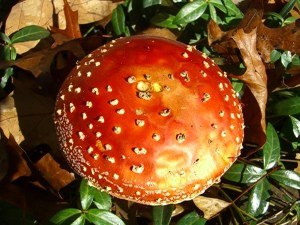 In “retirement,” I became the nanny as well as Nana, to my grandchildren, reading them books, instructing them on names of mushrooms on our walks to the park, and later pressing their chubby palms in to dough as we kneaded loaves of bread.
While working in the pay-day world, we fantasize about retirement, especially when our backbones ache for sitting through late-day faculty meetings, or our Sunday afternoons disappear under stacks of essays in need of grading. I had two fantasies: one was to wait tables so I could still enjoy the company of others, even serve them a pleasant dining experience, but not wake up in the middle of the night revising a lesson plan to better suit a challenged student. The other fantasy was to drive a big truck, sitting high behind the wheel watching the landscapes exchange their variable beauty from one state to another. There would be no student hovering by my side to complain about a grade — the cacophony of high school pep assemblies replaced by soft jazz from the truck radio. This fantasy focused me so completely that one morning I almost missed my freeway exit to school when I saw the sign: North to Vancouver, B.C.
No doubt, restaurant servers and truck drivers would educate me on these naïve perceptions of their jobs. My husband reminds me that driving the truck is only part of the job. I would have to be strong enough to unload it upon arrival. 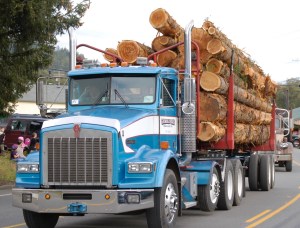 Fantasies serve to get us away without getting away. Once retirement comes, we have finally escaped those parts of our jobs we didn’t enjoy. Yet clinging to those displeasures like a demanding child, are those tasks that actually fulfilled us. In teaching, fulfillment might be that very clinging child whose progress depended on our support. From serving others, our work and ourselves gain importance. I confess that upon leaving Woodinville High School, I couldn’t imagine how seniors unable to take my college prep English class would ever survive in college. (Time here for laughter)
Retirees miss not only their jobs but the routine that employment offers. Sure, my friend’s husband is still driving back to his old school. 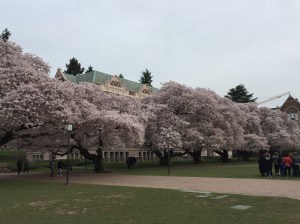 I walked to and from the University of Washington my final years teaching on campus. I walked down the hill each morning, stopping for a latte and scone on the way. At the coffee shop, Jackson, a garrulous Scottish baker, swapped stories with me as I bit into one of her jam-filled scones she pronounced as “Skhanz.” On the way home, I took the opposite bridge across Lake Washington’s ship canal and back up Capitol Hill. Seasons blessed my exercise with meditation on falling chestnuts and blooming early plums. In retirement, I missed that walk, though I could still walk down and around the university whenever I wished. But without a purpose? Years passed until I began offering to walk my daughter’s golden retriever down the hill and through campus, where the dog’s “I love people” expressions and wagging tail attract undergrads who miss their dogs left at home. Now the walk resumes with “purpose. ”
Routines plug us into the circadian rhythms of a day. My husband’s friend who this year accepted “forced” retirement for those over 70, is depressed. “I don’t know where to go mornings,” he said, with the grief of loss. Something needs to call us, and now it is time to listen for new voices. With time, they may speak from within.
Each Labor Day I feel called to buy notebooks and new shoes. I have not returned to a classroom of my own; however, I have volunteered for after-school homework help at the library and a couple of years tutoring in a ninth-grade classroom at Garfield High. In 2004, a poetry box I affixed to the fence surrounding our home offers a routine of selecting and printing a poem I copy each month.  I email the monthly poem to those not close-by to take a poem from the box. On telling those folks this is my 15th year with the poetry box, my husband’s niece wrote, “We appreciate the lessons and places you’ve taken us with your 15-year commitment to the Poetry Box. Roger and I would likely never discuss poetry without the Poetry Box so thank you for this gift!”
The recent government shutdown leaves many feeling helpless. Many complain, “But what can I do?” That sentiment is akin to the helplessness experienced with retirement. Our years after the routine of salaried employment may offer time to put usefulness in perspective. For me, often a poem rises from memory. John Milton, who felt his career as a writer was his service to God, lamented how his blindness curtailed his writing. From his sorrow came Sonnet 19, that concludes:
“God doth not need
Either man’s work or his own gifts; who best
Bear his mild yoke, they serve him best. His state
Is Kingly. Thousands at his bidding speed
And post o’er Land and Ocean without rest:
They also serve who only stand and wait.”

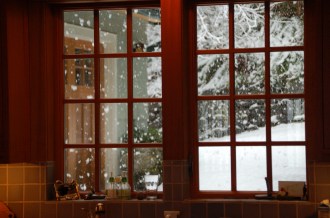


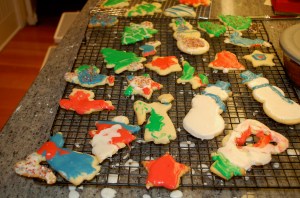 Today, some may be frosting cookies to set on a plate by the fireplace for when Santa descends. The custom may continue each year, long after the children have left for college. Many families either follow established traditions or stumble on to their own, without realizing a little habit or ritual grows like a child whose appetite wants feeding.
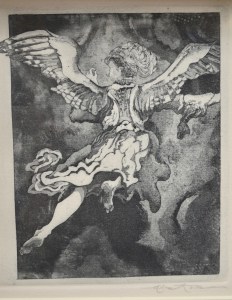 Influenced by the etchings of Rembrandt, Allan drew an elysian image of a descending angel, etched it in a metal plate, and ran twenty-five original prints for those to whom we wanted to send our Christmas greeting. We made no commitment to ourselves or to others that there would be another the following year.
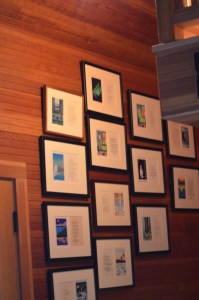 Inevitably, we needed to trust the reproducing work to a professional with a large studio. Allan still creates the image and cuts the stencils before passing on the stencils to Tori, our third professional printmaker.
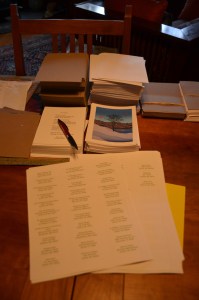 Then there is the Washington Athletic Club group. What started as a small gathering of early-morning athletes celebrating a Holiday Season breakfast, grew to sixty strong. Gordy dresses as Santa. After handing out our cards, Allan describes the artistic process, and acknowledges the fellowship of starting each day with a workout among friends. I read the poem aloud. Each year, we wonder if maybe we should forego the task of contacting catering, renting a room, taking sign-ups in the locker rooms. But each year, club members ask, “What is the date of this year’s breakfast? We love that tradition.” Suspending a “Tradition” can feel like desertion.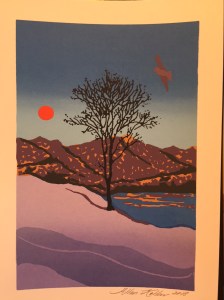

 I jumped to Obama’s defense. “Are you aware?” I asked my friend, “that you regularly disparage people who have money, although you are quite wealthy by any standards?” My words reduced her to tears. I felt as if I had wounded my sister.
 Do Americans more freely offer opinions than people from other countries? If so, perhaps there is a link to the way we teach our students. When teaching high school English, I may have started the class with “What happened” questions just to review the plot of our current book, but I soon moved on to the Why questions, those asking for opinions, granted opinions backed up by the text. We call it critical thinking, and American schools pride themselves in educating not only willful students but also ones who think critically.
 So many balls in the air at one time. Then back to Fox News, or CNN, or any other show touting itself as a news source. Good luck at finding anything approaching factual news. A body lies on the pavement, a VW in the ditch, but the commentator is rushing around with a microphone asking twenty people what they THINK happened.
 Later in the morning I meet with a woman I have known for twenty-five years. She asks to meet with me to discuss a sadness in her life for which she believes I might have a shared experience. We have family and friends in common, and they are the subject of her grief. First, we catch up on little things we do to fill our days. Then, testing a shared comfort, she begins to tell her personal story of a loss she experienced years before we met. She pauses. Because I know the Girl Talk script, I sense she is waiting for me to tell of my own loss years before we met. From our stories, there might not arise exact similarities, but there will be a kind of universality of experience that brings understanding to a sad occurrence. People seek reasons for their pain, but will settle for parallels, if reasons can’t be found.
 Gossiping is inherently judgmental, and I regret that it is more often associated with women. But men gossip too. They tell about a business rival who cheats on his income tax. Men’s Sports Gossip (sometimes referred to as “Locker Room Talk”) can be as rough as the sports they discuss.
 The stand-up comedian, Hannah Gadsby from Tasmania, based her humor on the awkward lives of lesbian women. A lesbian herself, she told about her own experiences suffering criticism and misunderstanding. As the show continued, what was at first humorous, became tragic. Annoyance grew to righteous indignation. What she said was no longer funny. The show was, however, profound. My husband didn’t enjoy the show, because of Hannah’s expressed anger, even though he sympathized with her many grievances. If she had spoken softly and slowly, her voice not pitched in indignation, I wonder if he would have more readily accepted the truths she offered.
 . And there you are — all stories are love stories, because through them we bond as we walk along the tangled paths of our human condition.
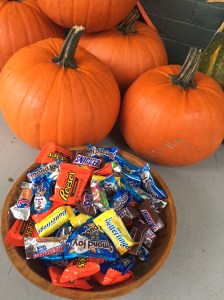 How many Snicker Bars or Peanut Butter cups does one child need? Does any child remember what house gives out Milk Duds and which Nestles Crunch? Little distinction, even less distinction in flavor or freshness. Super markets shove bags of Halloween candy on their shelves in late August.
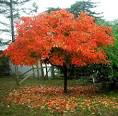 Below them we dumped the unfamiliar, and therefore suspect, sopping honey confection. My adult self longs to return to the front door to be given a second chance. From many houses we got apples, always apples, barely welcomed in our greed for sweets. Mom separated them out from our Trick or Treat bag, parsing them out for school lunches. She also saved the nickels given by those unprepared to bake. Once there was a quarter among the change.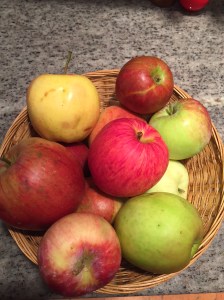
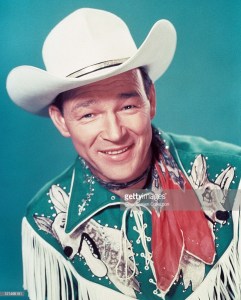 I borrowed my brother’s leather cowboy vest, redolent with his own sweat that I identified with horse flesh. His cap gun hung heavily from my non-existent hips. If I were lucky, he would share a red roll of caps, their explosive pops filling my lungs with sweet sulfur.
 It is only an occasional child, usually a young one, who has changed identity for the night, who growls like the furry beast it is. I long for role-playing, for the ferocious tiger who will dare me to open the door wider. I hold out the wide wooden bowl brimming with mini Snickers and Tootsie Pops. Each year the packages shrink, but the kids don’t seem to notice. Their plastic pumpkin carriers are brimming with replicas of what we are giving. Over their shoulders, the little monsters thank us as they race back down the stairs to the sidewalk where an adult or two waits to escort them to the next house. As they secure their children’s sticky hands, does their tongue remember the taste of their own childhood? Gone are the days when children ran out the front door as soon as dusk swallowed the maple trees, to tag along with older siblings, combing the darkening streets until the soiled pillow case, filled with treats, weighed them down. Then it was time to return home to parents, unconcerned about absence after dark, sitting by a lamp reading until their costumed children had played out their one-night characters and were ready for sweetened sleep.
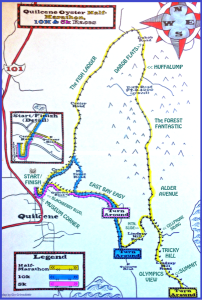
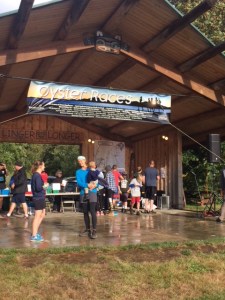 I don’t think I have run more than 6 miles in 2-mile increments, since 2016, when I ran the half marathon (another last minute decision) . This Sunday, I turn on I-Tunes on my phone at the start of the 10K. It will take only two complete replays of Pink Martini’s “Get Happy” album to keep me company until the finish line.
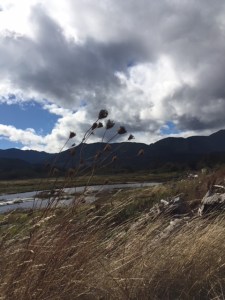 Its force reminds me that I am a slender woman who with a big gust could be blown off the road to topple on to the grassy fields. I pass ancient apple trees, their trunks bent in testament to the wind, fallen apples fragrant with fermentation.
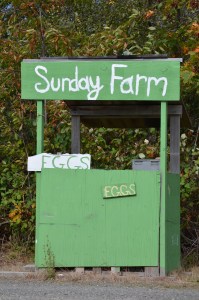 I begin the slow ascent south that will take me by the field where Racer the horse used to run to greet me for a fistful of grass. Gone now, his spirit keeps me running. Soon I approach the water stand outside our own drift-wood fence where my husband sets out paper cups of orange and lime Gatorade on a small table. I grab, gulp and go on. I know the hill rises steeply for another eighth of a mile, the open view from the top, showing the bay is at high tide, the longer autumn shadows splitting the sun on the water’s surface. Blackberries thrive on that hill top, berries now dried and fragrant as old wine. Turn-around for the 10K comes in a dip in the road, darkened on both sides by Palmers’ woods, old as the peninsula itself in giant Doug Firs and Big Leaf Maple trees. If I were not mid-race, their deep woods would invite me in. But here is turn-around, monitored by Linda and Stan Herzog. Linda calls my name. Stan snaps a photo.
 This is an oyster run, celebrating Quilcene’s famous oysters, so the aroma of wood coals and garlic bread already permeates the air. Depending on where you stand, it is fried food or local ale to keep a mind motivated for returning to this spot after the race. Everyone is happy. Those who know me, cheer me on. They seem more confident than I that I will make it the whole way. I will make new friends as the race begins, when I discover whose pace falls in with mine. That is how I meet Michele and Meg. We don’t talk much during the run. All of us are tuned in to whatever music lifts one foot in front of the other, but there are moments of encouragement among us. Good going. Feel free to pass. Yes, the hills are tough for me too. I pass a woman with her arm around her young son, a stalky boy who clearly has some cognitive impairment. He smiles widely at me.
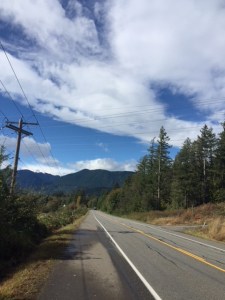 And finally, the physical part. I want to remember when the endorphins kick in after the 2nd kilometer. I am running downhill by the green apple tree where yesterday I stole enough for a pie. I look up to Mt. Walker ahead and my chest fills with autumn-washed air. Breath is wonderful. Deep, deep breath is exhilarating. I could run forever on this feeling. I could spread my arms and mimic the gulls and ravens swooping over the bay. I start to write this essay in my head so no feeling will fail to remain.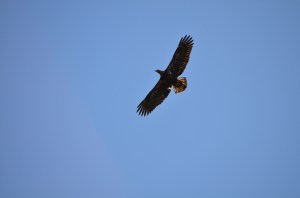
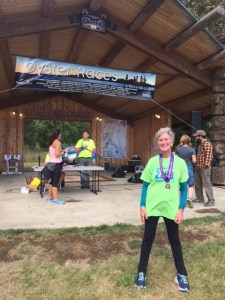 Only after one takes my picture, do I realize my face is raspberry red. I sit by another runner on the grass while our bodies cool. The sun is full out, but I am beginning to chill. My newly acquainted runner drives me back to my cottage where I peel off my running pants and shirt. My tongue tastes salt. My skin feels like salt. I realize I have excreted a good amount of salt water. As soon as I persuade myself to leave the hot tub jets, I will drink a tall glass of water. Every part of my body has been used: my feet, my legs, even my shoulders and neck. I should feel beat up, but I don’t. I feel twenty years younger. Maybe I will get back into this running thing.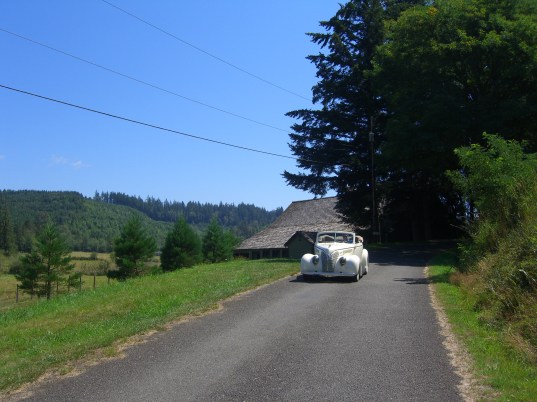
 And none too soon. Driving back to Seattle later that morning, we spot a sleek, futuristic car speeding past us on I-5. Its silver lines are like a heron in flight. Sharp and angular, the chassis is mostly sculpted metal for aerodynamics, with only a small bubble for driver and passenger. As it speeds by our 1997 Toyota, I note a New York State license plate.
 We keep both automobiles at our Hood Canal cottage, driving them only on sunny days, a rarity except for summer months. He also pauses the T.V. remote on the car auction sites when channel surfing for a program we might both enjoy. As for fast women, I can’t say. I snagged him pretty early on, and he was a shy guy who found me interesting enough to ask me to a movie.
 Marsha, for example, had that same silky black hair that cascaded in a rakish wave over her left eye. She rolled her shoulder length hair in wide curlers that she slept on all night. I did the same, waking in the morning, my cheeks branded with curler rounds, having slept fitfully on the plastic rings that were held in place by stiff internal brushes. I also learned how to smoke, tapping out a Pall Mall Thins from Marsha’s pack that she kept in her plastic purse. Those were the sacrifices needed to be a fast woman. I could only dream that the good-looking guys would look at me the way they looked at Marsha.
 Besides, the night before, we stayed up late to watch an old Paul Newman movie, The Young Philadelphians. I can never get enough of Paul Newman with his shirt off. It has been years since I relinquished any fantasy that Paul would leave Joanne Woodward for me. Today I cherish my husband’s stride with a noticeable limp from his basketball years, while I still remember the muscles in his thighs when he leapt for his famous hook shot.
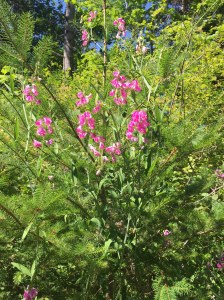 A flowering vine blooms along East Quilcene Road. Its lavender blossoms are bubbles, like sweet peas, so I have called them wild sweet peas, until my neighbor recently shocked me, identifying the vine as vetch. Walking up the road Sunday afternoon, I saw a long, flowering vetch vine winding itself like a garland around a young pine tree. The vine used the tree as a support for its growth, an attractive decoration.
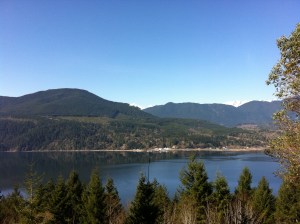
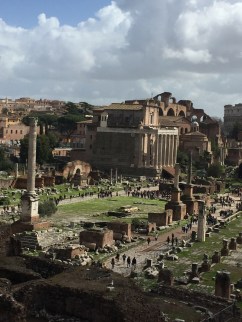 Greta and I had our own cozy VRBO apartment and had just settled in for our first night to adjust to jet lag, when I realized my necklace was no longer around my neck. We both scoured the apartment to no avail. I did not want to dampen the holiday by laying my grief on my granddaughter. I made light of it all until she had fallen asleep. Then I texted my husband back in Seattle, wailing in cyberspace about the loss, how I had loved that necklace he had given me for an anniversary gift. I may even have asked his forgiveness for being so careless in fixing the clasp. His response? “Is that all, Mary? Look now, you still have Greta.” There he was again, my support in an unimagined way.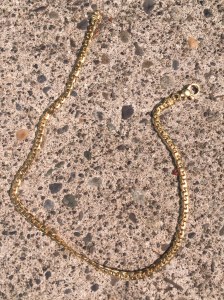
 Mary's Room With a View