“Do you want to read the draft of my new blog post?” I ask my husband before his first sip of morning coffee.
“What’s it about?”
“Preparing for loss.”
He rolls his eyes, (his reluctant “Ok”) revealing he has no interest, but will acquiesce for marital harmony.
He twists the espresso arm in place. “Why don’t you write about fast cars and fast women?”
He doesn’t have to say that “loss” is depressing, and why would anyone want to read about something depressing?
My gut rejects “fast women.” After all, it is MY blog, where I would have no inclination to write about a guy’s interpretation of what makes a woman “fast.” I inform him that I named my blog domain thouightsafterseventy.com. People over seventy think about loss and death and stuff. He need not remind me that he too is over seventy, but he would rather think about fast cars and fast women.
I am feisty enough to take his suggestion as a gauntlet thrown down. I decide to write about “fast cars and fast women” for those of us over seventy.
 And none too soon. Driving back to Seattle later that morning, we spot a sleek, futuristic car speeding past us on I-5. Its silver lines are like a heron in flight. Sharp and angular, the chassis is mostly sculpted metal for aerodynamics, with only a small bubble for driver and passenger. As it speeds by our 1997 Toyota, I note a New York State license plate.
“What kind of car is that?” I ask my husband
“A McLaren,” he tells me. “Very rare. Super expensive.”
“Not much room for passengers.” I am critiquing it as if anyone might find the car useful.
“Probably some young, rich, techy guy with money to burn,” he says.
The lane that holds the sexy McLaren slows, so we are now side by side. We strain our necks to spot the fast, rich dude.
The driver has blonde hair, falling to her shoulders, an attractive woman about thirty years old, her chin raised confidently to see over the steering wheel.
“Fast car. Fast woman.” I tease my husband.
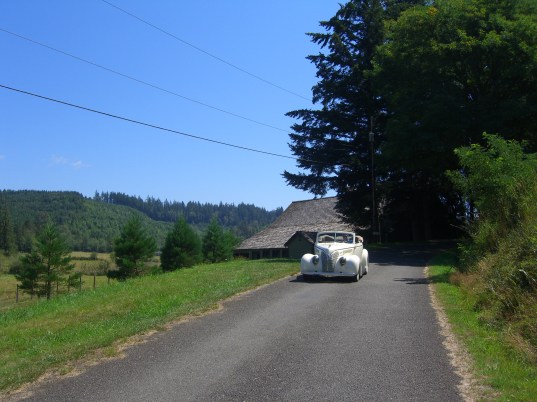
If once we sought out fast cars and fast women, do our tastes change substantially fifty years out from our youth? Clearly my husband maintains his interest in cars. Two of his most cherished: a stock 1951 Chevy truck and a rebuilt 1938 Ford Club Cabriolet.  We keep both automobiles at our Hood Canal cottage, driving them only on sunny days, a rarity except for summer months. He also pauses the T.V. remote on the car auction sites when channel surfing for a program we might both enjoy. As for fast women, I can’t say. I snagged him pretty early on, and he was a shy guy who found me interesting enough to ask me to a movie.
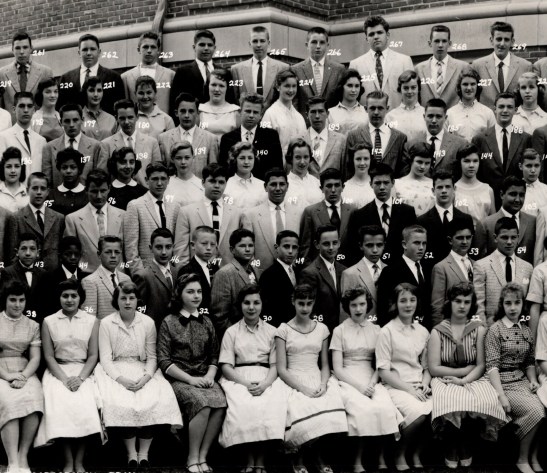
As I pass from one year after seventy to another, I often tell friends that no matter how old I am, I am always 16 inside. When I was sixteen I was a string bean, 100 pounds, in a time when Marilyn Monroe’s curves graced gas station calendars. My brother joked I was so skinny that if I stood sideways in class I would be marked absent. Nonetheless, I wanted to be a fast woman. I struck up friendships with girls who looked like Veronica in the Archie comic books. 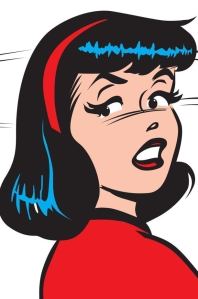 Marsha, for example, had that same silky black hair that cascaded in a rakish wave over her left eye. She rolled her shoulder length hair in wide curlers that she slept on all night. I did the same, waking in the morning, my cheeks branded with curler rounds, having slept fitfully on the plastic rings that were held in place by stiff internal brushes. I also learned how to smoke, tapping out a Pall Mall Thins from Marsha’s pack that she kept in her plastic purse. Those were the sacrifices needed to be a fast woman. I could only dream that the good-looking guys would look at me the way they looked at Marsha.
Sometime between our twenties and where we have landed, we give up pursuing those adolescent fantasies, but I don’t think fantasies disappear. When I was forty and in the second year of psychotherapy, Dr. Phillips asked me about my fantasies. That was after bemoaning conflicts with my teenage daughter and emotional distance from my husband. I was teaching high school full time, and feeling a failure as wife and mother. Every minute of my life filled with Must Do’s.
“Well, I do have one,” I told my good doctor. He encouraged me on. “I am sitting by a slow-moving river on a warm spring day. I have spread out a picnic cloth on which there is a glass, a bottle of good French wine, a loaf of French bread, a wedge of brie, and a great novel. I have all day to stay there if I want.”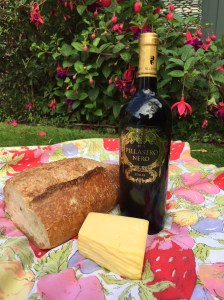
“That’s it?” he asked, stifling a yawn. “You know some people fantasize about sex or even murder. Even doing away with their defiant children”
I shrieked in opposition.
“There is no right nor wrong to having fantasies,” he explained. “It is acting on them that gets people in trouble.”
Now we are in the midst of the #METOO movement where hundreds of women are stepping forward to indict men who tried to actualize their fantasies. If wisdom comes with maturity, here might be the lesson. Hold tight to your fantasies. but keep your zipper zipped.
It is good that finally there is a public platform to expose eons of sexual abuse against women. Men are becoming more sensitive about what they say or do around women so their friendliness is not misinterpreted. I wonder how caution affects their fantasies. We are all sexual beings, even if the libido takes a nap after sixty. I cringed when my husband suggested I write about “fast cars and fast women,” for I considered his words most inappropriate for this #METOO time, but I appreciate his freedom to express his fantasies.  Besides, the night before, we stayed up late to watch an old Paul Newman movie, The Young Philadelphians. I can never get enough of Paul Newman with his shirt off. It has been years since I relinquished any fantasy that Paul would leave Joanne Woodward for me. Today I cherish my husband’s stride with a noticeable limp from his basketball years, while I still remember the muscles in his thighs when he leapt for his famous hook shot.
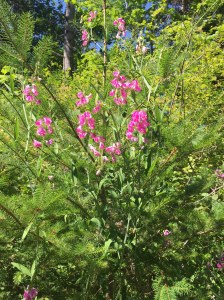 A flowering vine blooms along East Quilcene Road. Its lavender blossoms are bubbles, like sweet peas, so I have called them wild sweet peas, until my neighbor recently shocked me, identifying the vine as vetch. Walking up the road Sunday afternoon, I saw a long, flowering vetch vine winding itself like a garland around a young pine tree. The vine used the tree as a support for its growth, an attractive decoration.
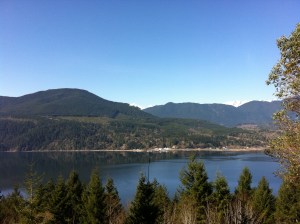
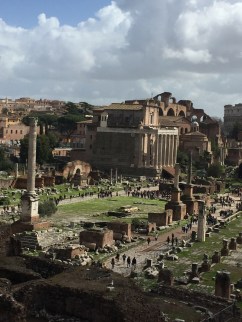 Greta and I had our own cozy VRBO apartment and had just settled in for our first night to adjust to jet lag, when I realized my necklace was no longer around my neck. We both scoured the apartment to no avail. I did not want to dampen the holiday by laying my grief on my granddaughter. I made light of it all until she had fallen asleep. Then I texted my husband back in Seattle, wailing in cyberspace about the loss, how I had loved that necklace he had given me for an anniversary gift. I may even have asked his forgiveness for being so careless in fixing the clasp. His response? “Is that all, Mary? Look now, you still have Greta.” There he was again, my support in an unimagined way.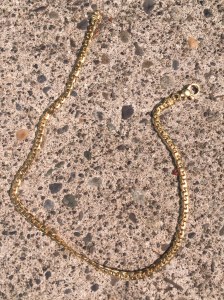
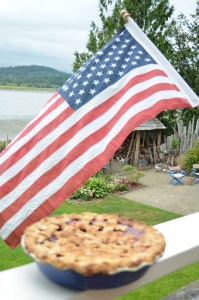
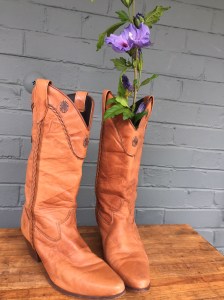 For many, Independence has come to suggest self-sufficiency. How many men (yes, it is more of a male thing) have boasted that they “pulled themselves up by their own bootstraps?” My love for figures of speech intrigues me to imagine some dude leaning over his cowboy boots and tugging on those side-leather extensions until he becomes entirely erect, feet shoved into the narrow toes, head shoved high into a ten-gallon hat. Under that hat he has not imagined the person who made the boots, or even the parents who, at the very least, fed him for his early years, and likely purchased the first boots for his tiny toes. No sir, he did “it” all alone, whatever “it” is.
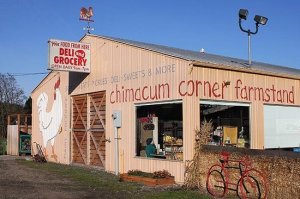 To celebrate success, the farm stand owners decided that the week after the 4th of July, they would declare an Interdependence Day. Over eight years, the celebration grew too large for the farm stand and its pebbled parking lot. The party moved over the intersection to Finn River Farm and Cidery, today, a million dollar business that started because one farm family and the Land Trust figured out a way to acquire land for orchards, and farm buildings for cider tastings and casual dining adjacent to fields along the salmon-running Chimacum creek — where families could toss horseshoes, or play shuffleboard, while local musicians tune up their fiddles in what once was a feeding trough for pigs.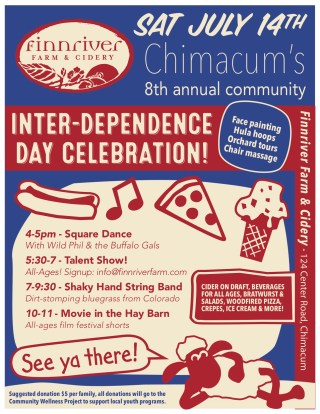
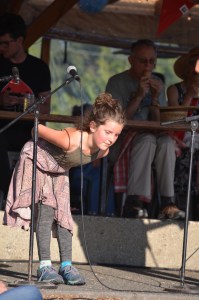
 Last Saturday, Allan and I sat at a round table we shared with new friends. We drank cider, ate pizza and watched parents and children line up for the talent show. Sitting under the late afternoon sun, families and friends applauded as each child stretched to the microphone with a ukulele, harmonica or their own sweet voice. The audience whistled and clapped. Children need that applause because they are growing. They are growing, not by themselves, but with the love and support of that community on which so much depends.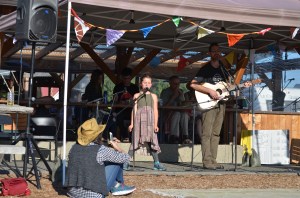
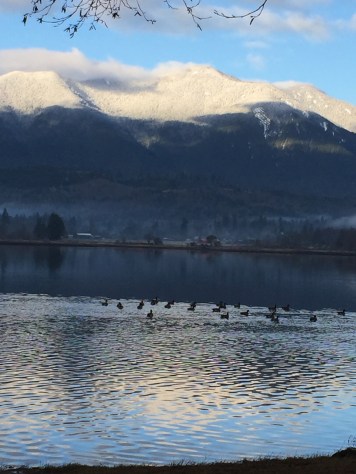
 But they do. Are they that foolish, or are they aware the odds are on their side as they are hundreds strong against a handful of hunters, hovering before dawn in a chilled swampland?
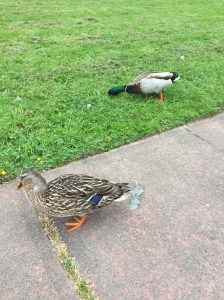 And what comes to mind, is not the under-fire ordeal they may have experienced over a duck hunting winter, but how vulnerable they are when mating.
 wedding invitations for the month of June. We buy a gift, attend the wedding and listen to one more couple swear “’till death do us part.” Having known divorce from life-experience, I wonder, sitting there in the church pew, “Does the covenant refer to death of the individuals, or death of the marriage?” Either way, commitment leads to grief. I bought an anniversary card for my husband last week. Pictured on the front was a rustic couple in comical attire. Above the picture: “Marriage requires commitment. But so does insanity.” Inside, on a cheerier note: “Still crazy about you after all these years.”
 Recently I saw the film Call Me By Your Name that depicted the infatuation of a teenage boy with a man about six years his senior. How much more vulnerable could the boy be than to fall deeply in love with a person of his own gender, a man who would only be with him in the same Italian estate for a summer’s duration? “Where is this going?” one partner often asks as they couple. Here was a passionate love that showed no hope of continuing to a life of companionship. Still, I (and probably lots of others) applauded as the romance intensified, sensuous and consensual. Does love need a promise of security from heartbreak? I doubt the young boy could muffle his desire, even if he saw the truck rumbling down the road. Both partners could have chosen not to act on their love, though I doubt that too. Passion becomes its own reason for being. And even though the summer ended, and the older man married, there lingers a celebration as if the boy had an experience like climbing Mt. Everest, something the rest of us can only experience vicariously, looking on with envy.
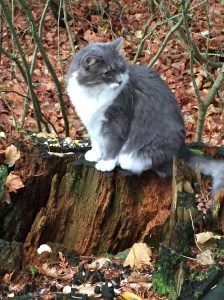 a pet. My friend who bonded with her cat for twelve fulfilling years, will not get another, now that beloved Chubby Toes is gone. “I could never endure the loss again,” she explains, as I try to drop a soft kitten on her front porch. My friend lives alone. Surely another cat would offer companionship, but a pet also offers loss, death by vulnerability.
 ![IMG_6141[1]](https://thoughtsafterseventy.com/wp-content/uploads/2018/06/img_61411.jpg?w=441&h=331)
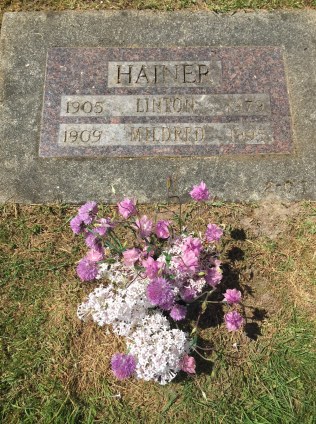
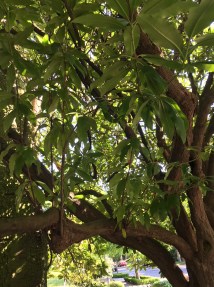

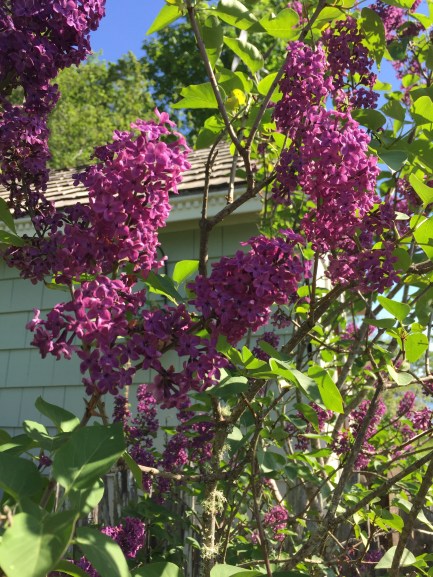 The lilac blooms in April, its intoxicating fragrance mourns with the hopefulness of spring. Mary Pearlman’s 31-year-old son, Mark, was gunned down in a hotel in El Salvador, killed under the Duarte regime that could never conclusively bring any killers to justice. Not a year passes without my thinking of all of this loss and all of the generosity, as the deep purple flowers bloom again.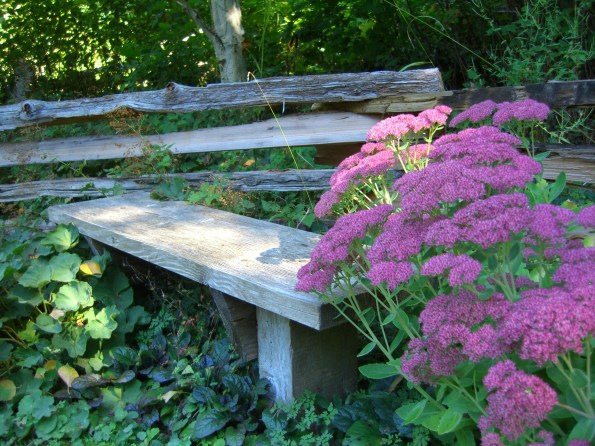

 O hushed October morning mild,
 October passed. The election failed to win the president I would have chosen. The Iraq war showed no sign of ending, and I stumbled across another Frost poem, November, that, if read closely, clearly indicates Frost was writing in opposition to war. December? Well my daughter mentioned how tacky the duct taped folder looked on the fence, so I removed it. In January, neighbors and folks I didn’t know (but who frequented the same coffee houses), asked me, “Where was December’s poem?”
 For the writer, the process takes her away to the shelter of her imagination. She puts herself in a garden or along a seashore. With the gift of remembrance, she sees the first daffodils blooming or hears waves licking the sand where her toes warm with each step. Escape? Yes, but in the process of getting away from the world, she returns to it with a greater understanding, as if she has larger hands with which to hold the worlds’ cares. Poetry gives her the confidence of quiet power — the greatest power known by the most courageous people like Dr. Martin Luther King or Ghandi.
 Now, however, as I walk along mornings, my earphones plugged to Spotify, some song I love begins. I pace my stride to the music that fills me with love and longing and imagination of that very song playing throughout the church, while my family sits before the altar and ponders why in the world I would have selected Billy Joel’s Scenes from an Italian Restaurant to be played at my funeral. “Bottle of white, bottle of red . . . “
 In the Book of John 20: 14 – 16, we have the account of women coming to visit the body of the slain Jesus. The stone had been rolled away. … Although they were the two closest women to Jesus in his earthly lifetime, they failed to recognize the risen Christ.
