

We do something on a regular basis and call it habitual. But when does Habit become Tradition? Tradition is an aggrandizement of Habit that brings people together. When my daughter was eight years old, she asked that I bake for her birthday the same cake her friend Katherine’s mother made for her. Winnie Sperry, known for her famous Mother Sperry’s Plum Pudding, made a birthday cake that requires four hours to finish. Even so, this year as my daughter turned 49 years old, I made that cake again. Once during her 14th year, I thought I would save time by making from scratch only the frosting, then using a yellow cake mix instead of the 5 eggs, 3-times-sifted, everything-at-room temperature recipe Winnie used. My daughter, clearly disappointed, complained, “Mom, how could you? That cake is our Tradition!” All it has taken over a lifetime with our daughter is for her to announce something is Traditional, and it might as well be etched in stone with gold-leafed letters.
December, including Christmas and Hanukkah, is weighted with traditions. We can easily trace traditions from lighting Menorahs or evergreen trees to Black Friday sales following Thanksgiving. Yes, some traditions have more luster than others. And we cannot judge Traditions by reason as much as a by familiarity. 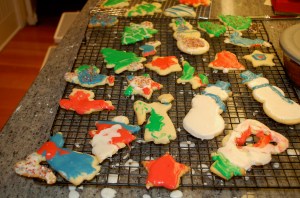 Today, some may be frosting cookies to set on a plate by the fireplace for when Santa descends. The custom may continue each year, long after the children have left for college. Many families either follow established traditions or stumble on to their own, without realizing a little habit or ritual grows like a child whose appetite wants feeding.
For many Traditions, a new one may hang like a leaf on the branch of an established one. Take Christmas cards. In the early lean years of our marriage, we decided to join the card tradition by making our own. My husband graduated with an MFA in printmaking, and the heavy steel presses lined up waiting to be used in his basement studio. 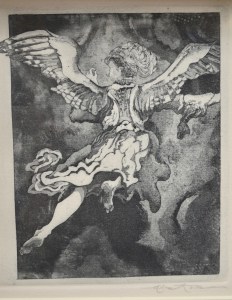 Influenced by the etchings of Rembrandt, Allan drew an elysian image of a descending angel, etched it in a metal plate, and ran twenty-five original prints for those to whom we wanted to send our Christmas greeting. We made no commitment to ourselves or to others that there would be another the following year.
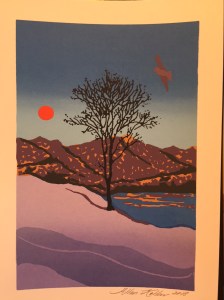
Over forty years later, this week we are sending out four hundred original prints. As the recipient list lengthened, my husband moved to silk screened prints. He completes a watercolor painting of his image. Then he cuts a stencil on a film for each separate color. There are several pigments. Next, he runs each color on every card, layering the stencils as he goes, and hanging each to dry between colors. In the early years, as he pulled each color, I would run the card to a drying rack. We were still under a hundred cards then. Recipients collected them, made special Christmas books for their coffee tables with a new page for each year’s card, framed the cards and hung them in their homes. Every time I climb the stairs from the first to the third floor of my friend Loui’s home, I follow the framed cards she has hung in increments along the stairwell. It is like climbing our history. 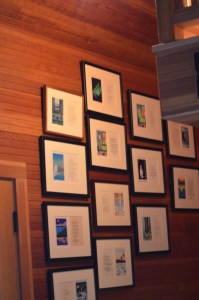 Inevitably, we needed to trust the reproducing work to a professional with a large studio. Allan still creates the image and cuts the stencils before passing on the stencils to Tori, our third professional printmaker.
In the twelfth year, as I admired Allan’s watercolor of ducks on a frozen bay, I told him, “This one reminds me of a winter solstice poem I wrote.”
“Why don’t you copy it and include it with the card?” he suggested. Shyly, I included Winter Solstice on Quilcene Bay. Our friends liked getting a poem with the print, and so . . . fifteen years later, my poem, Thin Spaces, accompanies this year’s print.
More than a repetitive practice, Traditions can be the creative force in a marriage. I don’t know when Allan first thinks of next year’s image, though he starts on the watercolor between October and November, getting it to the printmaker to allow her a few weeks’ work. I wait to see the watercolor, sit with it for a bit, and let it take me where it will. I never ask him what he intended. I don’t tell him what inspiration ignites me. Here we are separate creative entities. It may not be apparent why this poem and this image would be in the same envelope; however we ride this Tradition on different horses set out for the same horizon.
As much as making that birthday cake for my daughter, our Christmas card, like any tradition, requires time. In addition to old friends and relatives, our list includes my Bible Study group, Allan’s basketball buddies, our neighbors to whose mailboxes we hand-deliver the cards on Christmas Eve.  Then there is the Washington Athletic Club group. What started as a small gathering of early-morning athletes celebrating a Holiday Season breakfast, grew to sixty strong. Gordy dresses as Santa. After handing out our cards, Allan describes the artistic process, and acknowledges the fellowship of starting each day with a workout among friends. I read the poem aloud. Each year, we wonder if maybe we should forego the task of contacting catering, renting a room, taking sign-ups in the locker rooms. But each year, club members ask, “What is the date of this year’s breakfast? We love that tradition.” Suspending a “Tradition” can feel like desertion.
Within a weekend or two after Thanksgiving, my husband and I turn up Christmas music and sit down at the dining room table, one across from the other, while we address, write notes, and slip those cards and poems into envelopes for mailing. As tired as we are with that long sit, we are also remembering each recipient, sometimes sadly erasing the names of those deceased. We smile when a friend’s name takes us back to those early years when not having a lot of money to buy Christmas cards, we started a new Tradition and made our own.
Thin Spaces
The space is thin
where heaven and earth meet,
shallow as an ebbing tide.
Thin is winter wakening
beneath diaphanous snow
on hills seen through leafless limbs
of an oak planted in hopeful spring.
Thin is that hovering hush
before the raven calls,
a cry we know will come
with the returning tide.
The year divides itself in half,
speaking in a space without words.
Mary Kollar
December, 2018


