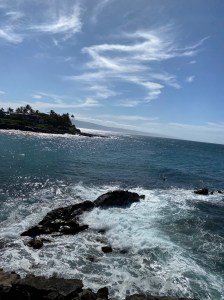
Here on Kahana Beach, I have had two weeks to think about waves. The screen doors to our sleeping room remain open for the cooling trade winds, so the constant crashing waves soothe us to sleep, a welcome diversion from Seattle’s mid-city traffic. But there are similarities. Whereas the all-night movement of vehicles on our city street, coincidentally called East Aloha, is occasionally interrupted by an emergency siren, so too the predictable waves periodically burst upon the rocks like a bass drum upstaging a symphony. We are not startled into wakefulness, although an accompanying tropical storm, slamming its arrival against the screen, will shake us so we slide the glass door shut and turn off the ceiling fan.
Daytime, the waves froth over the lava rocks, hiding the most jagged peaks. In their rush to slam against the sea wall, they carry turtles along for the ride. (In the lower middle of the photo you may spot a turtle’s shell) 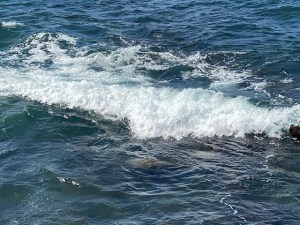 Sea turtles feed on the greenery on rocks along the shore, so succumbing to slamming against the boulders is like an encouraging push forward to feasting. Huge shells, some the size of a dinner table, ride just below the water’s surface. Whether the flippers help the turtle to navigate at this point is unclear. Rather they seem to give in to the waves’ force, all decision-making left to momentum. There must be a lesson for us there, something about trusting what carries us ahead.
Does one wave differ even slightly from another? Why do I admire the pearly opalescence of some waves while others roll over in a blue-green sameness? How is it that the sea before me may depict a calm plane for miles out, then spot itself with wavelets where there are no rocks to be seen for crashing? Had a whale passed by? Was there a sandbar too far out for my imagination?
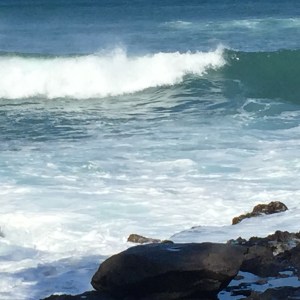 Those are five sequential questions for which I have no definitive answer. So much for Oceanography 101. No mind. Poetic connections to the waves complement what science offers. The string of curling waves evokes images of peppermint ribbon candy. When the wave hits the rocky coastline, it splashes high and frothy as thrilling fireworks, then recedes leaving a damp memory on the stones.
Currently, I am reading Virginia Woolf’s novel, The Waves, a story that is an accumulation of soliloquies from siblings who, unique in temperament, are together an amalgamation of consciousness. It is as if Woolf wants us to see one identity made up of separate souls. How appropriate, then, to call her work, The Waves. Looking out now at wave after wave approaching, then receding to the ocean, I can follow one just so far before it is consumed by its neighbor and they become one wave.
Most of our planet is surfaced by the sea, yet until we are slammed by a tsunami, we look landward. The waves reflect our own inspiration, they inhale and exhale, a lub/dub of each heartbeat. Perhaps that is what makes the sound so comforting. It asks for familiarity, for identifying with its life force. All it takes is one venture in for a swim to trust those inhales and exhales. Gingerly, I walk across the sand, my feet sinking its prints until the place where the water has washed up, erasing sandcastles and the presence of swimmers before me. 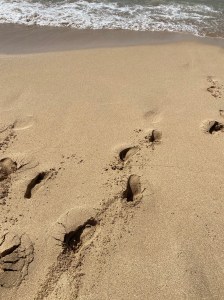 I take cautious steps forward, letting the wavelets tease me, toes-first. Step, sink a little, step again. As the waves surge to my knees I look out, guessing where the next large wave will rise. Will it break on top of me, sucking me helplessly under, grinding my face to the sand? Or do I wait until the breaking point and dive within its incoming belly, emerging only when the wave has receded for the next roller behind it. I dive. How successful I feel emerging up through the wave that took me, then I swim in a parallel line to the beach, far enough out to spot the fish, but close enough to see the shore where I want to return.
Alas, returning to shore requires more tact than knowing when to interrupt a conversation. I focus on the shore where I will land; my back must be to the waves. I have to allow a wave to ride me inland. I need to have my feet within inches of the sand so I can set them firmly for a fierce run up the beach before a kindred wave chases the one that carried me in, and thus sucks me back to the deep or splays my body across the sand. I have experienced both scenarios.
We have been coming to this small Maui resort for two weeks every February for over twenty years.  On each visit, we note how the waves have chewed up more of the beach and/or the retaining wall that keeps the condos high and dry. The beach was once long enough for an invigorating walk at low tide toward a cave in the far rocks, a place I led my small grandchildren where we imagined pirates storing chests of gold doubloons, then hurried back before an incoming tide flooded the crevices in the rock. No tide is low enough to allow that walk today. Nearby, huge tractors work to restore a wall that had shored up the property of a wealthy landowner, his estate now several feet closer to sinking into the sea. Once long, the beach now is but a patch of sand. From half a world away and in eighty-degree heat, melting ice caps deliver messages in the rising seas.
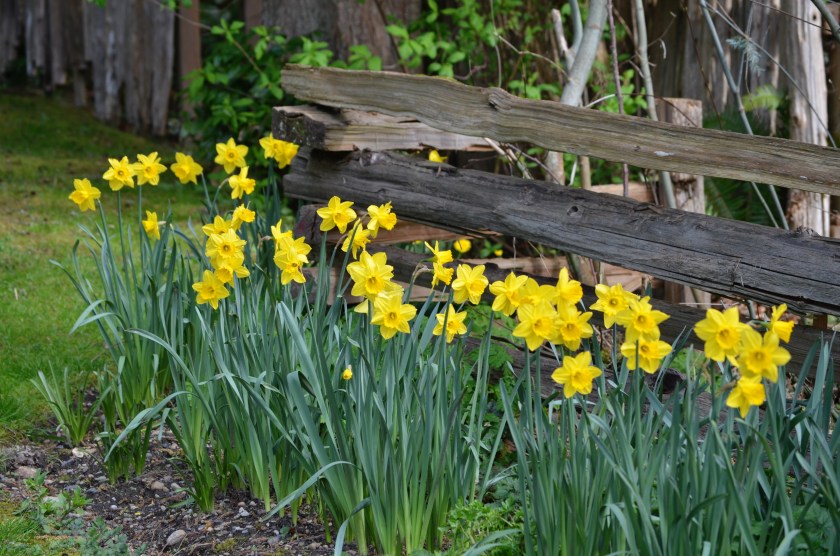
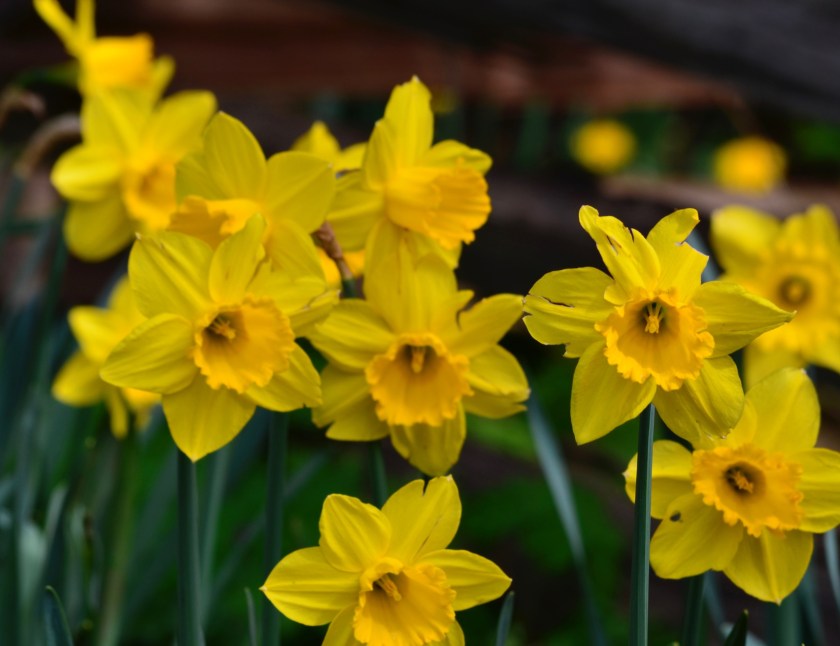
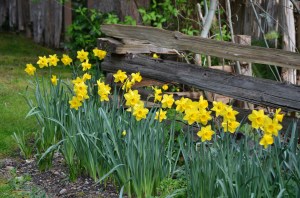
When we return to Seattle at the end of the week, the weather will not encourage opening windows to hear nature’s noise. Traffic will replace the rhythmic surge of water plunging through my dreams. There I will look out for waves of spring rain, daffodils bending before each in-coming breeze.
 How excited they are to fill me in on what I failed to teach the year they were in my class. Here I could groan in 3-D cynicism, not to mention disappointment. Instead, I share their joy that their minds are still engaged learning about their English language and literature.
 In the final act, Hamlet is about to have a duel with Laertes, a fight that he will likely lose. Hamlet’s friend, Horatio, tries to deter him from the match, because Laertes is by far the better and more practiced swordsman. Hamlet won’t be dissuaded, saying, There’s special providence in the fall of a sparrow. If it be now, ‘tis not to come; if it be not to come, it will be now; if it be not now, yet it will come. The readiness is all. ( Hamlet, V, ii, 230-233). Hamlet knows he will likely die, so when he dies is not his concern. What is important is his readiness to die. He is ready. How lucky for Act 5 and for preparing the audience to accept the inevitability.
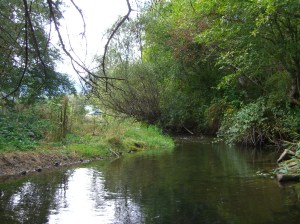 On the opposite side, there is humility in readiness. These are the agreements we make with each other to step out of our comfort zone, to try something new. One-two-three- ready . . . set . . . go! and I am leaping off a small ledge to cold waters when my brother encourages me to swim downstream.
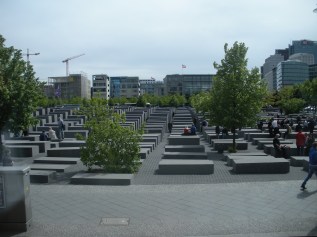 Reading about the German environment prior to Hitler’s rise – the accepted antisemitism, distrust of immigrants (Roma), excessive nationalism, putting The Fatherland first – it is clear that enough of the German populace was ready for Hitler. He was duly elected in a “democratic” republic.
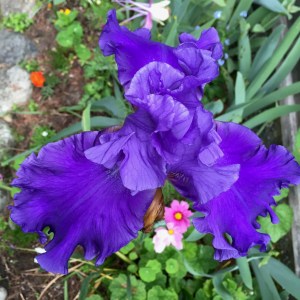
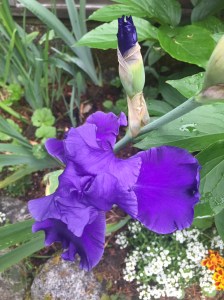
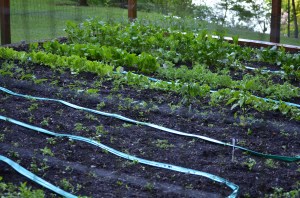 I hear myself reciting from another sacred text: For everything there is a season, and a time for every matter under heaven: . .. God has made everything beautiful in its time. (Ecclesiastes 3, 1 & 11). Yes, a time to plant and a time to sow . . .. Every year I jump the gun when my readiness does not match Mother Nature’s.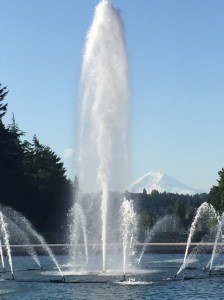

 When I look outside of my own experience to other women’s lives, I see similar patterns of fulfilling needs for others, mostly domestic needs, that make others’ lives comfortable. Does the fulfilling of those needs enrich the “needed” woman? Would she have chosen the tasks without societal expectation?
 or she sat before the television watching Murder She Wrote with Angela Lansberry,
 Top on the siren call would be perceived needs from my grandchildren and daughter. My granddaughter, a college senior, emails me a draft of her senior English thesis for editing. Her request leapfrogs to the top of my to-do list, real or imagined. I am flattered to be needed, especially to be needed for something that acknowledges I have a brain, not only a scrub brush.
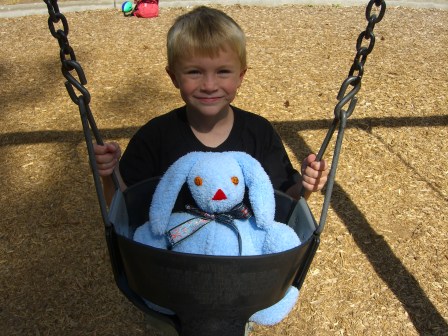
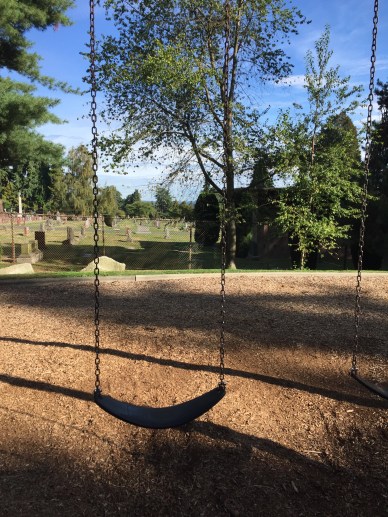 A late September afternoon, I am walking home through Volunteer Park, past the playground, quiet as expectation now that children are back to school. Swings, slides, and sculptures for climbing stand silent midst a leaf-spotted lawn that borders Seattle’s historic Lakeview Cemetery. A chain link fence separates a high swinging child and rows of manicured tombstones, many erected in homage to the settlers who first populated our city with Gold Rush, timber-eager adventurers. Pausing before a limp swing lit with early autumn light, I am back seventeen years, lifting my toddler grandson into the swing, then swooshing the boy and swing for a high cemetery view. When both of us are ready to proceed to the slide, my grandson tells me, “I know, Nana, how all those people died.”
 Well into my grandson’s nineteenth year, I have retold that story to my grandson and the entire family, so it is a chapter in our book of family humor and nostalgia. However, this morning, the passive swing not only reminds me of the funny story. I actually feel his three-year-old self is forever in that swing. Were he to ask, “Nana, push me,” I would not be surprised.
 Don’t tell me animals live only in the present with no vital memories. When it is time for us to go to our cottage, and we take out the cooler from the basement, our cats disappear. They know the cooler means travel, equals kitty carriers, equals confinement. We must put them in their carrier before even thinking of fetching the cooler. Yet remembering and simultaneous existence are not the same.
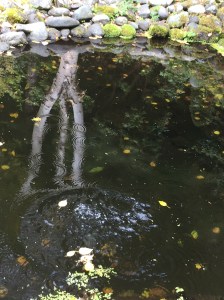 It circles around itself like a whirlpool in a pond, gathering newly dropped leaves as it turns. We are brought back around as we proceed forward. Have you heard the declaration, “I don’t want to go there?” I have. The sentence suggests a benefit to burying the past. Understood, as a way to avoid adversity, but today I am thinking that having lived through so many experiences with so many people, I am in a position to live in two or more places at once, and thus able to be more empathic with others who may be experiencing something for the first time.
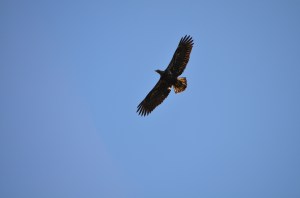
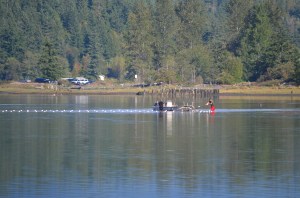 spread nets – as well as dodging ravenous seals a hundred pounds greater than the fish’s silvery weight, and the penetrating eyes of eagle and osprey from great heights.
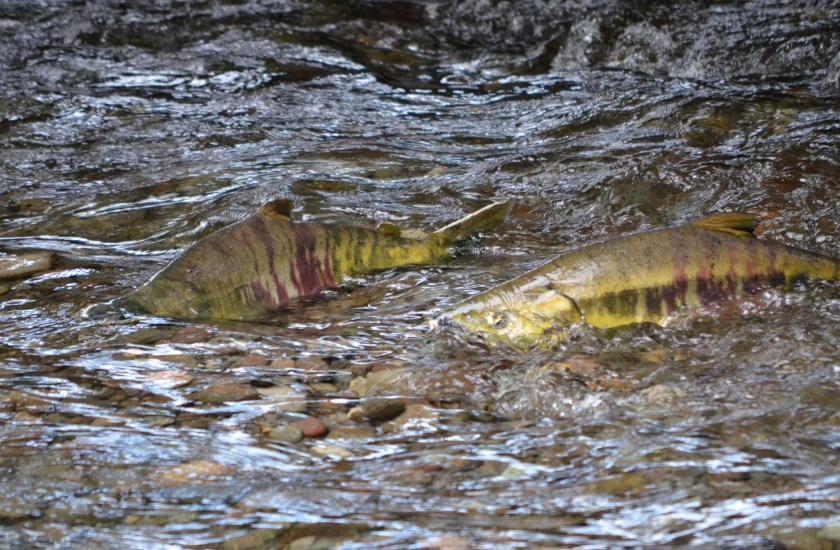
  I lean precariously over the Little Quilcene Bridge and hold my camera steady, my back against the glare of early autumnal light, to capture the thrilling swish of a spawning pair. The shallows swirl around them in mock frenzy, river water splashing upwards like reverse rain.
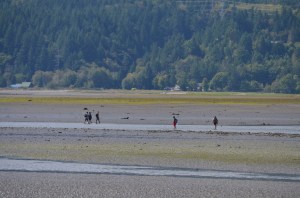 They have parked their trucks along the road at the end of the bay and sloshed through the flats with fishing gear to snag the stragglers in the shallows. Determined to spawn, the fish have lost interest in feeding, ignoring any dangling bait, and thus victims only to snagging. Some sport.

 Language changes faster than sunrise sets to dusk. Practice makes perfect. Besides, I am on board with the ways gender stereotypes control our thinking. More than fifteen years have passed since my church replaced old hymnals with new ones that removed gendered pronouns, yet that change doesn’t take easily with all. My voice raised in song, I often miss complete stanzas to an old hymn I thought I knew. All around me, I hear parishioners of my age stumble as they pray, “Our Father, our Mother . . .” Yet gradually God has changed from the great white man I envisioned in Sunday School, until God is now a spiritual wholeness with the feminine in me. Takes practice.
 Similarly, the speaker peppered her commentary with “like” when there was no comparison intended that would call for “like.” Both the upspeak and “like” come from Valley Girl Talk, a dialect that connotes, for me, bikini clad California girls mostly interested in what they will wear to the next beach party. My granddaughter argues that “like” is the filler of her generation that allows the listener pause time to catch up; whereas in her grandparents’ generation is was “um.” Hmm.
 Is the English language going to Hell in an I-Phone? The evolution of language is more than accepting new vocabulary. It is also accepting new tones and inflections. If we are lucky enough to converse with our grandchildren we can ride along.
 Or maybe language does not change as a rapid-running creek into a stagnant pond, but rather a long, slow river, winding around like an ox-bow to the sea.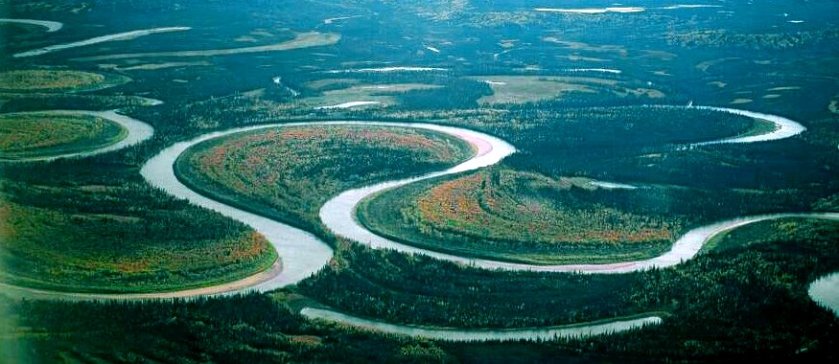
 Everyone laughed.
 A young black woman raised her hand. “It is mostly older white people who say this,” she explained, “but I feel oppressed when people think they are flattering me by commenting on how articulate I am.” What she heard in that compliment, was “You are a black woman and so I am surprised that you speak so well.” The black man sitting next to her added he was tired of representing to others the conditions of a black man in America. “Just read the front page of your newspaper, if you want to know what it is like to be a black man in America. It is not the job of the oppressed to educate the oppressor.” Although that quotation came from one of our readings, hearing it from him, I heard it as Truth.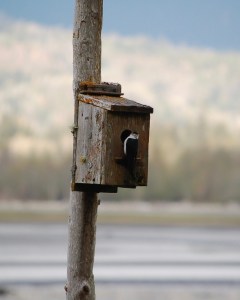
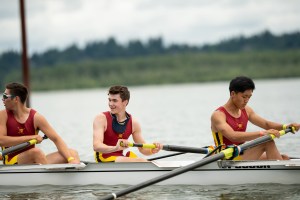 Then he began, in acute detail, to describe the sunrise over a semi-cloudy horizon above the Cascades. The scene called for his attention as we drove at 55 mph over the Ship Canal bridge. I remained attentive to cars ahead. Max described a ribbon of light between mountains and clouds, a “urine yellow beneath a black cape.” Mid-range, between Lake Union and the Cascades, he noted marshmallow clouds hovering at vacillating heights opening to reveal snow-spotted peaks. “ It seems even more dramatic,” he said, “because we are driving past.”
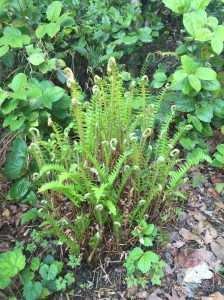 We notice each new flowering dogwood tree or rose, pausing because we know the blossom will not last for weeks.
 My generation sometimes boasts that it is The Greatest Generation and romanticizes cruising Route 66 in gas guzzling cars. Our generation paved miles of farmland for highways to take us to strip malls cemented over where valley farms once stood. Were we so inattentive to the environment we took for granted? Now we foresee a great debt called in for our children and grandchildren to pay.
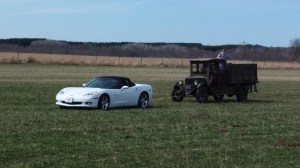 Especially in Seattle, they are aware that student housing costs as much as their tuition, in a city where the two richest men in the world live in mansions. Unlike our generation, these young adults do not expect to surpass the prosperity of their parents. As Max focused on the beauty of a sunrise, they are paying attention to climate change and the very air they breathe.
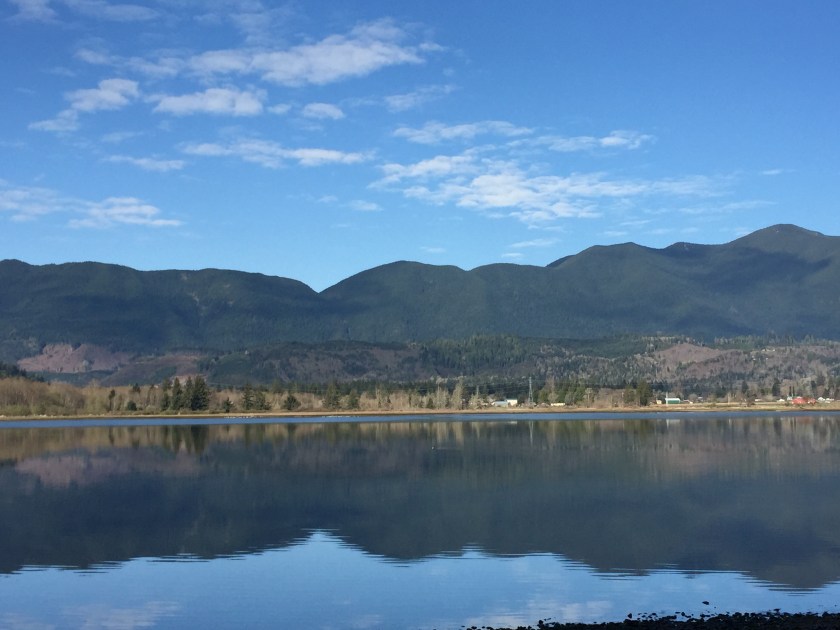
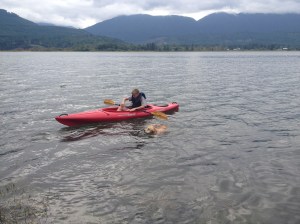 No matter what tasks we are doing, we stop to run through the open gate and plunge in for a swim, push out in a kayak. or balance on a paddle board as soon as a chart in that book registers eight feet or more. Winters, the high tides can exceed 13 feet, and when married to high winds, the sea trespasses, often knocking out the gate with a floating log, white caps swamping our lawn.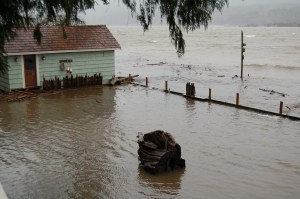
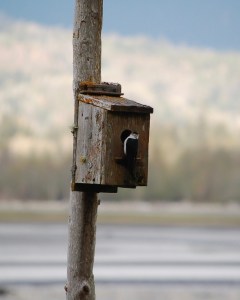 “I love the low tide, as much as the high tide,” he said, reaching for the binoculars to spot heron tiptoeing between the streams and the violet green swallows checking out the boxes he has raised on poles along the shore.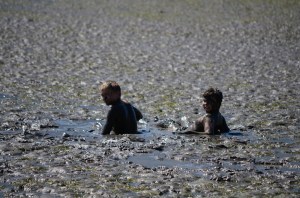
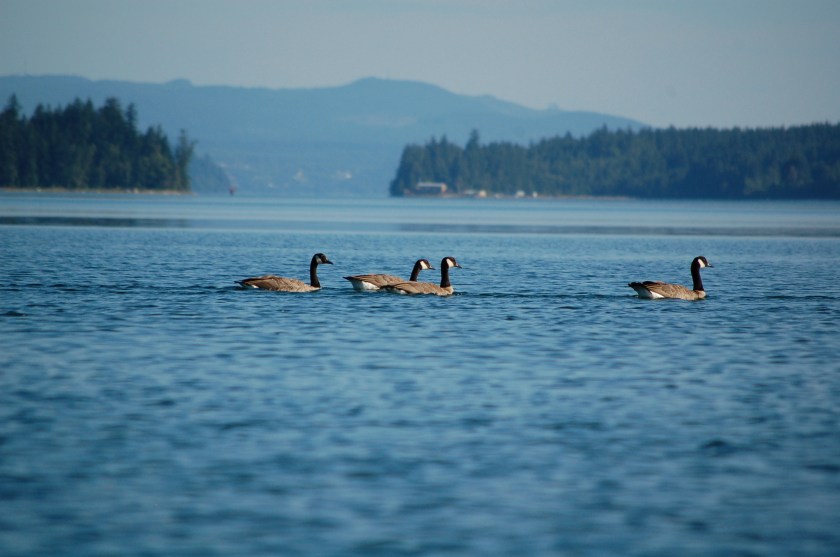
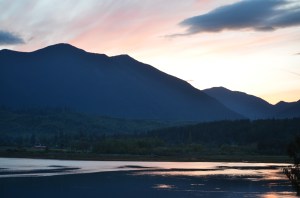 Changing tides inspire humility, helping me to accept what gifts I didn’t know were coming. Just as high winter tides carry a battering ram of a tree trunk to wipe out our driftwood fence, so the water retreats, dumping our fence and stairs at the end of the bay. Neighbors help us retrieve what is ours, and in our scavenging, we find even better planks for restoration. Low tides uncover oysters and clams: a table-is-set ebbing of culinary fame. Even baby crabs scramble along the shore. In late August, salmon return along the streams that lace the flats. Salmon battle determinedly up those streams between lines of families fishing for a big one to take home for dinner. The tides give and take away, like the hand of a natural god.
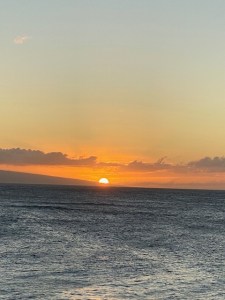
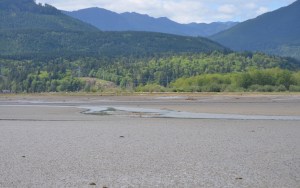 If it is a Low – Low, I may forget that there ever were welcoming waves in front of our cottage. If it is a high tide day, I know I am riding a surface on a paddle board, head-high enjoying the sunset sink behind Mt. Townsend. Most days are those Low Highs or High Lows, but nothing is stagnant. All life is movement. We know the moon will turn from crescent to full, and the bay that emptied all but bubbling craters where clams breathe, will within hours, cover meandering streams with salt and sea.