The Weary World Rejoices

            This week before Christmas, lyrics of carols repeat in our heads when we are walking into churches, department stores, or the lobby of my athletic club.  Rightfully called ear worms some pursue us like demons to expel our sins of the year. Penance: Ten repetitions of The Little Drummer Boy.  There may be no other holiday abounding in so much song as Christmas.  Think of it.  How many Valentine’s Day songs do you sing throughout February?  I love the carols I learned as a child and play every December, either on recordings or my hesitant playing on my piano.  Seventy to eighty years are adequate to retain the lyrics even if sung only one month of the year.  The melodies are harmonious and, with a few exceptions, notes within a close pitch so I can sing along with minimal straining.
            Singing along is best because almost everyone else knows the carols as well.  Each year Pacific Lutheran University’s renown Choir of the West performs a Christmas Concert at Benaroya Hall, home of the Seattle Symphony.  Two hundred college choir members walk down parallel aisles holding lit candles before ascending the steps to the stage.  There they move into risers as gracefully as swimming swans.  And all around their voices, accompanied by the orchestra, fill the hall with celebratory sound.  After every three or four pieces sung by the choir, the conductor turns to the audience, waving us to join in on a familiar carol.  We all rise as one, and we sing and SING and SING.  The song might be Joy to the World, and it might not, but JOY overwhelms me as I sing familiar songs with as much choral gusto as I can summon.  Surrounded by several hundred voices, who will recognize my strained, untutored voice?  I feel marvelous.  I feel proud when I can get through two verses without having to read the printed lyrics.  This is MY music, My heritage.  By the second verses, I am back in the children’s choir of a small white Congregational Church in Massachusetts.
            After all those vocal trips to the manger, this year I am focusing more on the lyrics.  Many were originally poems, later adapted to music.  Because I am often captured by a phrase and held until I thoroughly hold it to the light of thought, my earworm this Christmas is not melody but verse.  Over and over, I recite The Weary World Rejoices.   In 1843, I learned, Placide Cappeau, wrote the poem O Holy Night in a commission to write something to celebrate the opening of new church in Fance.  Later, the French composer of operas, Adolphe Adam in 1847, set the poem to music.  

O holy night, the stars are brightly shining,
It is the night of the dear Savior’s birth;
Long lay the world in sin and error pining,
‘Till he appeared and the soul felt its worth.
A thrill of hope the weary world rejoices,
For yonder breaks a new and glorious morn;

Now I know the dates of the original, I wonder what was happening in France in the 1840’s to include the phrase, “the weary world,” as if anyone reading the poem would agree that the world is exhausted.  I intuit that the 1840’s in France were similarly stressed as we are in America today.  Still the richest country in the world, if the news is to be believed, Americans are struggling with their finances and their values.  I don’t need the news to tell me that there is such political division in our country that we are exhausted hearing the latest shocking event coming out of the nation’s capitol.  I have friends who, in an effort to shield their mental health, no longer listen to the news on television.  I walk cautiously around lifelong friends who have political beliefs I know are contrary to my own.  Will I engage them in debate?  No way.  I am just too exhausted.

Yet there is O Holy Night that acknowledges the world’s weariness as a backdrop for rejoicing.  There in the birth of a messiah is a thrill of hope.  Here the day before Christmas, I am rereading the many holiday cards sending greetings our way.  The most common phrase is Merry Christmas, but this year, I am finding another word often repeating.  It is hope.  Such an abstract word.  Out there like a thin line of ground fog on a winter morning is hope.   We can’t earn it or buy it.  Emily Dickinsen wrote Hope is the thing with feathers/That perches in the soul,/And sings the tune without the words,/And never stops at all. There it is, I notice hope  and rejoicing more when the world is weary. 

Perhaps this season, when so much seems uncertain, when many Americans feel their voices are not heard. we are more aware than in certain times of the promise of a Messiah.  So much better than putting our money in a lottery.  Like Emily’s bird flying against a storm, we are singing, if only the tune without the words.  I find comfort in the community of carolers.  I hope you will sing along.

Pine Trees or Politicians

Certain phrases stick with me like burrs to my clothing when walking through a grassy field.  No sense in trying to brush them off; besides, to do so I may discard something of value, that in the right surroundings could save my life.  This week’s sticky burr of a quotation comes from John Philip Newell’s Sacred Earth Sacred Soul,  in which he covers a chronology of Celtic Christianity with short biographies of theologians as far back as the 4th century who lived a Celtic spirituality. 

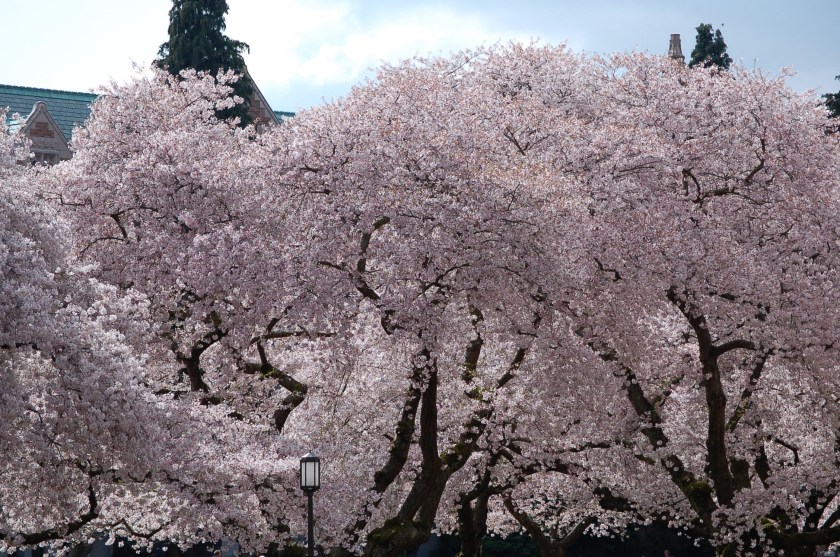
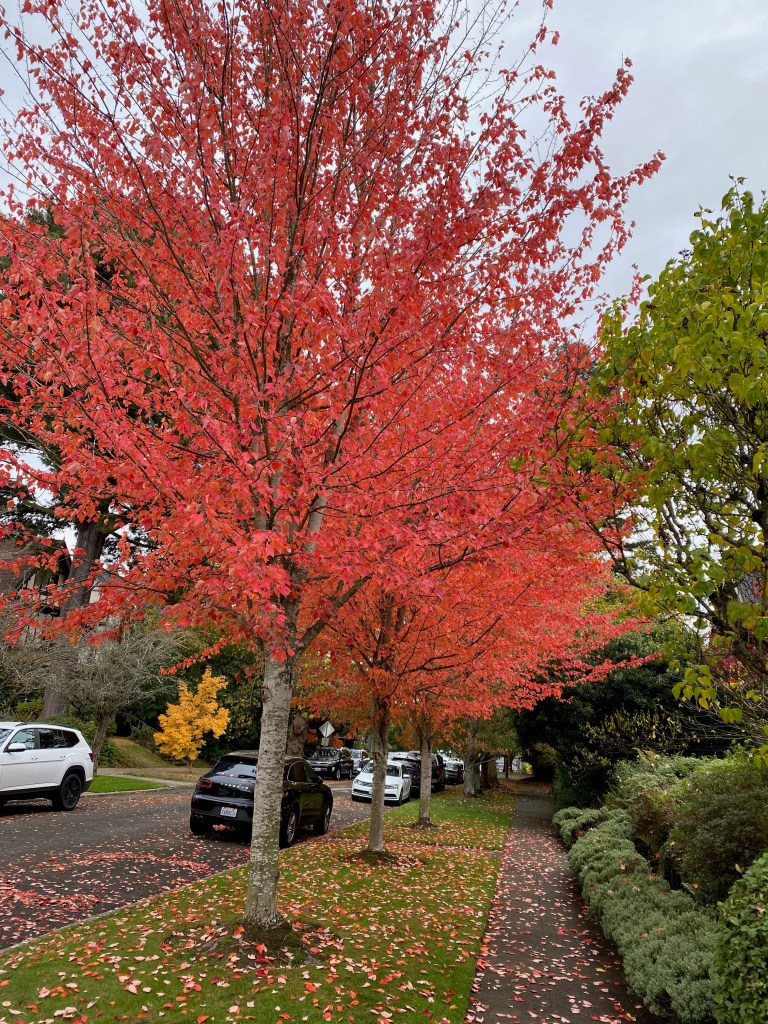
Perhaps the phrase stuck for its alliteration – easy to hear those “p’s” skipping from my lips as I juxtapose pines and politicians.  Nonetheless, White’s phrase stays with me.  I want to consider my relationship to Nature and Politicians.  How do I start my days?  I often turn on NPR for the morning news and commentary that is 99% depressing.  I hear voices of politicians in their most recent declarations of intention. Their words are consistent with whatever feeds their ambition.  There is no plot to follow.  I could skip listening to Morning Edition for a year, then return to it a year later to discover I had not missed a thing in the tenor of our time.  Rather like a bad soap opera.  For variety, I could switch to another newsfeed, perhaps not aligned to my feelings about the state of the world, not to mention the condition of our country.  But would any of these broadcasts enhance my life?  Would their negativity call me to action?  Would I come to a fuller understanding of my purpose on the planet?  Ironically, I am often listening to Morning Edition on my walks at dawn from my house down to and around the U of W campus, a six-mile morning walk under old established trees in old established neighborhoods: blossoming cherry trees in April, vermillion maples in autumn, tall proud pines and cedars all year long.

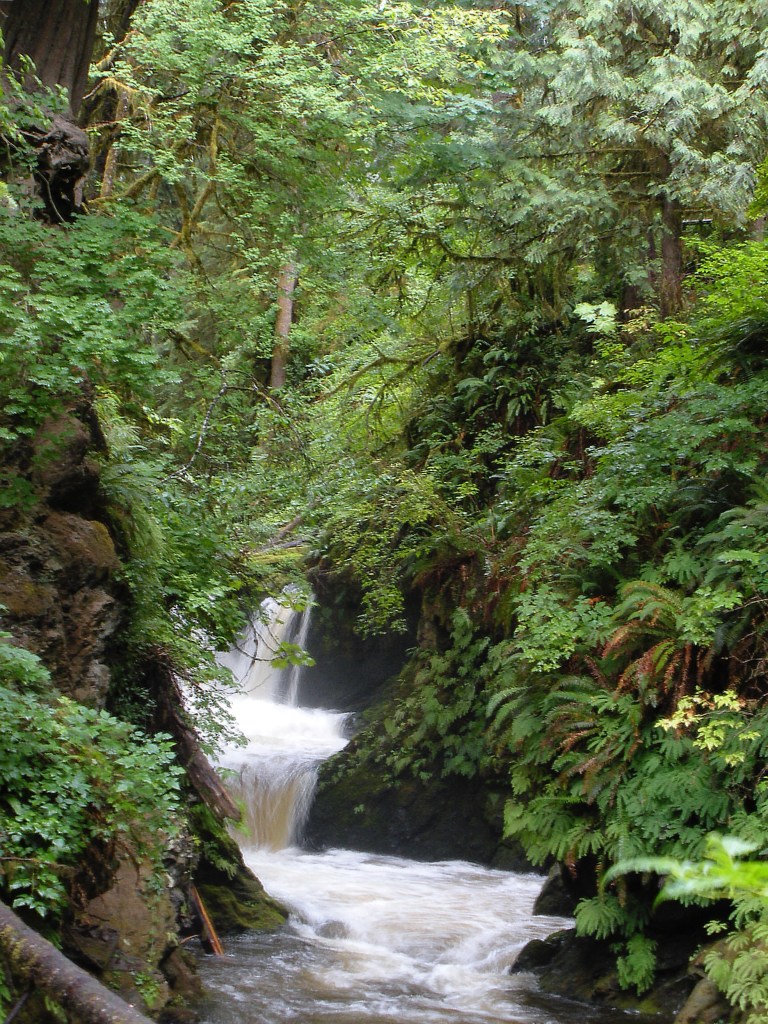
Now here comes Scottish poet, Kenneth White suggesting I might join him in listening to the trees rather than the politicians.  How do I listen to the trees? The cherry blossoms are speaking beauty and rebirth.  The autumnal maples and sweet gums recite their own poetry.  Poet Gerard Manly Hopkins evokes images of trees in fall and mourns the imminent death of summer “Margaret are you grieving “ over Goldengrove unleaving? … worlds of wanwood leafmeal lie.” Then winter arrives and Robert Frost reminds us “The woods are lovely, dark and deep.”  Surely the poets help me listen to the trees.  Yet even without the writers, if I block out cars and pedestrians passing by, and if I concentrate, I hear the trees.  Their leaves whisper in summer breezes.  Occasionally, such as this very dry summer, the trees crack and snap, discarding a branch that lands on the sidewalk. These are city images.  Now if I take myself to the woods, I remember recent books I read about trees, teaching that there is a conversation between alders and the firs, one fast growing and nutritious to the welfare of the other.  Is that alder speaking to the fir?  I guess it depends on how we define language.

And if we can listen to the trees, especially hearing their needs for water and space and clean air, can the trees hear us?  Although we don’t share the same language, we are all living things.  Life communicates.  When my husband and I began to restore a clear-cut lot we purchased after the owners sold the trees and evacuated their property, we decided on a variety of trees, some 20 -foot Douglas Firs purchased from neighbors across the road, and some small fruit trees for a space left vacant when the previous owners disposed of their cabin. One pear tree initially grew fast and tall, but its pears did not thrive.  Insect-infested and hard, the few pears on gnarled branches fell to the ground where deer consumed them before we had a chance.  Every time my husband and I walked by the pear tree, he said, “That tree looks bad.  It really has to go.”  So how would you feel if every time someone passed you, these were the descriptive words for you?  You would want to die, right?  And of course, the pear tree died.  Not wanting to accuse my husband of projecting a death wish on the tree, I nonetheless registered the lesson.  Years later, I desired a Katsura tree, for there are several in Seattle where I walk.  In autumn the pink leaves wave a fragrance I associate with the sweet smell of cotton candy.  From the moment we planted it, I have welcomed that Katsura tree almost every day.  I tell it how lovely and thriving it is, even though a workman backed his tractor into the trunk last year, leaving a two-foot scrape on the trunk.  “Good morning, Katsura.  I am so glad you are here.  Looking forward to your autumnal fragrance.”  It is now almost twenty-five feet, its leaves fluttering in the dappled sunlight, even though nearby cedars consume a great deal of available light.

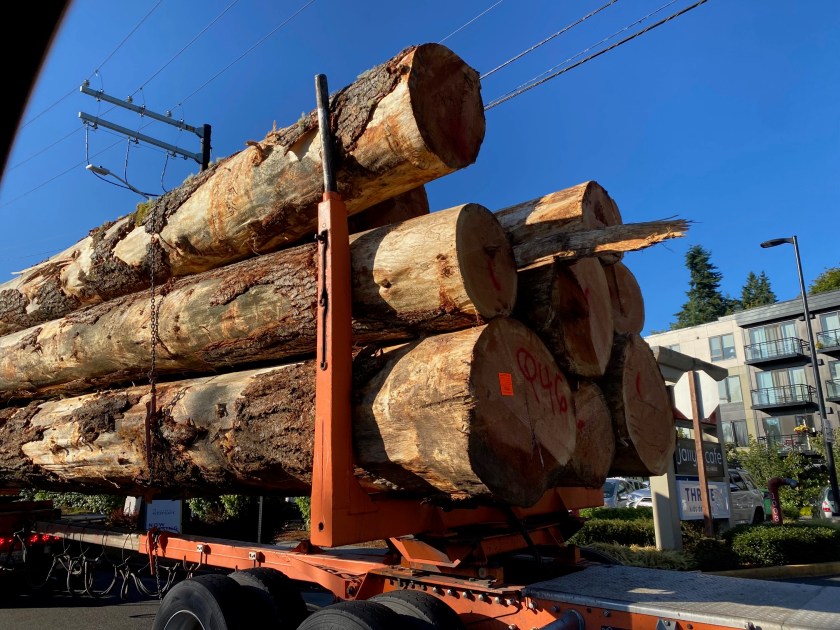
On the way back to Seattle Monday morning, three gigantic logging trucks rolled on to the ferry ahead of us.  Their beds were piled with logs about five feet in diameter and perhaps fifty feet or more in length.  These were not the usual harvest of tree farms.  Rather they looked like the established trees from the National Olympic Forest.  I recall Donald Trump’s call for opening-up national forests to loggers.  I can imagine what birds and animals would say in response. But what about the trees?  Is any politician listening to the pines?

WHAT I DIDN’T PLANT

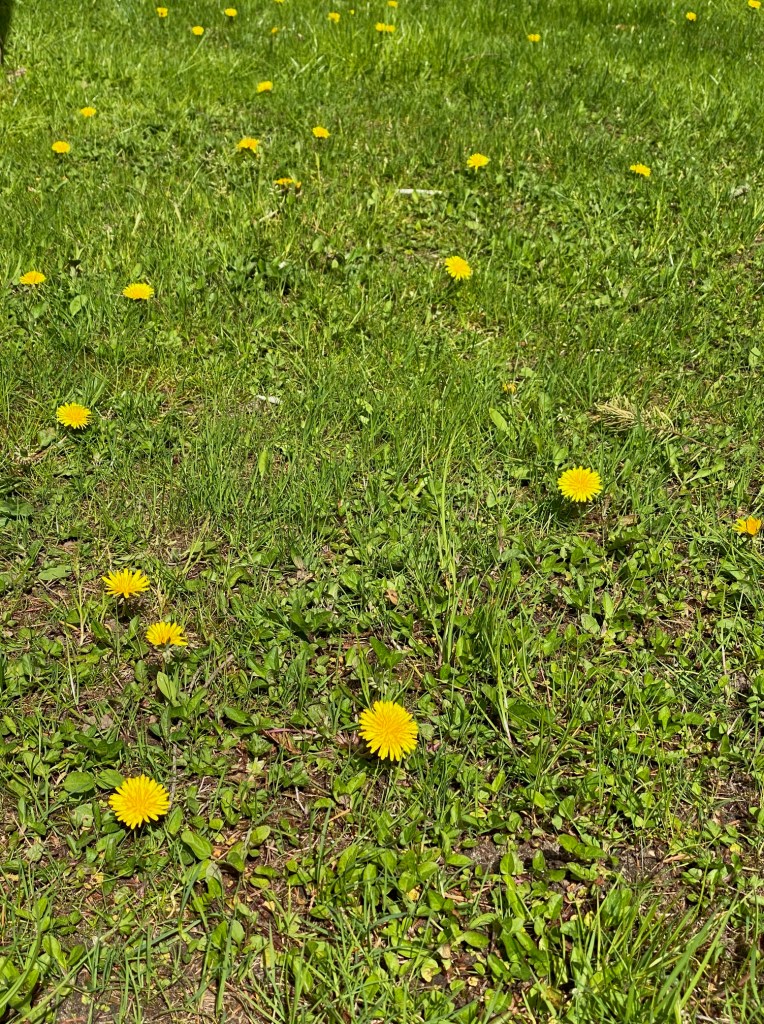
A rare sunny spring day at our cottage on the Olympic Peninsula, I walk up the hill and through the wooded path to the adjacent space that includes my hopeful vegetable garden, a small frog pond and a field of what was meant to be grass below four fruit trees. Today, the grass serves as a green canvas for an abundant peppering of dandelions, seemingly more sun-yellow this year.  They rival the sun itself, an in-my-face yellow that wins me over with joy for their prevalence, weed-reviled as they are.  Prime in their moment, I imagine their demise to fluffy seed balls the wind will scoop up and shake out and reseed in resurrection.  As children, we speeded the seeding by picking a large puff ball and blowing the white effervescence until it rained with whiteness, an act motivated by power and plenty, but always uplifting with joy. Who cannot love a dandelion? Yet today, my meditation on their yellowness is disturbed by the growling John Deere mower moving up the hill to level them all within minutes of their glory.  I am resigned.  My husband loves a flat and green lawn as sterile as a golf course.  Or is it his glee in riding high on the cushioned seat of the big John Deere while its whirring blades shave the upper lawn of dandelions, clover and moss?

I turned my back on the devastation, opening the gate to my garden to discern if any vegetables, whose seeds I planted two weeks ago, are surviving.  The temperatures were still equinox cold at night, and rain predicted almost daily when I decided to borrow from the early spring light and put in rows of spinach, lettuce, arugula, radish, kale and beets.  Having loosened the garden soil and mounded rows for each, I gently planted each seed an appropriate distance from the next, patted a little soil on each row and covered all with a diaphanous cloth that serves like a greenhouse, allowing in only warm sun and easy rain.  In today’s sunlight I raised the cloth with a Christmas present hopefulness that I might spy a thin line of green venturing through the garden soil. Voila!  Radishes boast boldly as the dandelions.  Although timid and circumspect, spinach germinated in thin lines like new grass.  What a marvelous start to a gardening year.  Surely there will be leaves of lettuce and crisp bites of radish for salad days in June.  I felt a “Look what I am growing” pride.  Gardeners do that, you know.  We are a boastful bunch, hosting garden parties in early summer, or carrying bunches of kale to our neighbors.  We dd it.  We planted, fertilized and watered our abundance.

Yet, I cannot dispel that image of lawn-dotted dandelions planted perhaps by birds, but more likely by wind-blown fluff.  Why do I celebrate what is cultivated more than what is wild?  In April, there is nothing that better signals resurrection than the trillium flower.  One trillium returns each year smack dab in our cedar-chipped trail on the way to the treehouse.  We welcome it like an expected house guest, marking its space with a circle of stones so we can find it early the next year and avoid discouraging its return with a pile of newly spread cedar chips.  Why did it grow there?  Or why along the way to the woodpile are three thriving trillium that would go unnoticed were it not for our trips to fetch logs for the woodstove?  They start as white flowers in the shape of a cross, so I associate them with Easter.  As weeks spill into spring, the white moves from pink to vermillion.  I would have a flower border of trillium if one could seed these flowers, but no, they rise where they want to rise.  They surprise us as we walk through the woods, for the blossoms may peak under branches felled by winter wind.

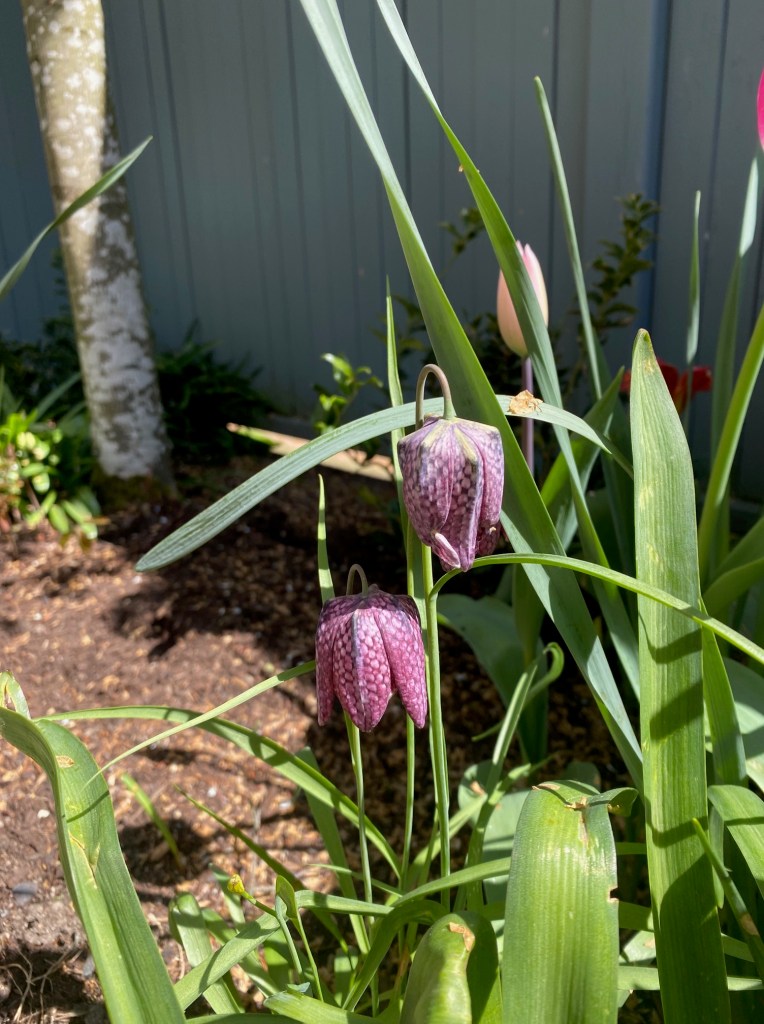
Every season I feel the political pull between taking credit for creation and being surprised at what Earth created with no contribution on my part.  At best, the contribution could be that I left undisturbed a patch of lawn.  Perhaps I once planted them (I cannot recall), but every spring in a narrow flower border below a bird bath, checkered lilies sprout.  Their stems are thin as a chive.  Its head bended as in prayer, a delicate lavender and white checkered lily.  Sometimes there are only a couple of blooms.  This year there were four.  I am surprised and delighted as one receiving a birthday gift, though that date is two months away.  In the autumn when Seattle’s rain returns in regular earnestness, I often find on the parking strip at least one amanita mushroom.  Deep red with spots like the shell of a ladybug – but bigger – they are the image of mushrooms depicted in story books, mushrooms that serve as umbrellas for dwarfs. Amanitas are hallucinogenic, and unless boiled down, likely poisonous.  Like the dandelion, their reputation suffers with no respite from their beauty. 

As soon as I spotted that yard of dandelions, I knew I wanted them to launch my next blog in Thoughts After Seventy, (now Eighty). though I had no idea how I would relate the little flowers to thoughts worth blogging.  Now I reread and realize.  These days, as old age insists that I recognize her, my thoughts often drift to what I can still create and what I am given.  Purpose seems as random as those aging dandelions, their white fluff blown to the wind.

False Spring

After three weeks of February freeze, we have enjoyed a couple of promising weekends that the local forecaster calls “false spring.”  That’s to keep our optimism in check, not that many are optimistic these days.  Those who are still listening to national news are ricocheting between what is true and false, so much so that despair chills us from our toes to our ears, just like those icy February days.   We who have abandoned the news in preservation of our mental health, may still flounder for a sense of purpose.

            Then here comes “false spring,” and I throw my gardening arms around it like a prodigal child who has returned home just when I was longing for reunion.  I lift pitchfork and rakes from standing attention in the shed behind the greenhouse and call them to work, composting and turning the soil in my vegetable garden.  For an eighty-one-year-old woman this is muscle work beyond her actual strength.  But I have always excelled at denial, ignoring the arthritic elbow or the challenge of getting up quickly after I have bent over to harvest a row of wintered-over beets.

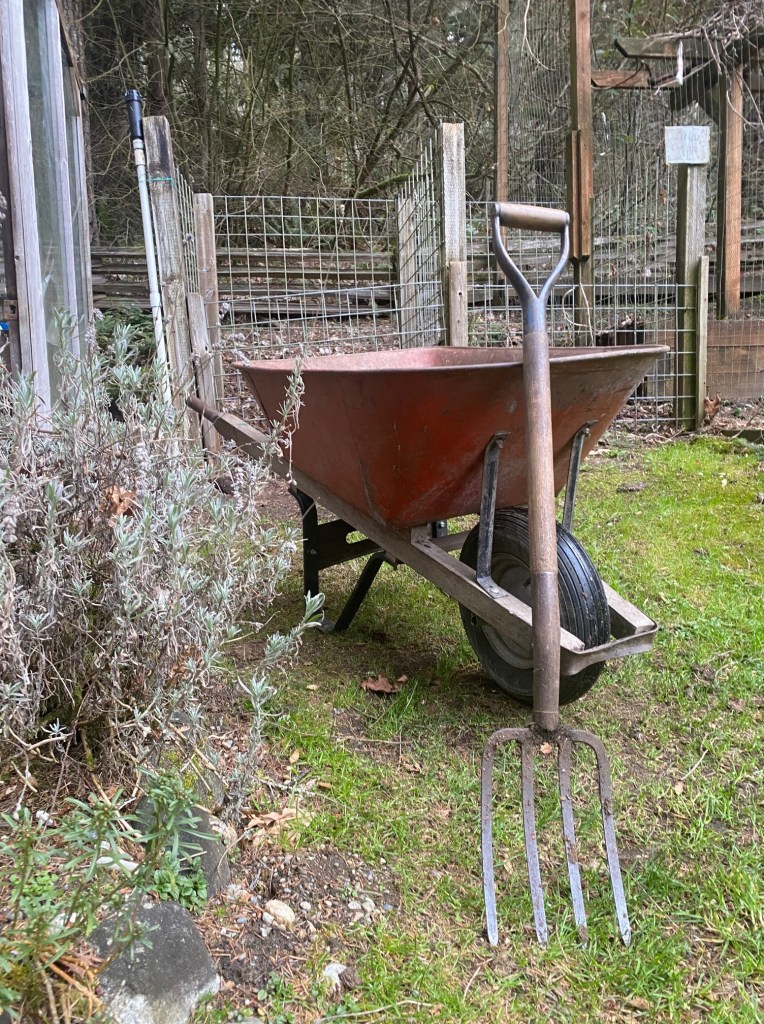
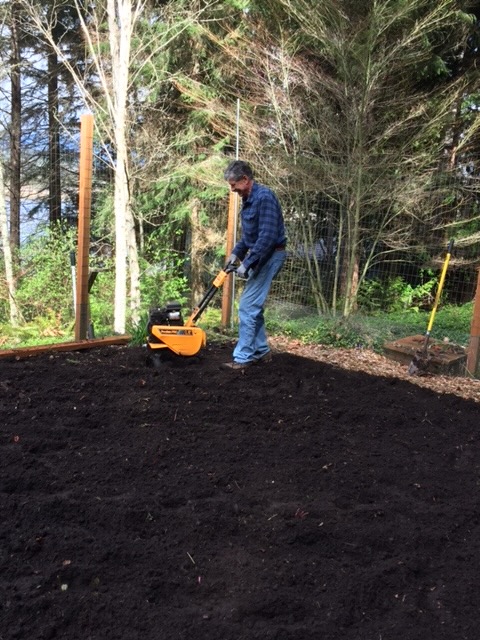
 I love my compost bin, a wire and wood enclosed structure just feet from the garden gate.  I back up the red wheelbarrow while chanting William Carlos William’s poem: “ So much depends on a red wheelbarrow . . .”, I spear a heavy chunk of composted leaves and grass with my pitchfork and swing the load over until the compost mound in the wheelbarrow is my little Vesuvius to spill like lava on my garden.  Over and over, eight times I do the trip before shaking on six bags of steer manure.  I call for my husband who pushes out the rototiller from the shed, its winter-chilled motor spitting and coughing before it starts to plunge and rise through the soil as Allan disciplines it like a willful animal.  Soil, compost and manure blend together in a farm fragrance only a gardener would love.  I inhale it mixed with the late winter salt air from the bay below the hill.  This is sensuous.  This is loving the land and feeling the land love back.

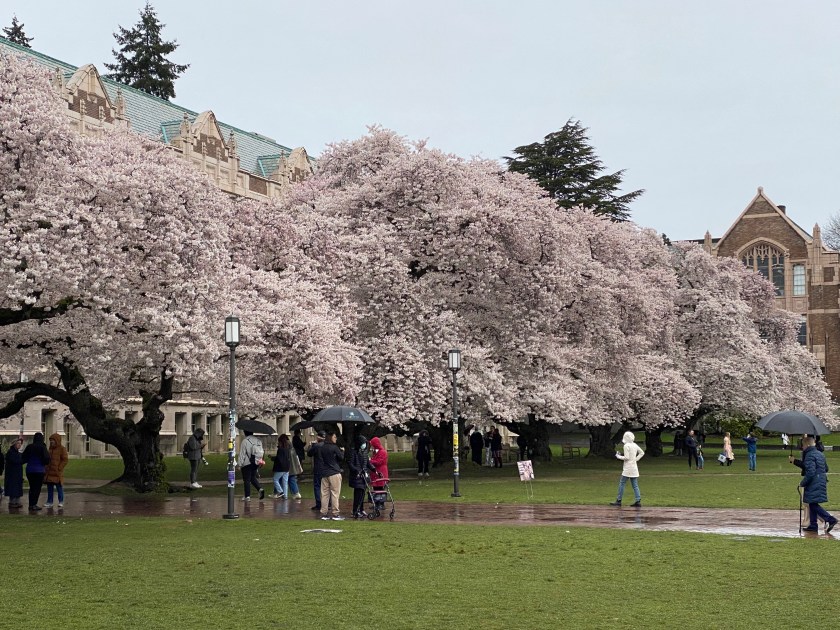
            This quarter, at the University of Washington, I am taking a class in Literature and the Environment.  The texts include writings by Charles Darwin, Aldo Leopold, Rachel Carson and more.  Subjects evoke awareness of all the crimes we have wrought on our environment from pesticides, plastics, fossil fuel emissions . . . Each day I leave campus more informed but grieved. I walk through the Quad where cherry blossoms crouch tightly in their buds.  In a few weeks visitors and students will swarm below those trees, taking selfies among the delicate pink blossoms.  Brides will pose for wedding photos.  Japanese children, dressed in diminutive kimono or lacy party dresses will pose for their parents’ cameras.  This bountiful gift of nature arrives each spring, yet I know now that those blossoms are a false spring as well.  Sadness chokes me even as I luxuriate beneath the warm spring sun in an overheating planet.

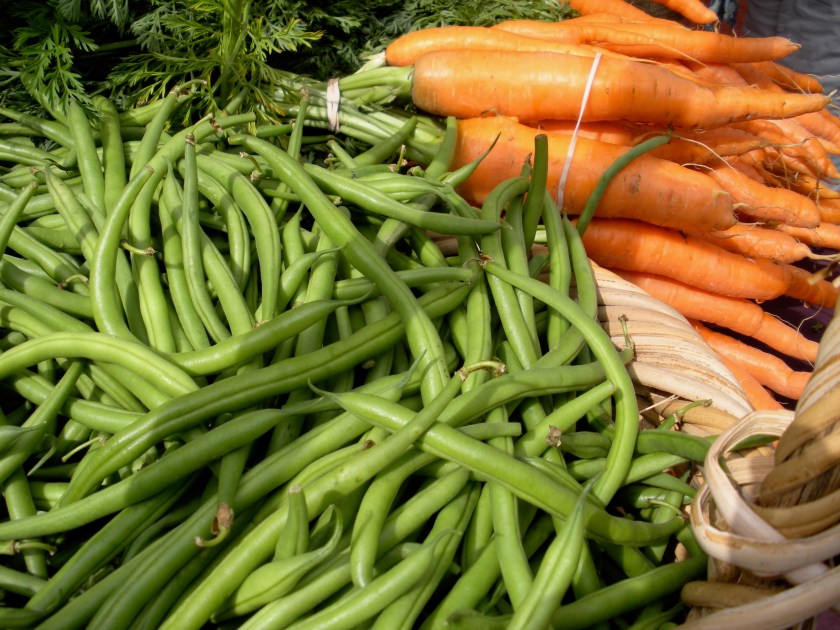
            I can only evade the news so long.  This past week, Donald Trump announced his intention to encourage logging for profit in the National Parks, leading to fewer trees to absorb the excess CO2 emissions — excess CO2 from proliferate use of fossil fuels.   Here I am preparing soil for a garden, for vegetables my family will eat all summer and early fall.  I will bag up beans and carrots for my neighbors.  There will be plenty to take to the local food bank as well.  There is dirt under my fingernails.  I am aware of it as I wring my hands in despair at the disregard for our planet exhibited by enough people in our country who thought Donald Trump would “take care of them.”  My grief and rage diminish somewhat in the fresh air and in my preparation for a garden. Why should I experience anger while I prepare for nourishment?

Today’s reading for the Literature and the Environment class is from Terry Tempest Williams ’Refuge (Third Vintage edition, 2018. P.137). Williams relates a conversation with an African woman: “I am Kikuyu.  My people believe if you are close to the Earth, you are close to people. . . What an African woman nurtures in the soil will eventually feed her family.  Likewise, what she nurtures in her relations will ultimately nurture her community.  It is a matter of living the circle.  Because we have forgotten our kinship with the land, our kinship with each other has become pale.  We shy away from accountability and involvement.  We choose to be occupied, which is quite different from being engaged.  In America, time is money.  In Kenya, time is relationship.  We look at investments differently.”

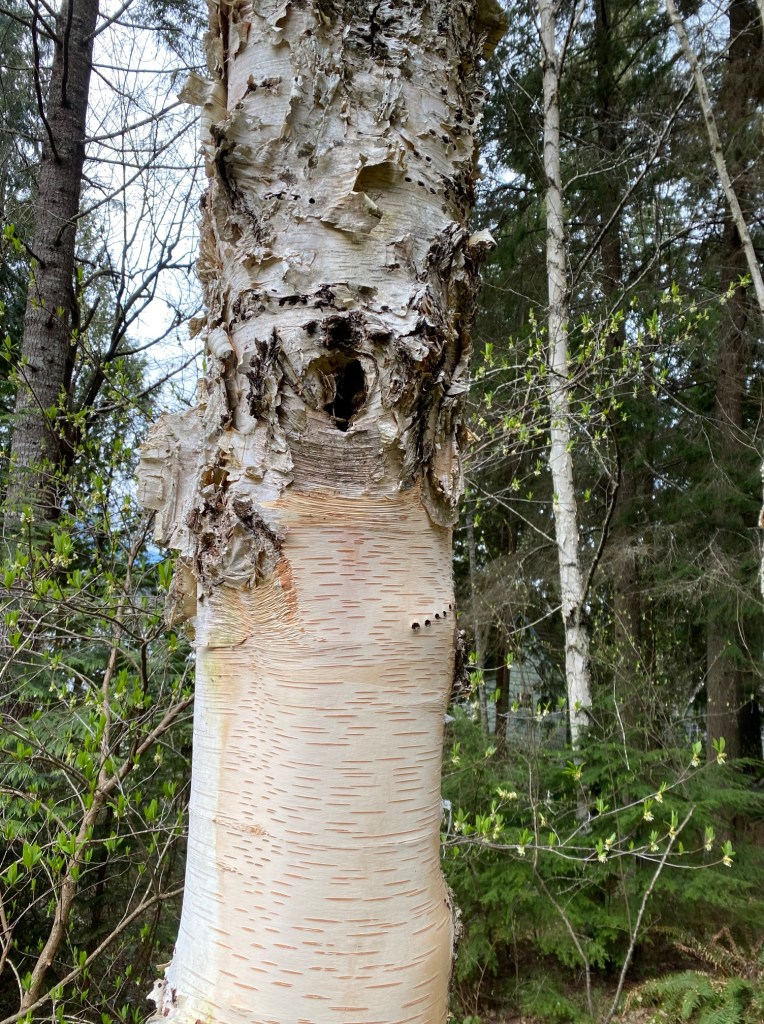
Engaging with the land may be an unusual octogenarian occupation, especially as my harvest years will be fewer, but we all need hope for regeneration.  I am slower in my gardening tasks.  I am easily distracted after latching the garden gate to return down a path to the cottage.  I pass a bark-shedding birch tree we planted twenty-five years ago.  The old, grayed bark cracks its way up the thirty-foot height of the tree.  Hundreds of holes, large and small, tell a story of invasion by insects and foraging for those insects by red-headed sapsuckers.  Some page-sized sheets of bark have shed to the ground.  I reach to experience the satisfying release of more bark, coming like wallpaper peeled from an ancient wall.  The exposed trunk stands in striated caramel and cream.  I lay my hand against it.  The surface is moist as the flesh of a newborn child. 

CHRISTMAS RETURNS

Christmas and Returning – not standing at an Amazon Returns Outlet with an unwrapped gift that doesn’t suit your needs or desires.  Returning is also about remembrance and renewal.

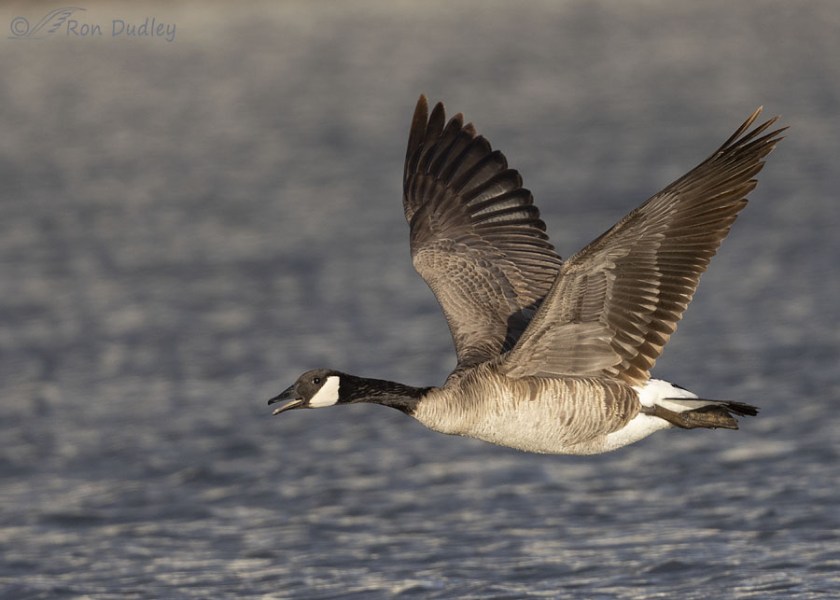
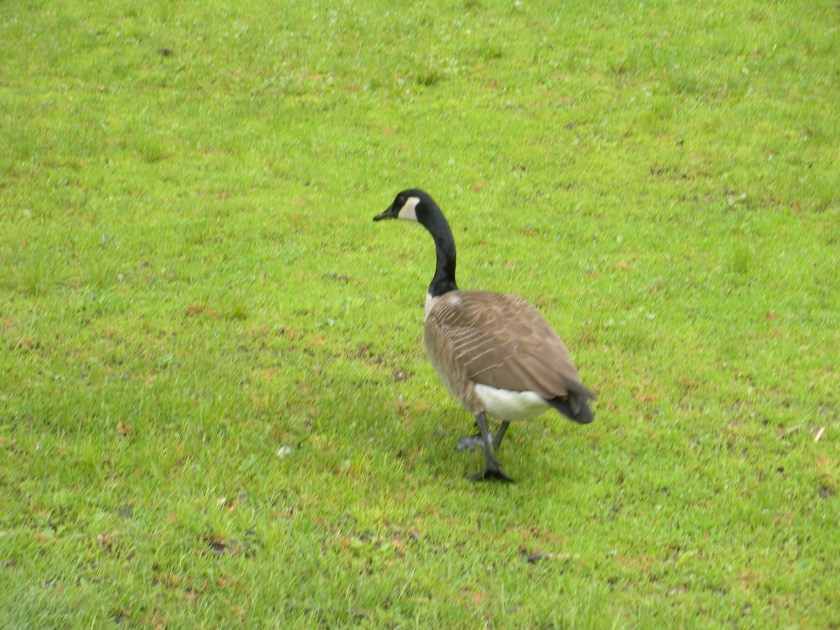
Our cottage on the tidal Quilcene Bay looks out at migrations in cinemascope. This week the scaups return, hundreds whistling down to the water’s surface.  Last week there were mallards.  Soon the Canadian geese migrating north will divide the horizon in a perfect V-formation that is a marvel. Which goose gets to lead the flock?  How does each following goose sense the exact spacing one to the other like cadets on a drill field?  While pondering these ornithological questions, I remember Huey.  Years past, on the hill behind our cottage, a man found a goose egg in a nest and brought it home to see if he could hatch it and have the goose imprint upon him.  It worked all too well.  That goose, we called Huey, thought he was dog, and therefore chased any visitors off his owner’s property, flapping his wings and honking a battle cry as he flew low at knee level to attack the passerby.  That hiker was my husband who knows waterfowl and gave Huey a toss by his neck that not only humbled the goose but attracted it to Allan’s authority   Soon, Huey left the hill and settled on our waterfront lawn, there to nip at my bottom when I bent over to pick strawberries.  Some days he marched around honking his ownership of our place, leaving deposits of goose poop for our grand-dog to slurp up.  

Surely ours was a love/hate relationship with Huey, but who couldn’t feel affection for a bird so clearly devoted to my husband as to follow him around just in case Allan needed a goose to lend him a wing.  Inevitably, Huey looked up during the autumn goose migration and spotted an attraction to divert his attention, likely a lovely lady goose. And he was gone. We rather missed him. Then the following spring, while planting the garden, I heard the clarion honks of returning Canadian geese.  Like a mother remembering the cry of her infant, I swore I could discern Huey’s distinct honking.  I looked up to see one goose peeling off from the perfect V, flying toward me, then landing on our cottage roof where he waved his wide wings, singing something like “Hey guys, I’m returning home.”  For two years Huey went and returned, until he didn’t.  Perhaps he fell victim to the waterfowl hunters shooting from the opposite shore. Perhaps we will never know, but what we do know is that somehow Huey returns in the telling of his story.

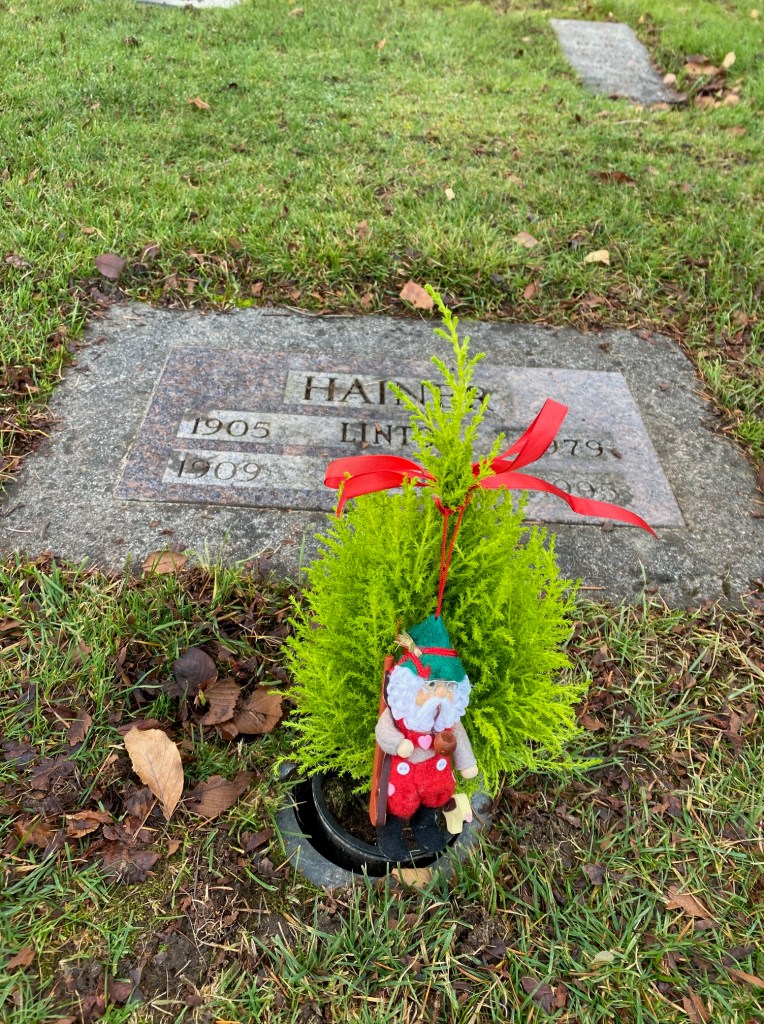
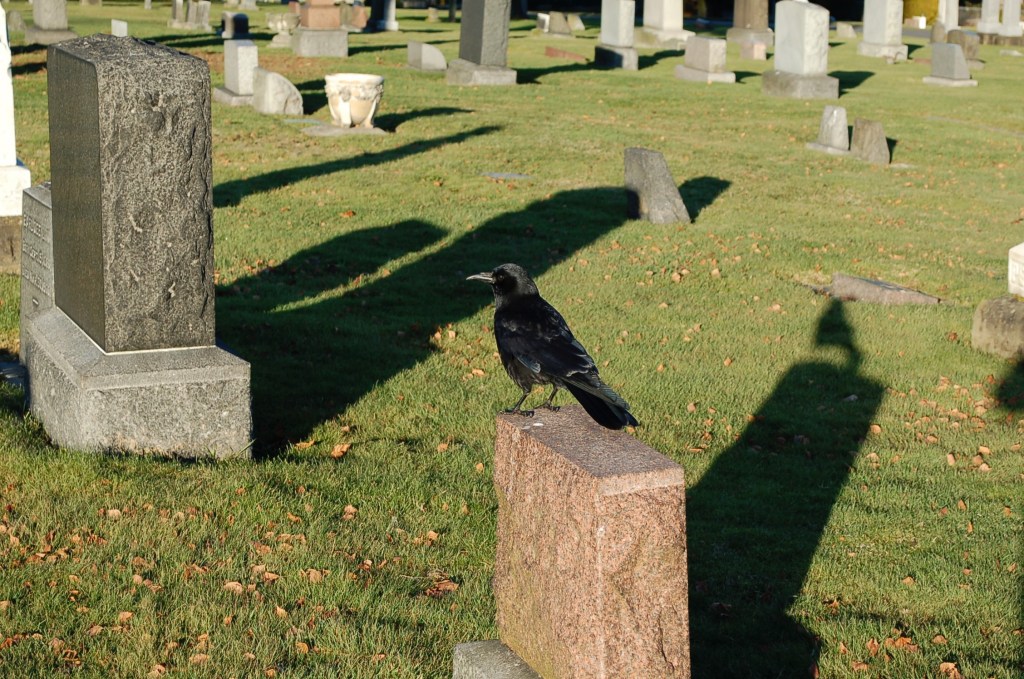
Christmas is a season for telling stories.  Surely, nostalgia may invite emotions of loss and separation. But stories of those departed or times long gone live anew in God’s wonderful gift of remembrance.  I am fortunate that my Seattle home is walking distance from Lakeview Cemetery where my parents are interred. Early in December, I bring a little decorated evergreen tree to the stone, placing it in an embedded vase.  I clear the detritus of autumn from the carved names and wish Merry Christmas to Mom and Dad.   Sometimes, I sing a favorite carol. This year I retold them the story of Dad marching down the stairs Christmas morning.  He wore an off-center Santa cap and carried sleigh bells that usually hung from the mantel, all the time “Ho Ho Hoing” with a baritone Merry Christmas. As youths, my brother and I would roll our eyes wanting to get on with the presents. Now, standing in a mist at the cemetery, I retell the scene to the December air while the image of Dad’s white hair beneath the red Santa hat brings me comfort and cheer.

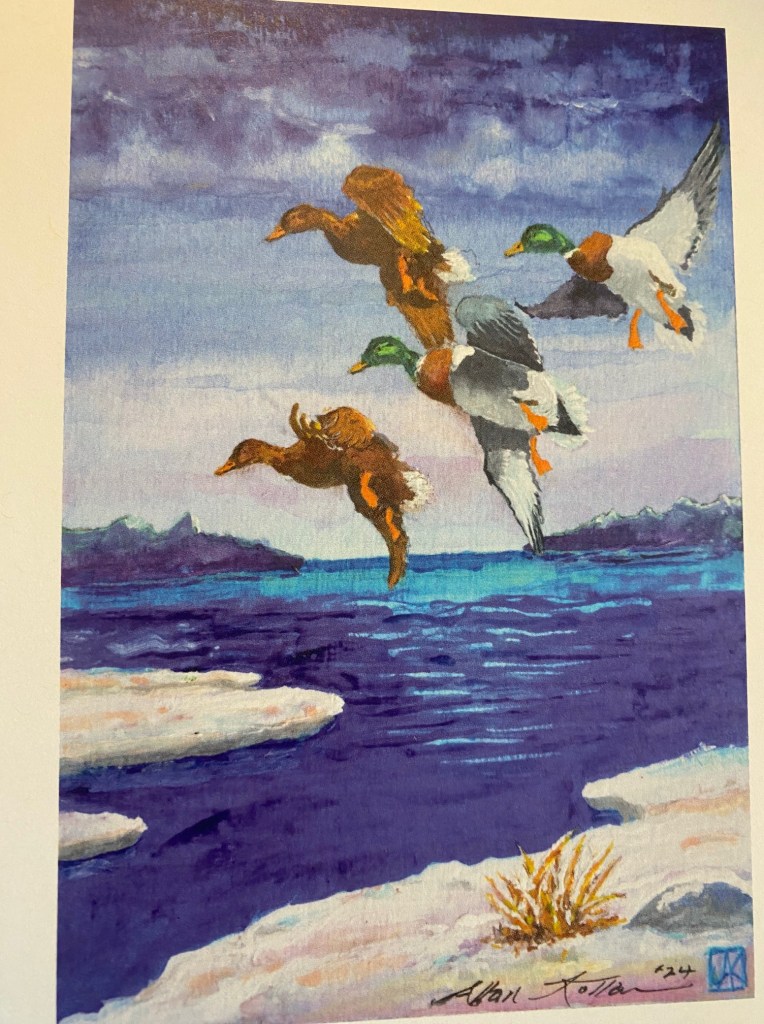
Each year, my husband and I send out Christmas cards that are his art accompanied by a poem written by me.  This year his watercolor depicts two pair of mallards landing on a wintry shore.  I dedicated my poem to Florence Cotton, a long-time member of our church, whom I visited monthly when old age and declining vision kept her from attending services.  Writing the poem reminds me of those visits and how Florence’s optimistic and venerable wisdom enriched my life.

                         Again                                                                                                              

 For Florence Cotton who lived a hundred years                       

This might be the year I return
in a season when songbirds have flown
but the first snow blesses brown grass
and skaters in red scarves carve
figure eightrs on the frozen cove
before Father calls us home,
his flashlight forming a cone directing
us back to where we belong.

Seasons are like that, marking themselves
in migrations. Nature shows off like Hope
born from living through months
with expectant faith that whatever fled
will return like shallow tides to flood.

Sometimes I miss things, Florence says, events
I meant to attend before succumbing to sleep.
Yet deep in morening dreams, departed friends
return, their names and forgotten faces arrive,
bringing me what I feared had flown away.


MARRIED TO THE GRAVE

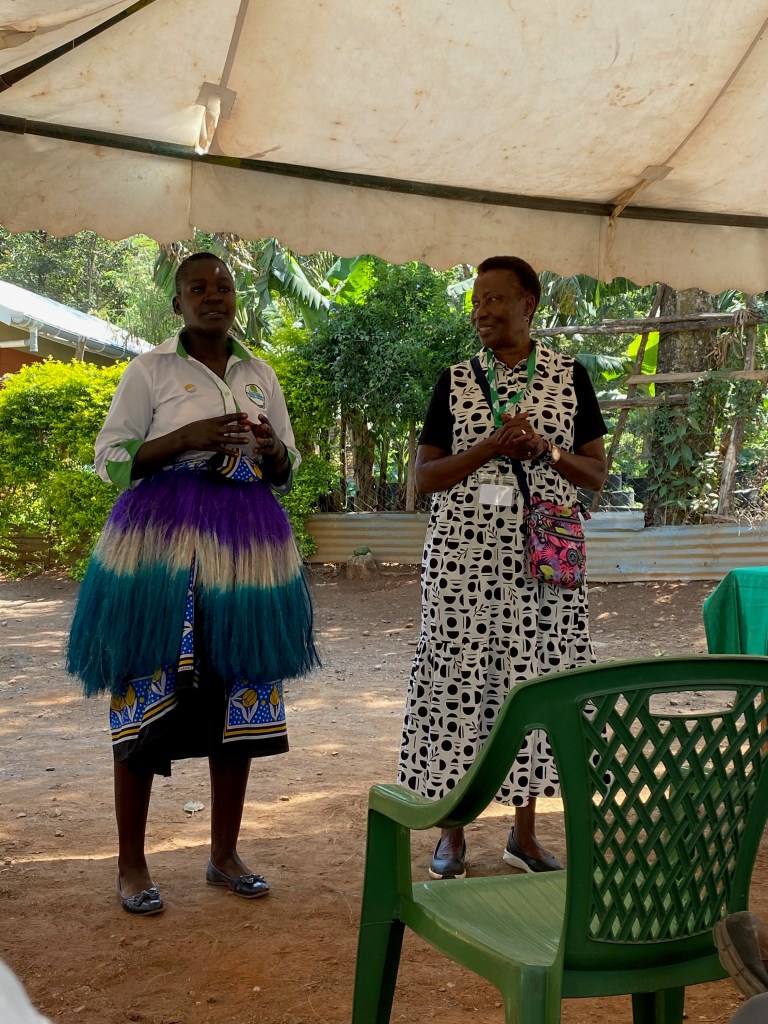
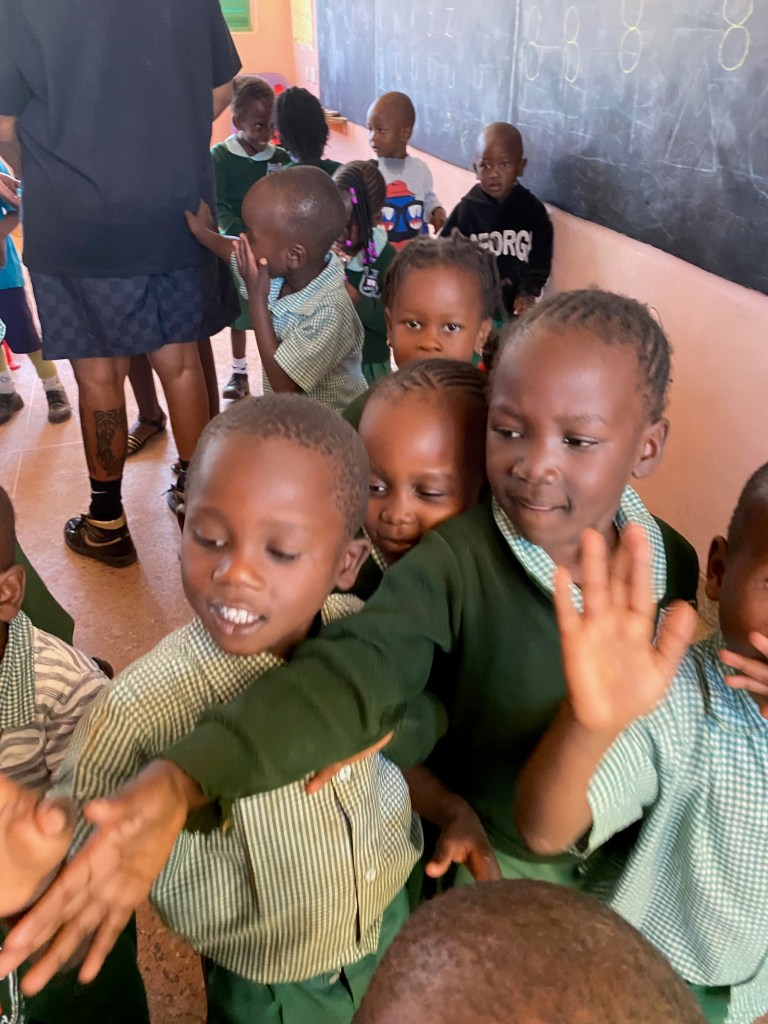
Recently I returned from the remote village of Rabuor, Kenya where I attended a celebratory opening of its primary school, clinic and community center.   Upon following a high-stepping scout troop welcoming our group to the school, I note inscribed on the first building: The Mwanzo WETU Centre of Excellence. Continuing with the young scouts to the stage for the celebration, I pass another sign: Hope Has a Home Here.  Indeed! So many phrases store themselves in my writer’s consciousness as I am consumed with the celebration, phrases I will share here, but none more poignant than Married to the Grave.

Like most tribal villages in Kenya, the men of Rabuor village, reaching the age to marry, must seek a bride from another village, or tribe.  Upon marrying, some women arrive fifty to a hundred kilometers from their native homes. They not only marry the man, they marry the village.  The bride’s job is to cook for her husband and to bear and raise their children.  She is not given, nor is she trained for any other job.  Sadly, this village was decimated by the AIDS epidemic, a plague that killed many more men than women, leaving a community of widows with little or no sustainability.  Even the forests mirror the devastation of AIDS, acres having been clearcut for wood to make coffins.  Coming from another tribe, the widows were not supported by those living in Rabuor, although neighbors might have an interest in supporting their children.  The widows are, in their own words, married to the grave.

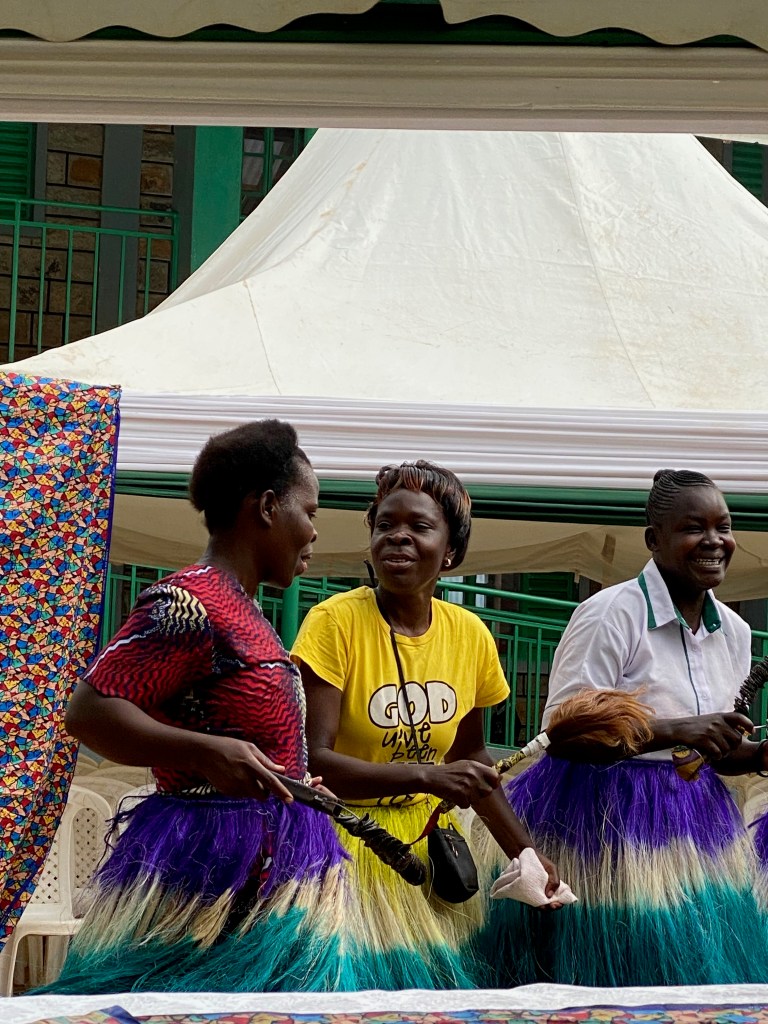
At the point of starvation, a group of widows arrived at the doorstep of the village’s matriarch, Mama Rosemell.  It was she who gathered over a dozen malnourished children into her home, a gathering that led to a preschool and eventually what is now Mwanzo’s primary school from preschool through grade eight. Mwanzo is a school and community project now overseen by her daughter, Loyce Ong’udi.   A woman of bountiful compassion, Mama Rosemell secured seed money to provide an incentive for the widows to start a business whereby they could support themselves and their children.  The women’s group bonded and grew, even attracting women and a few men from other villages. Now they have a sustainable income from raising chickens and running a catering business.  Their healthy pride and ambition are palpable.  When it is time for the women’s group to share their ventures with us visitors, they lead us to our chairs under a tent that shades us from the African sun.  Like the scouts, they welcome us with chanting, drumming, dancing in vibrant skirts of purple, blue and white, hips swaying to thrilling, melodious music.  My chest swells with shared joy for sisters who are surviving.  And yes, it is a communal glee, as each woman receives a unique introduction, a chance to tell her story.  Kenyans love speeches.  No one is overlooked.  Words form the community.

And here comes another phrase often repeated during my visit:  You are someone’s child, so you are here to help someone’s child.  Madame Director, Loyce Ong’udi, repeats that phrase almost daily, but the words blossom with significance when also spoken by those in the women’s group as well as by the teachers whose classrooms fill with children eager for education.

Perhaps the two phrases together speak to me of immortality.  Metaphorically, how often have I remained married to the grave, in other words consumed with the passing of my life, with the frequent deaths of friends and family?  Surely it is hard to look beyond one’s own life.  Or is it?  If I think of my life as being that of one child born to help another child, my influence can be immortal.  The children reach out to shake my hand.  All the children of the school follow each visitor, reaching out to shake our hands.

INCOMPLETE

It is the middle of July.   This morning’s walk along the trails of our woods, we stop as usual to climb the ladder to the treehouse where we listen to birds and the chuckle of the small creek emptying into our pond. At the top of the ladder and below the shake half-roof, Allan points to where the morning sun lights up a half-formed spider web. No better art lighting could enhance the architecture of the intricate web.  I approach cautiously to photograph it before the sun hides behind trees.  “But look, “Allan notes, “It is incomplete.”  As you easily see, the web is half a web, abandoned, no spider-creator in sight.

I dwell on “incomplete.”  As a teacher, it had import.  Often a student, unable to finish an assignment, would stay after class to ask, “May I take an incomplete?”  Sometimes the request was for a single project, sometimes for an entire semester’s grade.  There were multiple reasons for taking an incomplete from having begun too late or being ill prepared, to an interruption at home –an illness, a family vacation.  But whatever the reason, an incomplete was somehow better than an F.  Yet, although better than an F, it was still weighed down by a sense of failure, of falling behind. 

Sometimes the student would continue to work on the assignment and eventually return for evaluation.  But often an incomplete was something like Robert Frost’s words from The Road Not Taken.  As way led on to way, the traveler knew they would not go back.  Life interrupts life.  We are off to weave another web.

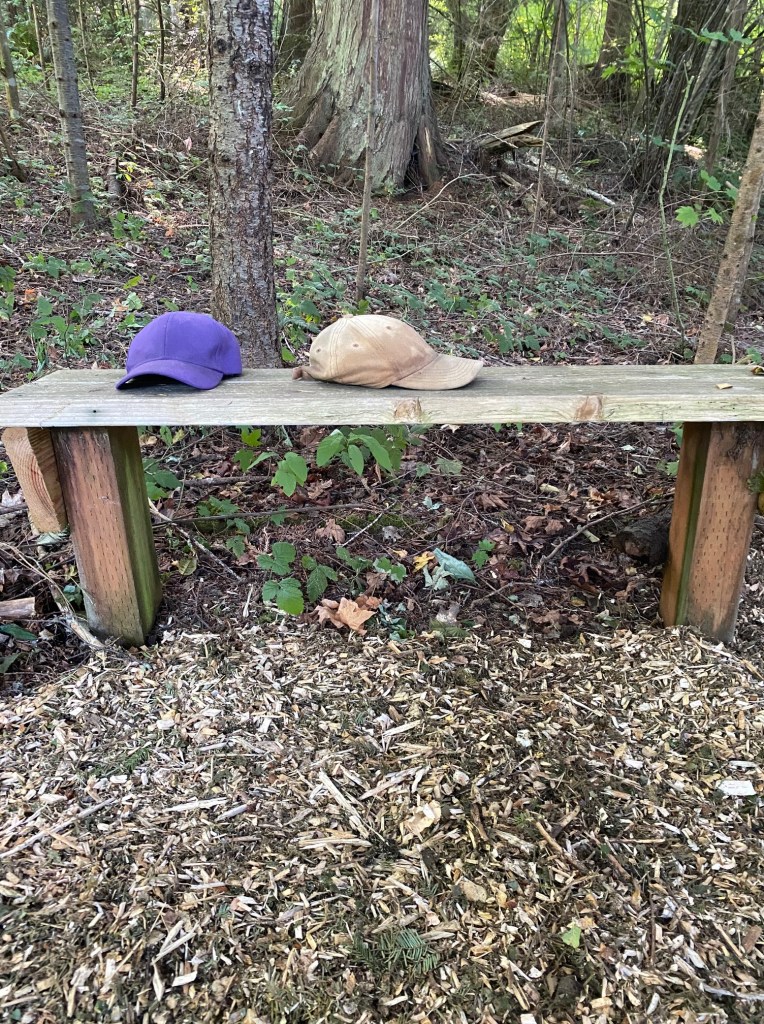
Today my meditation on the incomplete spider web would not leave me.  Farther along our walk, I noted on a bench two caps, one belonging to our hired helper who has been spreading chips on the trail, the other to his assistant.  Had they paused to rest here, chip hauling and spreading being a hard and sweaty task?  Although their work was incomplete, they had neatly spread yards of cedar chips, were nearly done, and promised to return on Monday.  I liked seeing their caps there and thinking of their wisdom in taking a break to rest, to drink from water bottles, and proceed later, even without their caps.

As usual, with my mushrooming thoughts, the figure of incompletion led to something bigger.  Today we learned that President Biden has chosen to pass the torch of leadership to another representative of the Democratic party.  Until today, he remained steady in his resolve to complete a task on which he set his whole life.  He did not want to take an incomplete. Wherein would his commitment to finish the job alone make a difference? Would there be shame in his taking an incomplete on this one?  Joe Biden has given his entire adult life to serving our country as an elected official, so today’s decision could easily be applauded as the completion of a dedicated career.

I think of so many accomplished people who chose not to complete school so as to follow their interests and talents in other directions:  the two-time Pulitzer Prize winning  playwright August Wilson, at fifteen left school to self-educate rather than suffer the racist intolerance he experienced in high school. Bill Gates with a privileged enrollment at Harvard University “failed” to graduate.  Is he a failure?

There is that spider web woven while we were sleeping and given to us in the morning light.  It is not done, but it is beautiful.  The artifice with which it was created cannot be denied.  Is completion overrated?  Among the many things I value in the University UCC church that I attend is the church slogan:  “Don’t put a period, where God has put a comma.  God is still speaking.”  Certainly, Creation itself is incomplete.

HELP!

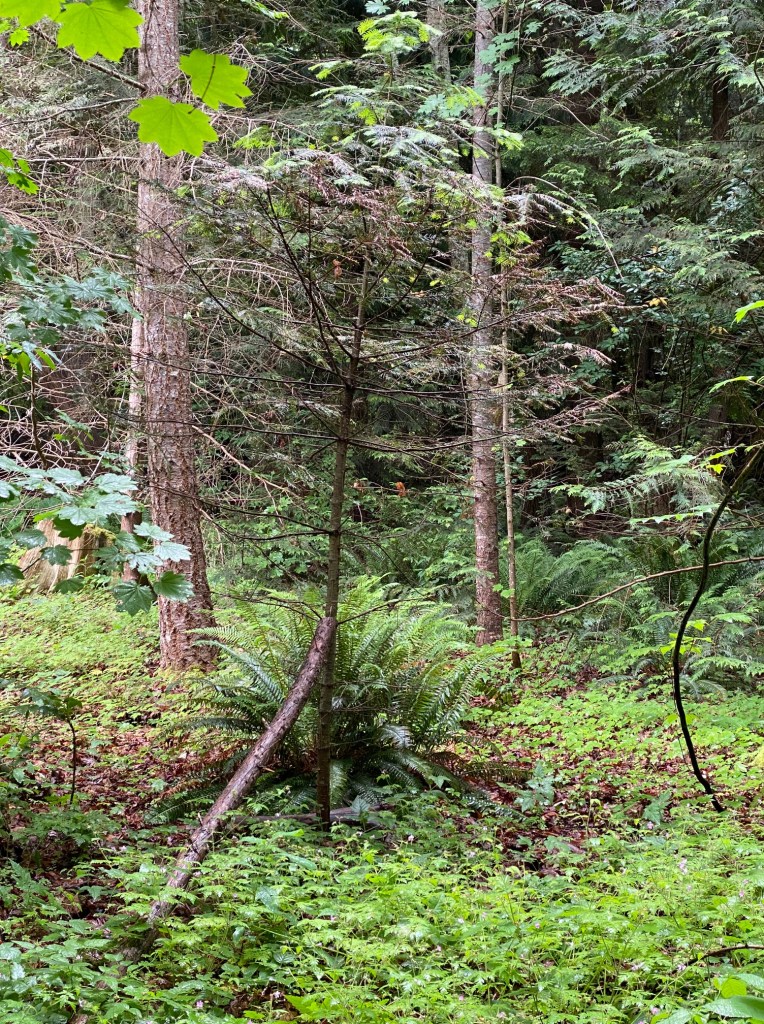
See the skinny fir tree.  See the board propped up against its trunk?  It has been a year and a half since we pulled up the adolescent fir from where it had grown and moved it to the present spot, a place much in need of a native fir after we removed four large Leyland cypresses.  We held hopes for our new open space, hopes to reforest with native trees, primarily firs, and we planted at judicious spacing some small ones before pulling up this teenager and plopping it in place where it soon leaned over as if mourning the move.  Thus, we propped a board against the trunk to help it continue reaching for the sun, then packed compost around the roots, and waited over an unusually cold winter, while the branches shed their needles, leaving us to ask in February whether the tree survived.  Now rainy April and sunny May have arrived.  At the tree’s crown, a fan of fresh green needles waves brightly.  The tree is alive!  We can already imagine its prominence among the other native vegetation on the hill.  How satisfied we feel in helping the tree survive.

Ten years ago, when I began writing this blog about Thoughts After Seventy, I had thoughts to examine about what it means to be elderly.  What are my needs?  Almost immediately the answer came to me, “I need to be needed,” and so I wrote about a septuagenarian’s wish to be relevant, to be helpful.  That remains true after turning eighty, but today I find myself struggling with HELP.  Human interaction is not the same as propping up an adolescent tree, as metaphorically pleasing as that sounds. 

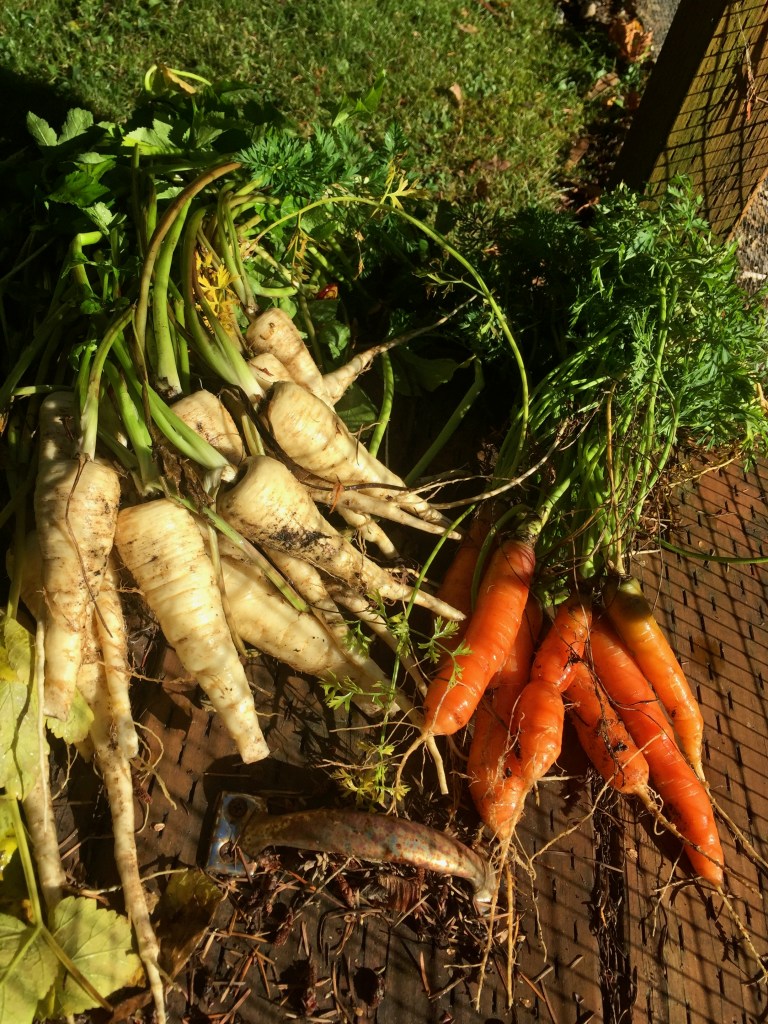
Whom might I help?  Who wants my help?  Who would eschew my help regardless of my good yearning-to-support-you intentions? In the grocery store a child wedges the shopping cart between a display of paper towels and laundry detergent.  His mother tugs at the cart to avoid tumbling paper towels in the aisle.  Her child squeals, “No, mine!  I can do it.” I hand a packet of carrot seeds to my grandson for spacing in a hoed furrow.  Weeks later, carrots emerge in a tight fist of orange spikes from spilled seeds.  He planted them “his way.” 

How can I be helpful if my help is not requested?  What skills or knowledge do I have at this point in my life that would be helpful to share with others?  Well, there are all those years teaching high school English.  I know the difference between subjective and objective pronouns, not to mention usage distinctions between lie and lay or less and fewer.  On occasion, friends and family ask for my help in editing their writing to check for standard usage.  I feel fulfilled by helping out. On other occasions, I see writing from friends and family that could use pronoun clarification or a punctuation tweak.  Their writing may come my way by a shared email, a letter, or even their own blog posts. I commonly note in their writing when a verb is separated from its object by intervening words, a writer will use a subjective rather than an objective pronoun; for example, “The coach chose my brothers and I,” for the team.  The writer would never write “The coach chose I,” but since brothers comes between verb and object, the writer doesn’t hear the verb crying out for an objective pronoun, and the writer uses I instead of “The coach chose my brothers and me.”  I confess here, that “errors” in English usage are like little missiles exploding in my English-teacher brain. I have yet to faint from a cerebral bleed. Would I be helping others with a little pronoun lesson?

In search of an answer, I asked my husband and three friends what I should do.  They were unanimous is saying, “Do nothing.”  You don’t “correct,” “teach” (whatever euphemism you choose ) someone’s grammar/usage without being invited to do so.  It will be felt as judgmental.  Even if I don’t feel as if I am judging?  Makes no difference – it will be felt as judgmental.  Should I ask friends, “Would you like my help with your English usage?”  Nope. That sounds patronizing.  With a granddaughter I might get away with it.  I read my granddaughter’s exquisitely written introduction to a book she is writing.  Noting some uses of semi-colons and colons, I asked if she would like my help. “Thanks, Nana, but I am not ready for line edits yet.”  Perfect.  Both of us felt good.

“Help” is circumstantial.  Having confessed that at my age I want to be needed, perhaps I am offering help where it is not desired because of my own wish to feel relevant and useful, long after I have left a classroom where I was employed to promote pronouns.  I am at an age where I will be asking for help more than providing it.  A call to my daughter or grandchildren for computer/ internet assistance is a diurnal request.

It’s all in the Beatles, Help.  In the first few lines, help and need are paired.  A few lines later age comes in:

When I was younger, so much younger than today
I never needed anybody’s help in any way
(Now) but now these days are gone (these days are gone)
I’m not so self assured .

To be able to help someone adds to our self-assurance, a kind of “I can do it” feeling when there are so many things I cannot do – such as open a jar of pickles or even the tops of pill bottles. 

Recently, I checked in with a friend back East whose husband is coping with age-related health issues.  She assured me that over-all he is doing fine, but last week he stumbled over a curb in the grocery parking lot and fell.  “I didn’t even have time to call for help,” she said.  “Within seconds there were four men by his side, helping him to his feet.”  We agreed, people can be instinctively helpful.

Is anyone out there stumbling over their pronouns or prepositions?  Would you want my help?

SHOULD, OR OUGHT TO?

Having turned seventy, I began this blog: Thoughtsafterseventy.com, as a platform for examining how life might evolve as a septuagenarian.  Without feeling much different, I am now an octogenarian, so let’s see what changed after that 80th celebration.  More things are shedding from my life’s work.  It occurs to me that with time I still manage to fill easily, I am less driven by things I SHOULD do.  You know, those obligations that affirm we are good people, still contributing in a positive way to the world in whose cart we are riding. 

Eager to write a blog about SHOULD, I recalled a favorite poem by Robert Frost  —The Runaway.  The poem describes a scene where the poet happens across a field surrounded by a stone wall.  In the field, a young colt races anxiously.  No parent horse is within view.  The poet muses that the colt is not having a good time of it but is afraid of snow that has begun to fall heavily.  I planned to quote the last line where I recalled the poet saying “Someone should come and take him in.”  However, when I looked up the poem, it ends: “ Whoever it is that leaves him out so late, / when other creatures have gone to stall and bin, / ought to be told to come and take him in.”  Frost did not write should; he wrote ought to.

I have been using should, for obligation; whereas, ought is what I meant.  Should, I learned from Merriam Webster, is used in auxiliary function to express condition and means predictable such as clouds indicate that it should rain.  Granted, Mr. Webster allows that should may also be used for obligation. Yet ought to is clearly the phrase for duty.

                  At eighty years, there are fewer things I ought to do.  Decades ago there were many oughts having to do with a work life of lesson plans and paper grading. With fewer remaining years, there are more choices.  Ought I attend church?  Answer an email?  Make a lunch date? Clean the basement? As those oughts emerge now, I find myself asking, “But do I want to?”  If I don’t want the task, it feels easier to let it go.  The food in the basement freezer, therefore, should be just fine – or not.  Care comes more frequently to mind. For what do I feel care?  I care about the public library, and so I continue to donate this year.  In past years, I donated to some causes for which I had less care, but ought to drove me reluctantly to take out the checkbook. 

                  According to actuarial estimates by a health insurance company, I should live into my 90’s, perhaps even to 100.  Do I want to?  And under what conditions do I want to proceed through the next one or two decades?  I like taking moments to savor those years, to shape a caring life less directed by custom and perceived obligations. It feels liberating to cut those obligatory ropes. I am going for pleasure.

What gives me pleasure? Yesterday, we attended a celebratory showing of a young friend’s film she created for her graduation project from NYU where she had majored in film.  We usually go to our Hood Canal cottage on weekends, but my delight in celebrating with Natalie was a happier choice. Auditing classes at the university also brings me closer to young adults.  Both my husband and I are often smiling, noticing toddlers on the ferry.  I have taken to complimenting dog walkers in the neighborhood on how handsome or well-groomed their pets are.  It is as if young life everywhere lifts my spirits.

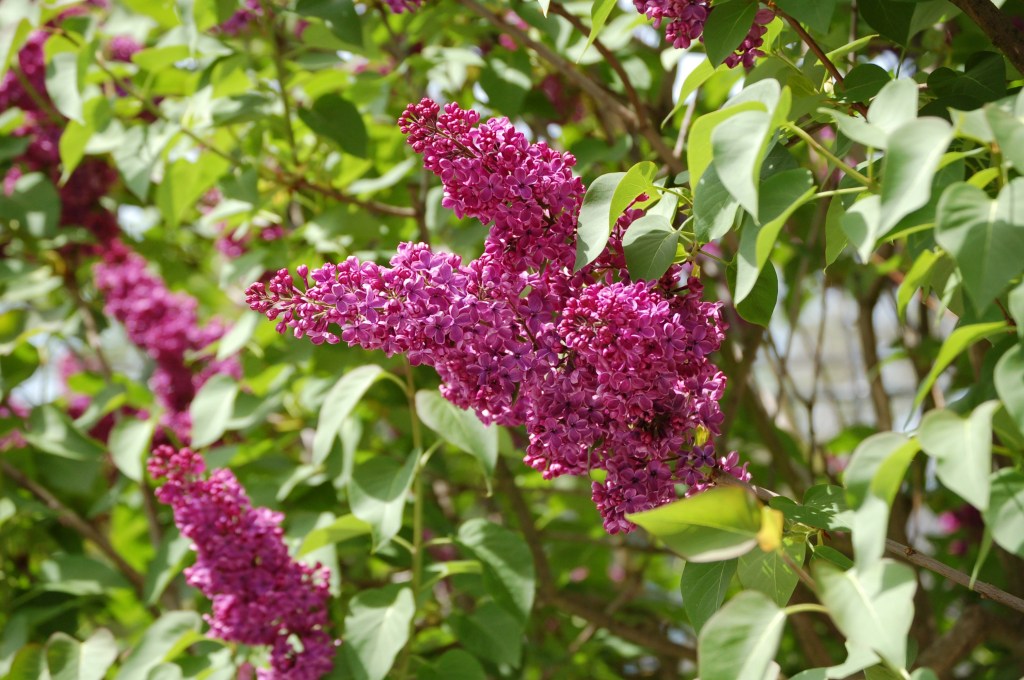
                  This Sunday morning in May there are flower and vegetable beds ready for seeds.  The thick grass needs mowing.  Hummingbirds compete in a whir of activity around the red feeder half-full of sugar water.  It is rather cold and raining.  Charcoal clouds hang over the yard.  Rainwater on the deck reflects the lilac bush hanging low with moisture.  I may remain in bed, admiring the morning light on rain-polished leaves.  The weather forecast predicts there should be warm sunny days by Tuesday, then, perhaps, my day for planting.  

COLLECTING PHRASES

                  Speaking with my older brother last week, he offered me, “Father winds the clock.”  The phrase set him thinking, and since his sharing it with me, the phrase is following me around like a dust mote that could be brushed off my shoulder if I would take the time.  Then last weekend when my grandson was visiting from college for spring break, we got to discussing movies.  I opined that I liked mysteries, more or less, sometimes less “more” than other times depending on the plot.  He laughed at more or less, took out his cell phone and wrote down the phrase in his Notes app.  In that app are hundreds of phrases that have intrigued him and for which he may someday find use, such as in naming a film script he is writing.

                  Words and phrases invade me like the body snatchers, a rather gruesome analogy, because they aren’t all creepy.  However, they are possessive of my conscious moments. Take Father winds the clock. I suspect Jim liked that as I do because it got him to thinking of the various roles we assume in a domestic household, roles that somewhat define character.  Few people have wind-up clocks anymore, a shame, because time is a patron saint of our lives.  To have to wind a clock keeps us mindful of the days ticking by.  In the phrase my brother loves, it also defines the role of a parent in a family, in this case a rather patriarchal role.  Father gains importance because of his role in winding the clock.  The clock becomes a symbol of Father’s purpose as caregiver, keeper of time.  In my 80th year, the phrase also triggers my image of a father dying and the clock silenced lacking his precise movement of the hands.  What a profound silence such death is.  For a moment, Time Stops.

                  Even time stops is one of those haunting phrases, particularly because it is antithetical to the truth.  Time never stops, regardless of any person or device marking its movement.  Never was I more aware of time’s progression than when my own father died.  The following day, I was running the track above the basketball court at the Washington Athletic Club.  Below me, a group of young men dribbled a basketball up and down the court.  Outside the open window, I heard traffic on 6th Avenue as people commuted to morning jobs.  Both activities felt like blasphemy.  How could the world march on when my father was no longer in that world?  Ironic, for with that very thought, I was running laps on that track.  Time does not stop.

                  What phrases are tucked in your pockets?  Do they astound you, arriving when you weren’t expecting, or are they phrases that remain with you for decades?  Perhaps they are the axioms of parenting:  Think before you speak, The early bird gets the worm.  Once you have become a parent, you polish those phrases off and pass them on to your offspring. If you have a wordsmith child, you may hear back, “But I am not a bird, and I don’t eat worms.”  As to thinking before speaking, what comes first, the chicken or the egg?  Oops there goes another one.  I like hearing new parenting phrases emerge, one in particular: Use your words. I didn’t have that phrase when I was raising my daughter, so when there were angry gestures, I resorted to physical responses, sometimes almost as physical as her tantrums.   Use your words suggests that the anger may be justified, but there is a more reasonable way to express it.  That said, my daughter was quite vociferous, and her words could have the force of a kick in the shin.

                  Some phrases are place specific.  Your familiarity with a locale goes along with your familiarity of place-specific phrases.  My friend Kristin, sent me a blog by David B. Williams in which he shares the linguistic history of words and phrases particular to Seattle.*  I was eager to add my own to his research (Montlake Cut, CHOP, Pill Hill, The C.D.)  My little collection reveals the years I have lived on Capitol Hill.

                  If you are a visual person, phrase collecting evokes many colorful images, and if you allow yourself time to visualize them, there is a chuckle for many are outrageous metaphors: sick as a dog, down in the dumps, high as a kite. Is an ill dog any more under the weather than your choking cat?  Who first imagined an intoxicated person as being high, and then up in the sky, making loops in the wind?  Down in the dumps makes perfect sense if you have ever held your nose while driving by a city landfill.

                  I look forward to the day when an imaginative linguist can find substitutes for empty phrases, especially phrases used when we really want to communicate feeling.  Our thoughts and prayers go with you is one of the most vacuous.  There is another school shooting, and the politicians bring out that phrase when grieving families want their children back.  I try to imagine those politicians on their knees that night saying their prayers and speaking the names of those lost. Yet, I also have sat with pen in hand, an open card before me, truly hoping to offer comfort when there has been a loss.  What comes to mind?  That same phrase, when I long for fresh phrases. 

_______________________________________________