I could tell you that the Swift Boat accusations against John Kerry were what tossed me into the drink that presidential election of 2004. But in spite of my progressive leanings, I will honestly say by October of that year, the Democrats crucified the English language as much as did the Republicans. Orwell was churning with the worms in his grave.
Those of us who were English teachers hung our heads in mourning, not only for the imminent death of our nation, but for the early demise of the English language. I felt helpless, wordless, as if my tongue were excised as much as my vote. Yet before I slipped beneath the stones, I passively struck out with a poem. It was October, and so my ears turned again to Robert Frost’s
 O hushed October morning mild,
Thy leaves have ripened to the fall;
Tomorrow’s wind, if it be wild,
Should waste them all.
The crows above the forest call;
Tomorrow they may form and go.
O hushed October morning mild,
Begin the hours of this day slow. . . .
Just typing the poem, was a salve for my offended ears. I printed 50 copies, slipped them into a plastic folder, wrote Take One, and duct taped the folder to the wrought iron fence around my yard. The poems were quickly taken; I suppose passersby assumed the house was for sale. How were they to know the folder of Frost’s sonnet was my non-violent protest not only against a nasty election but against the demise of our language. Instinctively, I felt if I could remind others how beautiful words could be, they too would rise up against the cacophony of cronies.
 October passed. The election failed to win the president I would have chosen. The Iraq war showed no sign of ending, and I stumbled across another Frost poem, November, that, if read closely, clearly indicates Frost was writing in opposition to war. December? Well my daughter mentioned how tacky the duct taped folder looked on the fence, so I removed it. In January, neighbors and folks I didn’t know (but who frequented the same coffee houses), asked me, “Where was December’s poem?”
Voila! After 30 years teaching high school English, forcibly stuffing poems down reluctant throats, I had finally an audience who wanted poetry. On January 1st, I replaced the plastic folder with a wooden box my brother built for me, the Poetry Box, and in it I put Emily Dickinson’s Hope is a Thing with Feathers.
Thirteen years later, I still approach the end of each month to consider what poem I will select for the following month. Over 300 poems are taken from the box each month. Never once has a crumpled poem landed on the parking strip. I have received notes of thanks, interviews on radio and newspapers, a little envelope with $5 from a teacher who knows what it cost to Xerox copies to disseminate to her students. And for those who do not live close enough to get a poem from the box, I have compiled a list of 44 emails to send out the poem, and usually a little something about why I chose the poem or some authorial background.
This month is February, a month I think of well in advance to choose a love poem. There are so many, and what fun to read and reread, to think which one feels right for this year. This February I did not use a love poem. After the first two weeks of Donald Trump’s presidency, as a good many Americans flail their arms to stay afloat in democracy, I turned to Wendell Berry’s Peace Among Wild Things. When despair for the world grows in me and I wake in the night at the least sound in fear of what my life and my children’s lives may be, I go and lie down where the wood drake rests in his beauty on the water, and the great heron feeds.
Within hours, my email fills with letters, “Thank you Mary, for the poem. I needed that.” I wasn’t surprised, but why is it true? Why do we need poetry? It is not a miracle drug. It will not cure cancer. Edna St. Vincent Millay wrote “Love is not all: it is not meat nor drink/ Nor slumber nor a roof against the rain…. Yet many a man is making friends with death / Even as I speak, for lack of love alone.” We can say the same thing about poetry. Poetry might not save the world but …What is there about a poem that helps us bear the weight of the world?
 For the writer, the process takes her away to the shelter of her imagination. She puts herself in a garden or along a seashore. With the gift of remembrance, she sees the first daffodils blooming or hears waves licking the sand where her toes warm with each step. Escape? Yes, but in the process of getting away from the world, she returns to it with a greater understanding, as if she has larger hands with which to hold the worlds’ cares. Poetry gives her the confidence of quiet power — the greatest power known by the most courageous people like Dr. Martin Luther King or Ghandi.
For the reader, he too takes a walk from strife. In despair one feels there is no control. It is as if an old thermometer has broken on a tile floor and beads of mercury scatter everywhere. It is dangerous stuff, but there is no gathering it up. Poetry is concise; it has form and shape. The very economy of a poem informs the reader that life can be gathered up. You can carry a poem in your pocket, take it out when waiting for the bus. The bus may be delayed or not come at all, but you have those lines. You might memorize them. They lull in the music of their meters: Whose woods these are I think I know/ His house is in the village though/ He will not see me stopping here…
And there is the conclusion to Wendell Berry’s poem.
I come into the presence of still water. And I feel above me the day-blind stars waiting with their light. For a time I rest in the grace of the world, and am free.
There is hope. The poem asks nothing of the reader but to hang in until the final lines that bring understanding of the world by asking beauty to step up and hold us in her palm.
And why does one poem a month, taken from a box make a difference, when any one of us could open a book and read a hundred poems, or surf the internet to find lots of sites for a poem? I can only guess, but here goes.
“Where was December’s Poem?” Having shared in the expected by two months of a poem each month, people like the anticipation of a gift. More gifts would lessen the gratitude. One gift, thirty days apart, makes the waiting worth it. Few people who take the poem know me. I do not know them, but we are a community of feeling. I have had many positive responses to that poetry box, but here are two of my favorites. One showed up on a blog I stumbled across about Seattle neighborhoods. My poetry box was discussed in the context of Capitol Hill and the writer called in a “carefully curated poetry box.” A curator is someone who consciously cares for art. The phrase suggests caring, caring for the poem, caring for those who might read it.
The second compliment was by an 8 year old boy who had to write for his school class about his neighborhood and what made it a community. He chose to interview me about the poetry box. Though intended by me as a soft political protest, for him it was the glue of his community. I have seen many children over the years take a poem from the box and read it, either alone or to their parent walking them to school.
These are tough times for those of us who identify as progressives. We are fearful for what we might lose at the whim of a president who has a vocabulary of a drunken sailor, whose depth of articulation goes no farther than the number of characters allowed in a tweet. He is an office holder, albeit a rather powerful one, but he is not the people. He is not the voice of the people. As long as there is poetry the language of the people will have form and melody. The people are the poem. The poem is the people. Walt Whitman knew it, and his words will endure long after any readily regurgitated hate.
Let us write our poems. We will write them in journals, on sidewalks, on the posters we carry in marches for our democracy. Let us read poems, and in the reading hang our livelihood on concise words that lead us to understanding, the penultimate destination before transcendence.
 Moving into our 70’s we still listen to our 16 year-old self sleeping in somewhere behind our hearts. It is the adolescent fame-future voice that promises some day to star in a film or rescue a child clinging to a rooftop while floodwaters rise. We feel we have the talent or the hero within, as soon as we decide to call it out of hiding. After seventy, we shed one goal at a time, after first allowing old-age wisdom to acknowledge those ambitions are now fantasy as if they were not always. I have concluded that I will never climb Mt. Rainier. Even nudging 50 years of age, I thought I might do that some day, would sign on to a group tour led by Jim Whitaker, who still ascended surrounding peaks well into his geriatric years.
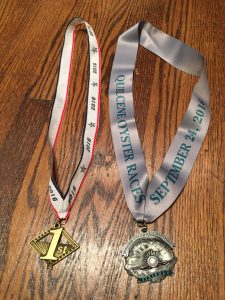 Was it the feel of the heavy medal on my sweaty chest? What made me feel most alive was the soreness of muscles, the labored inhales and exhales, that lifted my ribs as I lay on the cool quilt of our cottage an hour later. That is the pushed-to-the-limit soreness that rejuvenates, as in “makes young again.” Did I become a new person, thus far only fantasized? No, I became more of the same person, one competitive woman whose challenger is not the fifty-six –year-old running behind, but myself. After seventy I was getting to know me.
 Next best thing to a time machine is the memory of others who knew us way back when . . . A few years ago I met up with two high school friends I had not seen in years. They reminisced about how every weekend we would get together at Sally’s house to play pinochle, drink coke and smoke cigarettes. I remembered that too. What I didn’t remember was their recollection that as soon as the hour got rather late, I would stand up, say I had to go home to wash my hair, and leave. They laughed heartily at that memory. Now I don’t doubt its truth. What I am learning about myself, looking back as best I can through the smoky telescope, is that I likely had ADHD all my young life, long before anyone named the condition. Result? A nervous brat who couldn’t or wouldn’t sit still at any activity for any time. Stories help us remember what we did, but not who we are. The stories are useful in helping us understand with our own loving acceptance who we are and maybe who we were.
 Writing connects people. Certainly, it tells when we have arrived. Think of 19th century Poles, Italians, Irish immigrants, who lined the ocean docks where they waved a permanent farewell to families. From the departing whistle until their final days, I like to imagine the divided families connecting by letters. Stories once told by the hearth would spin themselves in correspondence– long narratives that included incidents lived over weeks and months. Perhaps the newly arrived immigrant sits at a small desk, faintly lit by gas light. He or she has saved the early evening after a long day of labor, to describe poetically a new landscape, from sky scrapers to tenements. Or if the immigration ended in the Midwest, miles of prairie grass as if the world were flat. As the writer continues with pictures and stories, a voice within speaks up reminding the writer of feelings, longings, comparisons between the homeland and the adopted one. By the letter’s end, the epistle looks only vaguely familiar to what the writer intended to say. The reason? Writing is a process, not a product. It is the process of thought. In the process of writing, we learn what it is we have to say. Consequently, writing not only connects between people, it also connects to the cognitive and emotional life within us. Much like wading into an incoming tide, the process of writing may begin in the shallows, but as words flow in, before we know it, we are swimming among ideas we didn’t know we had.
 Most of us are old enough to have generations of material. A week away from Christmas, I offered the prompt to generate our writing. I selected phrases from several Christmas carols, copying them on red and green slips of paper. The writers chose as many as they wished to initiate thought, or to incorporate somewhere along the way. Nina chose “Oh Holy Night,” and she was off, recalling her 10th year, when prior to Christmas, she and her father walked hand-in-hand five freezing blocks to an evening of Christmas music at the University Christian Church. In the process of writing, she recalled, and so brought to us, her chapped shins where her snow boots rubbed, and the feel of her father’s comforting hand surrounding hers. Nina filled with pride in being the only sibling who had her father all to herself. After reading aloud, Nina leaned back in her chair as if she needed a certain distance to see where her writing had taken her. “Oh my,” she gasped, “I don’t know where that came from. I haven’t thought about that night in over fifty years.” Nina had connected with the child within her, had resurrected a father long dead whom she still loved. In the process of writing, she connected with her inner self. She also connected with us, planting her story in our memory. We regular attendees of the writing group, intimately know our fellow writers, because we carry their stories within us.
 John is writing his memoir, each week his episodes carrying us to a small Michigan town where his grandfather was pastor of a humble church. John, himself a graduate of seminary, reads his work aloud as if it were a sermon. His resonant voice echoes in our meeting room. He affects his grandfather’s voice in one register, and his grandmother in another. We all feel we have visited Charlevoix, could find our way from the fishing camp to the church.
 Not all writing is sent to an audience. One might wonder why anyone should write, lacking intentions to publish. There comes the journal and its audience of one. Two years ago, with Lent approaching, I thought about what I might give up for 40 days. Realizing giving up might be less worshipful than taking on, I decided for Lent I would write a Gratitude Journal, 40 days of contemplating something for which I am grateful. Each day surprised me with another positive gift, my enhanced outlook on life. Articulating my gratitude made me feel good. I wonder how I would feel had I committed to 40 days of complaints. This past Lent, I decided again to write at least a page a day, but without the theme of gratitude. Rarely do I go back to read what I have written, but the seeds are planted in my journal for flowers I will gather in later written discourse.

