Where The Seed Drops

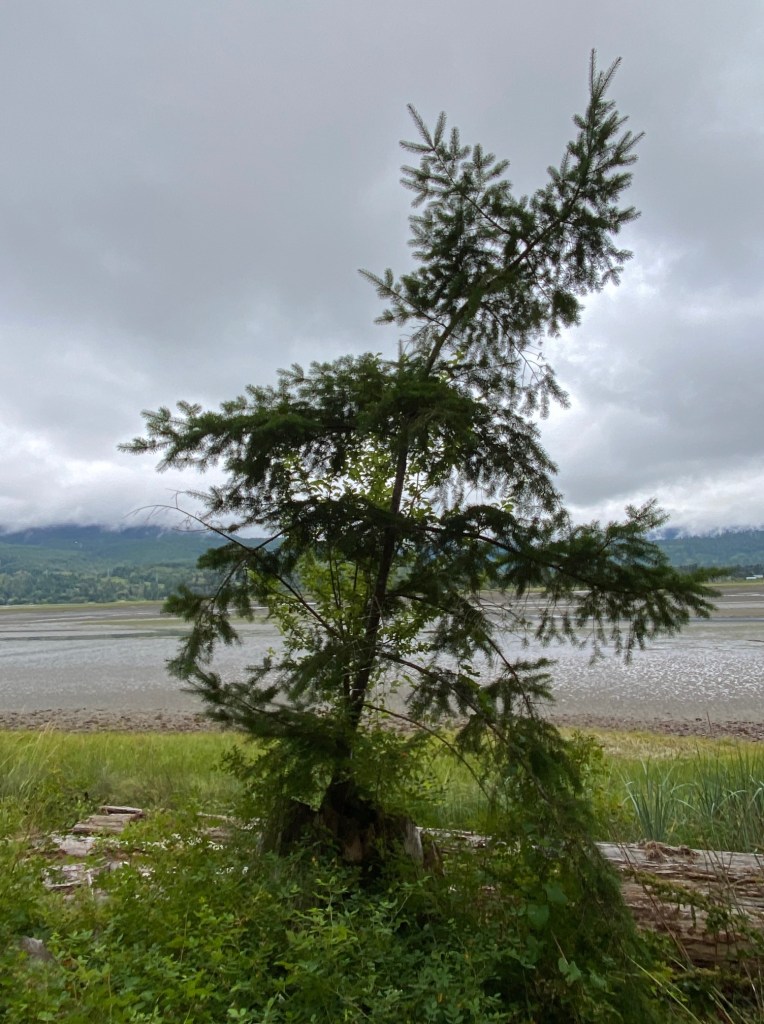
            Smack dab in the center of the south beach of our Quilcene home, a Douglas Fir is growing from a rotting stump logged before the property was ours.  A skinny thing at first, it leaned northward as the common winds come from the south.  It looked frail and pathetic, something we could have easily pulled out so it didn’t block our view of the bay at low or high tide and Mt. Walker across the water.  We didn’t remove it.  Rather, over the years, as we sit together on the south beach bench during our daily pre-breakfast stroll, we watch the fir lean and lean, no sign of a majestic fir like others up the hill behind us.

            “I wonder how it got started,” I mused. 

“That’s where the seed dropped,” my husband replied. 

            I live my life in a sea of metaphor, having poetically embodied squirrels and birds, so why not a tree struggling to grow, leaning by force of the wind? 

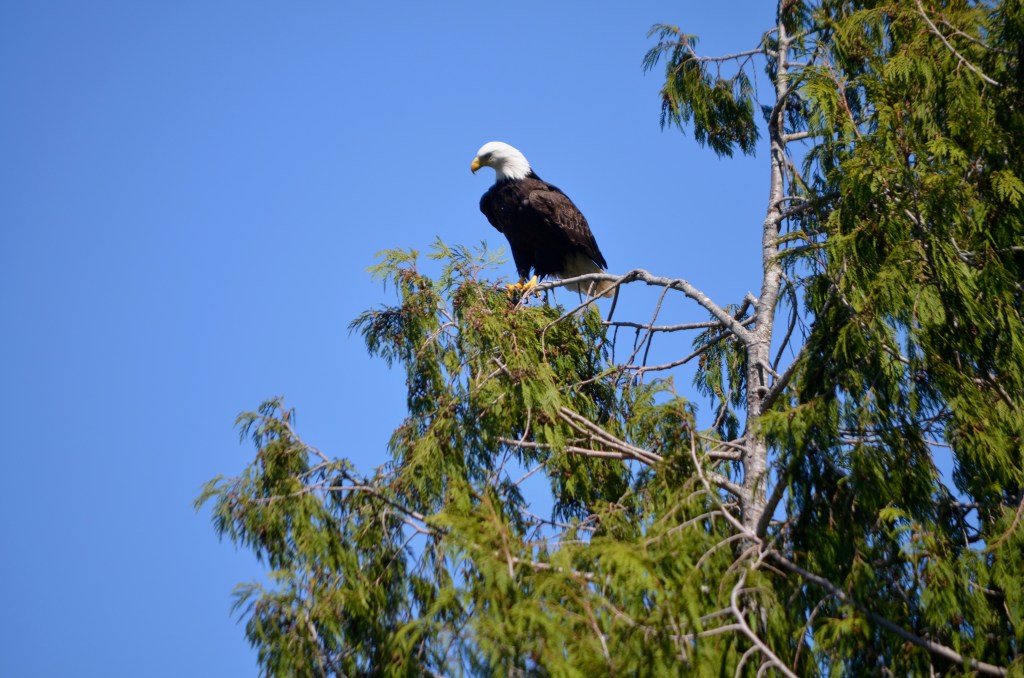
            At my age, long retired from daily employment, I find myself looking back at where my seed dropped, how I grew and what natural forces made that growth easy or challenging at different times along the way.  You see, if you look carefully at the photo on the start of this piece, you will note that the tree is no longer bending completely over.  In fact, it seems to be straightening. It is standing up against the winds

            Regardless of our age, all of us have moments to wonder how we chanced upon the Earth.  We like to think we were the long-awaited child of hopeful parents.  Some of us were.  Some of us were “accidents.”  But beyond the physiology of birth, there is something miraculous, perhaps full of chance that we were born in a particular time, place, and country. Taking a moment to recognize the coincidence of our seed dropping at a good place, can lead to empathy with those whose opportunities were less fortunate.  One of our favorite songs sung by Joan Baez is There But for Fortune Goes You and I. You can watch Joan Baez sing it on this You-Tube video (skip the advertisements that precede it): https://youtu.be/b6omDSxTCXE?si=rw1CO73kc-BnXc7j

 Each verse imagines a person whose life started out with hope but ended in despair.  The last stanza enlarges the image to nations:

Show me the country where bombs had to fall,
Show me the ruins of buildings once so tall,
And I’ll show you a young land with so many reasons why
There but for fortune, go you or go I you and I.
You and I,
There but for fortune, go you or go I you and I.

            An entire lifetime grows from a combination of nutrients, opportunity and the Grace of God.  Did our seed drop on fertile soil?  I relish one of Loyce Ong’udi’s frequent sayings about the people of her small village in Kenya.  “There is no lack of ability,” she explains.  “What is lacking is opportunity.” In a week I leave for Iona, Scotland with a group of friends from my church. Considered a pilgrimage to a source of Celtic Christianity, the group seeks spiritual awareness in a “thin space.” Travel is often thought of as a chance to reach outward. I would like to think perhaps each journey can be within ourselves to reflect on how we have endured and/or thrived from a chance seedling. 

Last week an appointment directed me to the Wallingford neighborhood. While there, I decided to see if the little house remained.  It was a mother-in-law, two-room cottage owned by a couple in the neighboring bungalow. My marriage having failed, and expecting a child, I had to leave my teaching position in Wisconsin and return to Seattle to give birth, to finish my 5th year at the UW for a permanent Washington teaching certificate and to find a new job. Not wanting to overstay my time with my parents, I rented that small house.  The little place looks just the same.  It felt good to stand outside my car and think back fifty-seven years. I was twenty-six years old, strongly confident, full of hope and joyful bringing my daughter into this house, into this world. It would be several months before I secured another teaching position, a new home for me and my daughter. Nonetheless, I cannot recall every feeling helpless.

            Noting that the Doug Fir was no longer leaning so far over, but straightening and even adding a new branch, I asked my husband, “How do you account for that?” 

“Easy,” he replied.  “It is reaching for the sun.”

            Together we walked over for a closer look.  There behind the Doug Fir is a wild cherry tree sharing the same stump.  Will they make it together?  Somehow that Fir looks less lonely.
Pine Trees or Politicians

Certain phrases stick with me like burrs to my clothing when walking through a grassy field.  No sense in trying to brush them off; besides, to do so I may discard something of value, that in the right surroundings could save my life.  This week’s sticky burr of a quotation comes from John Philip Newell’s Sacred Earth Sacred Soul,  in which he covers a chronology of Celtic Christianity with short biographies of theologians as far back as the 4th century who lived a Celtic spirituality. 

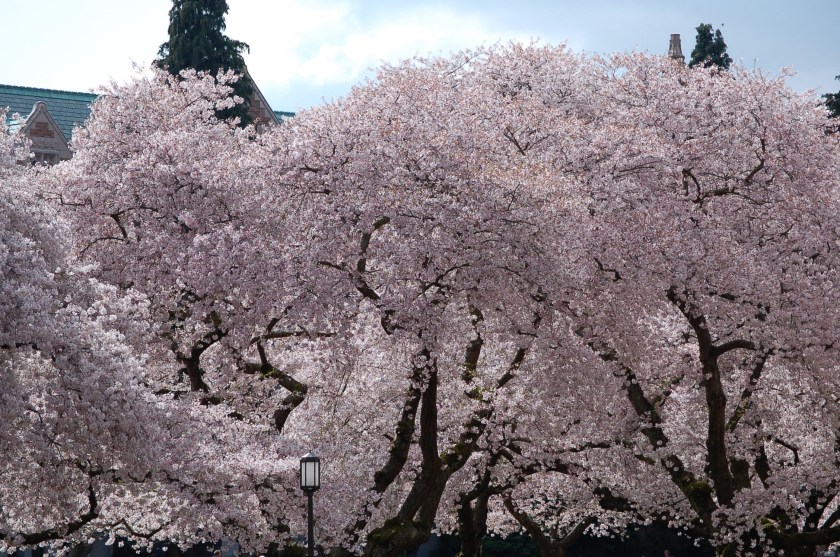
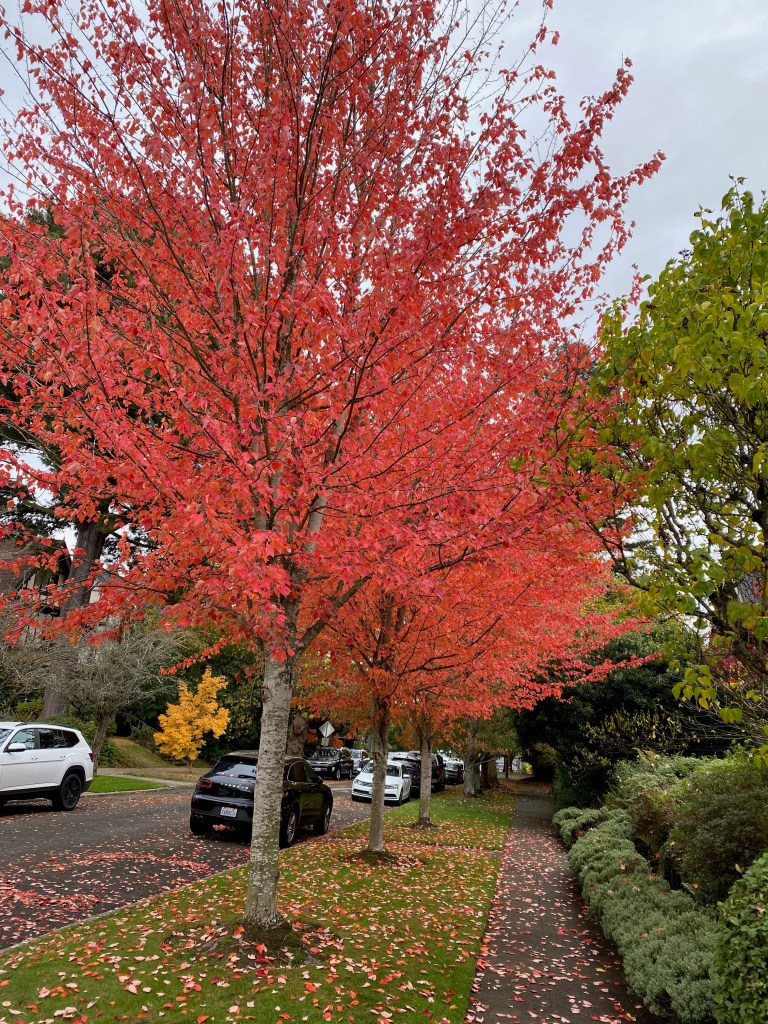
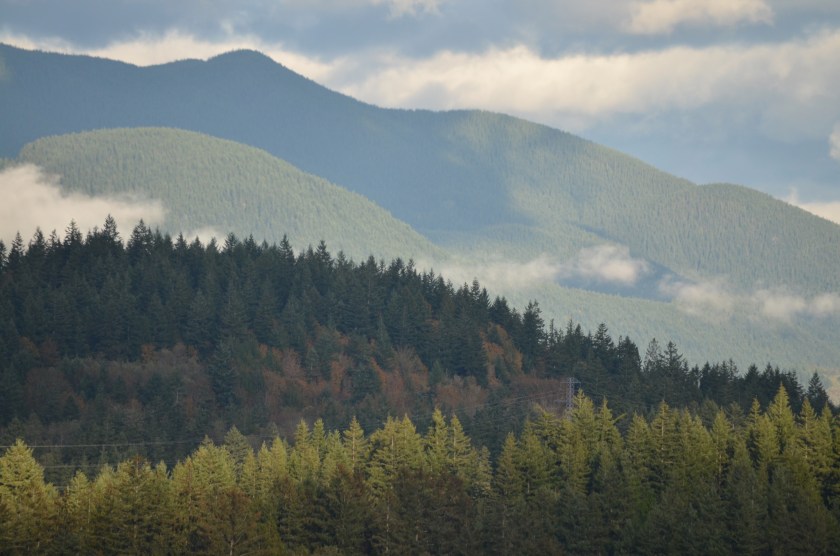
Perhaps the phrase stuck for its alliteration – easy to hear those “p’s” skipping from my lips as I juxtapose pines and politicians.  Nonetheless, White’s phrase stays with me.  I want to consider my relationship to Nature and Politicians.  How do I start my days?  I often turn on NPR for the morning news and commentary that is 99% depressing.  I hear voices of politicians in their most recent declarations of intention. Their words are consistent with whatever feeds their ambition.  There is no plot to follow.  I could skip listening to Morning Edition for a year, then return to it a year later to discover I had not missed a thing in the tenor of our time.  Rather like a bad soap opera.  For variety, I could switch to another newsfeed, perhaps not aligned to my feelings about the state of the world, not to mention the condition of our country.  But would any of these broadcasts enhance my life?  Would their negativity call me to action?  Would I come to a fuller understanding of my purpose on the planet?  Ironically, I am often listening to Morning Edition on my walks at dawn from my house down to and around the U of W campus, a six-mile morning walk under old established trees in old established neighborhoods: blossoming cherry trees in April, vermillion maples in autumn, tall proud pines and cedars all year long.

Now here comes Scottish poet, Kenneth White suggesting I might join him in listening to the trees rather than the politicians.  How do I listen to the trees? The cherry blossoms are speaking beauty and rebirth.  The autumnal maples and sweet gums recite their own poetry.  Poet Gerard Manly Hopkins evokes images of trees in fall and mourns the imminent death of summer “Margaret are you grieving “ over Goldengrove unleaving? … worlds of wanwood leafmeal lie.” Then winter arrives and Robert Frost reminds us “The woods are lovely, dark and deep.”  Surely the poets help me listen to the trees.  Yet even without the writers, if I block out cars and pedestrians passing by, and if I concentrate, I hear the trees.  Their leaves whisper in summer breezes.  Occasionally, such as this very dry summer, the trees crack and snap, discarding a branch that lands on the sidewalk. These are city images.  Now if I take myself to the woods, I remember recent books I read about trees, teaching that there is a conversation between alders and the firs, one fast growing and nutritious to the welfare of the other.  Is that alder speaking to the fir?  I guess it depends on how we define language.

And if we can listen to the trees, especially hearing their needs for water and space and clean air, can the trees hear us?  Although we don’t share the same language, we are all living things.  Life communicates.  When my husband and I began to restore a clear-cut lot we purchased after the owners sold the trees and evacuated their property, we decided on a variety of trees, some 20 -foot Douglas Firs purchased from neighbors across the road, and some small fruit trees for a space left vacant when the previous owners disposed of their cabin. One pear tree initially grew fast and tall, but its pears did not thrive.  Insect-infested and hard, the few pears on gnarled branches fell to the ground where deer consumed them before we had a chance.  Every time my husband and I walked by the pear tree, he said, “That tree looks bad.  It really has to go.”  So how would you feel if every time someone passed you, these were the descriptive words for you?  You would want to die, right?  And of course, the pear tree died.  Not wanting to accuse my husband of projecting a death wish on the tree, I nonetheless registered the lesson.  Years later, I desired a Katsura tree, for there are several in Seattle where I walk.  In autumn the pink leaves wave a fragrance I associate with the sweet smell of cotton candy.  From the moment we planted it, I have welcomed that Katsura tree almost every day.  I tell it how lovely and thriving it is, even though a workman backed his tractor into the trunk last year, leaving a two-foot scrape on the trunk.  “Good morning, Katsura.  I am so glad you are here.  Looking forward to your autumnal fragrance.”  It is now almost twenty-five feet, its leaves fluttering in the dappled sunlight, even though nearby cedars consume a great deal of available light.

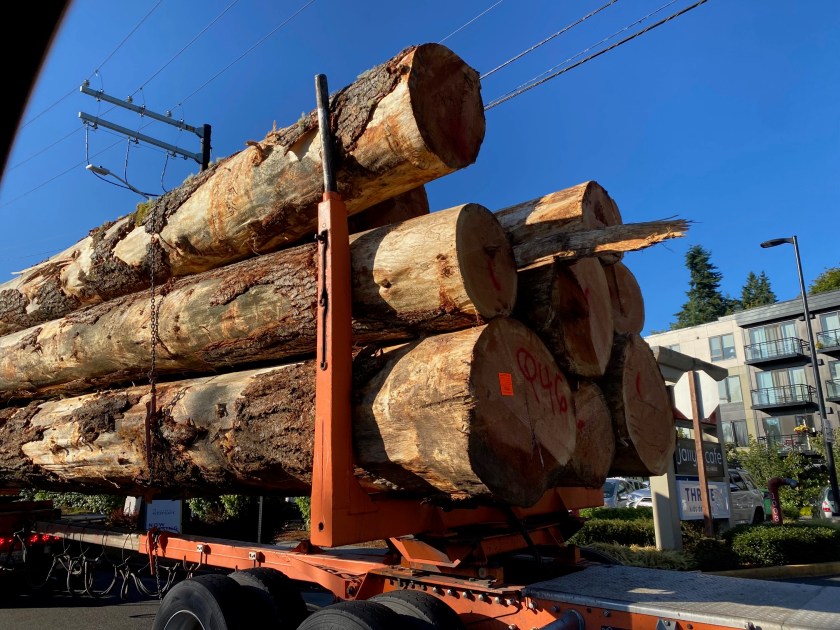
On the way back to Seattle Monday morning, three gigantic logging trucks rolled on to the ferry ahead of us.  Their beds were piled with logs about five feet in diameter and perhaps fifty feet or more in length.  These were not the usual harvest of tree farms.  Rather they looked like the established trees from the National Olympic Forest.  I recall Donald Trump’s call for opening-up national forests to loggers.  I can imagine what birds and animals would say in response. But what about the trees?  Is any politician listening to the pines?

WITHOUT

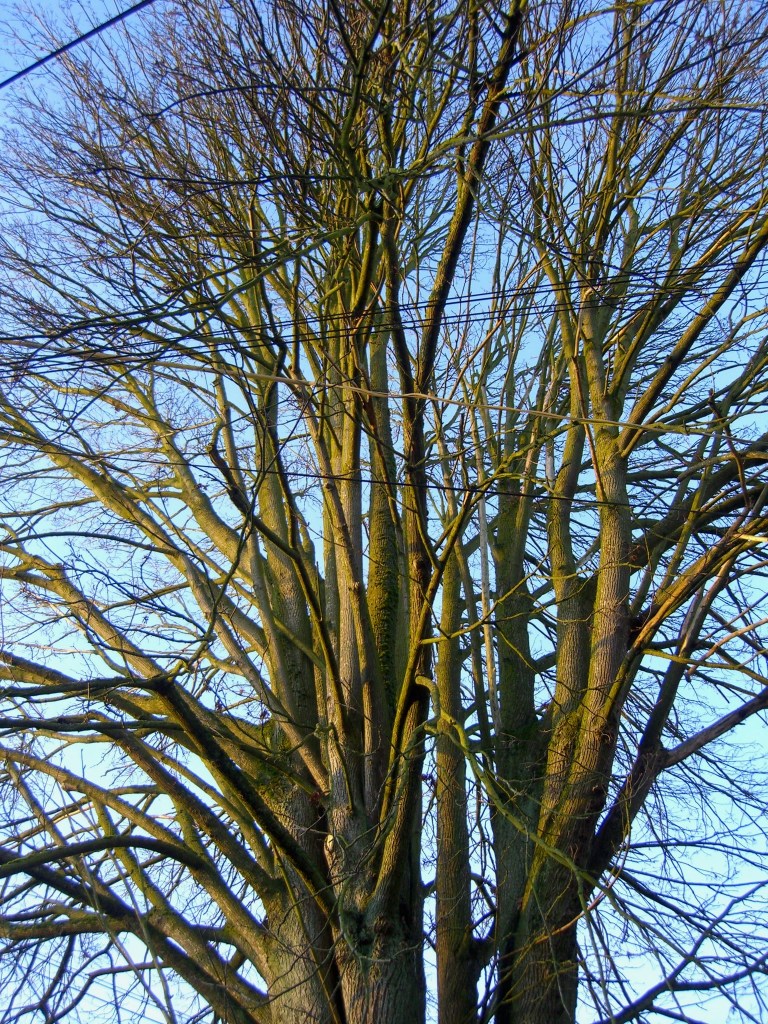
Walking in January, I praise what is absent.  Usually lined with sweet gum trees — a canopy of broad green leaves in summer, large golden leaves in autumn–in January not a stubborn leaf remains on a tree.   It is as if this part of Capitol Hill did a thorough house cleaning, stripping each tree, but for the brownish gray branches.  They reach outwards and upwards, a tangle of geometric limbs, reminding me of Nature’s architecture.  Each limb seems to have purpose as a balance for another on the other side, or an extension from which thinner branches reach out like tendrils to the sun.  Rather than admire a shower of leaves, I note the rounded burls up the trunk, like moss-covered hats.  Thick moss paints itself between heavy limbs that decided to make their own way from a massive trunk.  On this twenty-seven-degree day, surely insects must snuggle in the soft moss.  Grateful for the absence of leaves, I see high in some trees, baskets of crazily assembled twigs and grasses.  Perhaps they are nests for squirrels cleverly camouflaged in other seasons, but out there now vulnerable to winter’s wind.

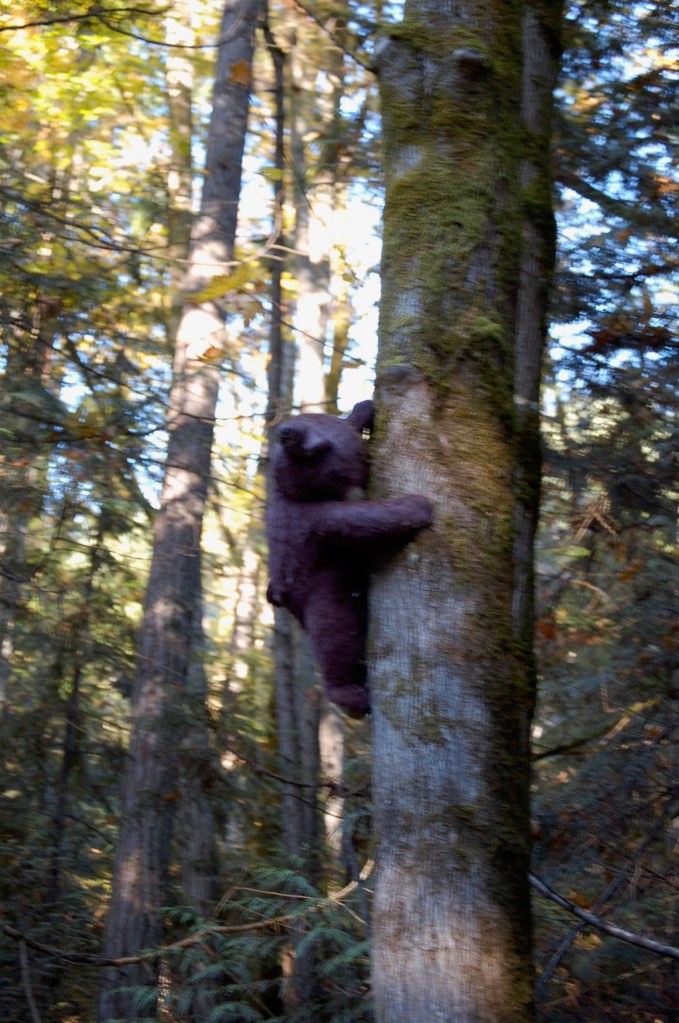
In the absence of abundance, I look for things to note, as if I were in a museum where the major exhibition is closed, and so I take time to view a few treasures I had ignored on other visits.  Last week, a wooded walk on Hood Canal revealed a giant stuffed bear attached to a tree. This morning, it is the angle of the sun on my neighbor’s door.  Although the solstice has passed, and each day may be a bit longer, it is as if the sun barely creeps over the horizon, casting long shadows even at 11:00 AM.  Today the light captured my neighbor’s front door where a Christmas wreath still hangs, a deep black-green circle with a velvet red bow.  Shadows from surrounding leafless trees dance around the wreath.

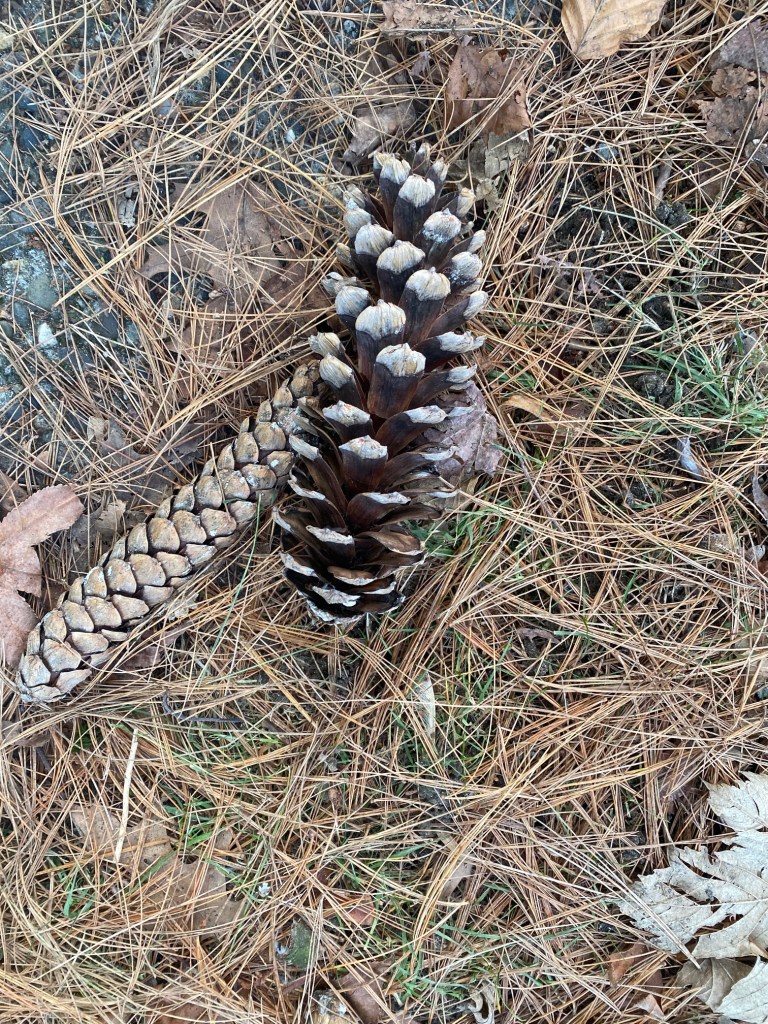
Granted this is a sunny day, uncommon in the Pacific Northwest winter, so sun and shadows grab my attention.  But rain or shine, there is interesting stuff dropped on parking strips and sidewalks.  A gigantic pine tree on the corner drops pinecones as large as ten inches long and three inches wide.  They lie atop a bed of thin dry needles.  Surely they would be a treasure if I imagined a creative use for them.  A friend celebrated Christmas by gathering large cones and stuffing them with suet and peanut butter, then hanging the cones around a park adjacent to her home.  She said her project was her gift to the many birds that winter-over in the woods. 

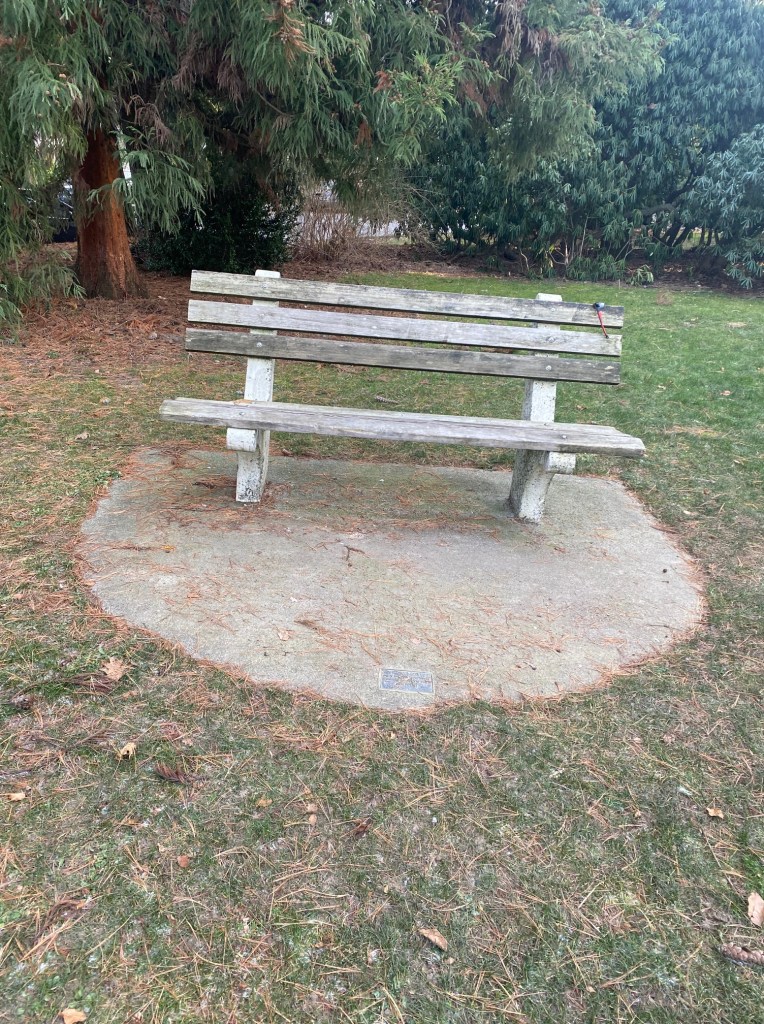
Walking through Volunteer Park, I note park benches and picnic tables without people enjoying them.  In summer they would be full.  There is something poignant about an empty park bench.  Is it waiting to be occupied?  Does it hold a memory of a couple resting there in June, holding hands, planning their future together?  And the playground, too cold for children today.  Iron poles chill a child’s hands.  I recall those warnings we shared in childhood about not putting your tongue on a frozen iron pole, then daring a kid to do it, but fearing consequences if the child accepts the dare.  The playground also remains in Waiting mode. 

Perhaps it is waiting that defines January.  There is no definitive Christmas on the horizon.  Even spring is far off, so waiting becomes waiting for what?  Yesterday my mailbox had three seed catalogs, each with a colorful cover of abundance:  golden carrots, blushing tomatoes, leafy lettuce.  If I fill out the order sheet, will my garden be ready any sooner? In my backyard,  I walk past raised beds where today skeletons of  tomato and pepper plants droop, bowing in submission to the freeze.  There too, a kind of beauty in the plants without fruit.  

At noon, I took a walk with my grandson to have a good, long visit before he returns to New York after his semester break.  As we walked along Prospect Street, an historic avenue of old Seattle wealth and mature maples, I shared with him my attraction to leafless trees. “Sure, Nana,” he agreed.  I have a leafless tree outside my New York apartment.  I love it in November when the last leaves drop.  Inside, I have more light.”  That’s it!  In a month when daylight only lasts seven or eight hours at best, we can feel as if we are deprived.  Yet a tree’s bare branches let the light shine through.