Fast Cars and Fast Women


CIMG3598.JPG


“Do you want to read the draft of my new blog post?” I ask my husband before his first sip of morning coffee.

“What’s it about?”

“Preparing for loss.”

He rolls his eyes, (his reluctant “Ok”) revealing he has no interest, but will acquiesce for marital harmony.

He twists the espresso arm in place. “Why don’t you write about fast cars and fast women?”

He doesn’t have to say that “loss” is depressing, and why would anyone want to read about something depressing?

My gut rejects “fast women.” After all, it is MY blog, where I would have no inclination to write about a guy’s interpretation of what makes a woman “fast.” I inform him that I named my blog domain thouightsafterseventy.com.  People over seventy think about loss and death and stuff.  He need not remind me that he too is over seventy, but he would rather think about fast cars and fast women.

I am feisty enough to take his suggestion as a gauntlet thrown down. I decide to write about “fast cars and fast women” for those of us over seventy.

https---specials-images.forbesimg.com-imageserve-f12c4c4d3aea44dd998f7d2d036f5b9f-960x0.jpg?fit=scaleAnd none too soon.  Driving back to Seattle later that morning, we spot a sleek, futuristic car speeding past us on I-5.  Its silver lines are like a heron in flight.  Sharp and angular, the chassis is mostly sculpted metal for aerodynamics, with only a small bubble for driver and passenger.  As it speeds by our 1997 Toyota, I note a New York State license plate.

“What kind of car is that?” I ask my husband

“A McLaren,” he tells me.  “Very rare.  Super expensive.”

“Not much room for passengers.”   I am critiquing it as if anyone might find the car useful.

“Probably some young, rich, techy guy with money to burn,” he says.

The lane that holds the sexy McLaren slows, so we are now side by side.  We strain our necks to spot the fast, rich dude.

The driver has blonde hair, falling to her shoulders, an attractive woman about thirty years old, her chin raised confidently to see over the steering wheel.

“Fast car.  Fast woman.”  I tease my husband.

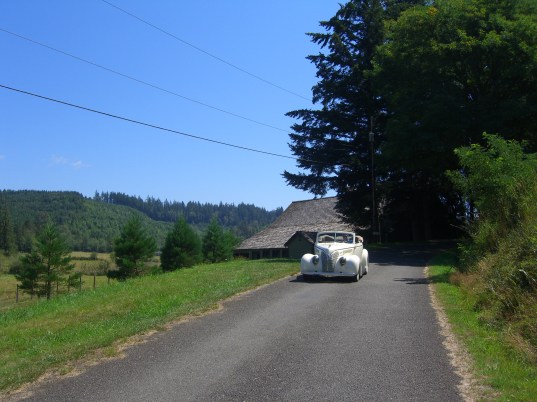
If once we sought out fast cars and fast women, do our tastes change substantially fifty years out from our youth?  Clearly my husband maintains his interest in cars.  Two of his most cherished: a stock 1951 Chevy truck and a rebuilt 1938 Ford Club Cabriolet.  DSCN0897.JPGWe keep both automobiles at our Hood Canal cottage, driving them only on sunny days, a rarity except for summer months.  He also pauses the T.V. remote on the car auction sites when channel surfing for a program we might both enjoy.  As for fast women, I can’t say.  I snagged him pretty early on, and he was a shy guy who found me interesting enough to ask me to a movie.
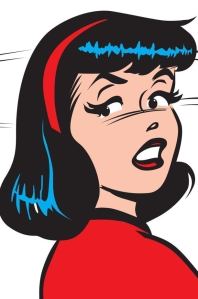
As I pass from one year after seventy to another, I often tell friends that no matter how old I am, I am always 16 inside.  When I was sixteen I was a string bean, 100 pounds, in a time when Marilyn Monroe’s curves graced gas station calendars.  My brother joked I was so skinny that if I stood sideways in class I would be marked absent.  Nonetheless, I wanted to be a fast woman.  I struck up friendships with girls who looked like Veronica in the Archie comic books.  original-grid-image-10351-1487214506-7Marsha, for example, had that same silky black hair that cascaded in a rakish wave over her left eye.  She rolled her shoulder length hair in wide curlers that she slept on all night.  I did the same, waking in the morning, my cheeks branded with curler rounds, having slept fitfully on the plastic rings that were held in place by stiff internal brushes.   I also learned how to smoke, tapping out a Pall Mall Thins from Marsha’s pack that she kept in her plastic purse.  Those were the sacrifices needed to be a fast woman.  I could only dream that the good-looking guys would look at me the way they looked at Marsha.
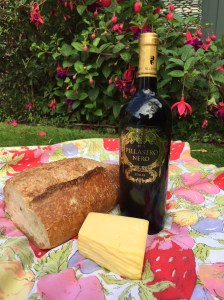
Sometime between our twenties and where we have landed, we give up pursuing those adolescent fantasies, but I don’t think fantasies disappear.  When I was forty and in the second year of psychotherapy, Dr. Phillips asked me about my fantasies. That was after bemoaning conflicts with my teenage daughter and emotional distance from my husband.  I was teaching high school full time, and feeling a failure as wife and mother.   Every minute of my life filled with Must Do’s.

“Well, I do have one,” I told my good doctor.  He encouraged me on.  “I am sitting by a slow-moving river on a warm spring day. I have spread out a picnic cloth on which there is a glass, a bottle of good French wine, a loaf of French bread, a wedge of brie, and a great novel.  I have all day to stay there if I want.”IMG_6454

“That’s it?” he asked, stifling a yawn.  “You know some people fantasize about sex or even murder.  Even doing away with their defiant children”

I shrieked in opposition.

“There is no right nor wrong to having fantasies,” he explained.  “It is acting on them that gets people in trouble.”

Now we are in the midst of the #METOO movement where hundreds of women are stepping forward to indict men who tried to actualize their fantasies.  If wisdom comes with maturity, here might be the lesson.  Hold tight to your fantasies. but keep your zipper zipped.

It is good that finally there is a public platform to expose eons of sexual abuse against women.  Men are becoming more sensitive about what they say or do around women so their friendliness is not misinterpreted.  I wonder how caution affects their fantasies.  We are all sexual beings, even if the libido takes a nap after sixty. I cringed when my husband suggested I write about “fast cars and fast women,” for I considered his words most inappropriate for this #METOO time, but I appreciate his freedom to express his fantasies. MV5BMjg4MmZiYTAtYzRkNy00OWE2LTlmMWItZGFkZmQzM2VkMDJhXkEyXkFqcGdeQXVyODc1NDEwNzQ@._V1_UX99_CR0,0,99,99_AL_ Besides, the night before, we stayed up late to watch an old Paul Newman movie, The Young Philadelphians.  I can never get enough of Paul Newman with his shirt off. It has been years since I relinquished any fantasy that Paul would leave Joanne Woodward for me.  Today I cherish my husband’s stride with a noticeable limp from his basketball years, while I still remember the muscles in his thighs when he leapt for his famous hook shot.
 

Rehearsing Loss


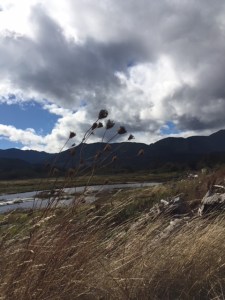
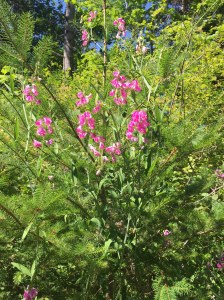
IMG_6335            A flowering vine blooms along East Quilcene Road.  Its lavender blossoms are bubbles, like sweet peas, so I have called them wild sweet peas, until my neighbor recently shocked me, identifying the vine as vetch.  Walking up the road Sunday afternoon, I saw a long, flowering vetch vine winding itself like a garland around a young pine tree.  The vine used the tree as a support for its growth, an attractive decoration.
I had been thinking on my solitary walk, about a recent email from a friend in Connecticut.  She wrote how she is supporting a friend who recently lost her husband.  Her friend’s loss made her fear how she herself would continue on, were her lover of over forty years to die.  Because they have never lived together, she might not know he had died, only that he would no longer call.  Where would she find support to proceed with her life without him?

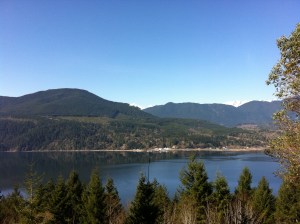
As I continued up the hill that hugs the shoreline of Quilcene Bay, I practiced what I would say to her.  It occurred to me that her imagination and her email to me were like rehearsals for inevitable loss.  I could reply, “Live in the present.”  But no one completely lives in the fleeting moment.  We prepare for our futures from the time we realize there will be a tomorrow.  After seventy, the tomorrow holds loss.  When the Seattle Times Obituary column starts to look like our high school annual, the future looms, and it is not one where we are preparing for college.

_DSC2574.JPG

Here is how we prepare.  We call our lawyers and make wills.  As we walk through our homes, we look with critical eyes at the stuff we have collected over the years: paintings and pottery, furniture willed from our own parents – settees and rockers we have not used in recent memory.  Thinking kindly of the ones who will have to deal with it all someday, we may begin to give things away.  My own mother taped our names on the bottoms of silver tea services. Somehow this disposition of accumulated stuff is not the most important loss for which we must prepare.  The most frightening for some of us may be to lose a life-partner,  a likely reality.  In my mind, I imagine living alone.  “ I lived as a single woman the first thirty years of my life — I can do it again,” I console myself, knowing that I will not be the same young single woman.  With this practice in mind, envisioning my single self, I walk on to the crest of the hill and watch the easy, returning tide on the bay.

IMG_0457

What we do not rehearse are the out-of-order losses, such as the death of a child.  Last week, a friend whose daughter died of cancer this year, shared with our church group some experiences she found comforting.  People have been coming to her to tell her things about her daughter she had not known.  They tell her stories about her daughter’s teaching, and how it had made a difference in the life of their own child.  Another had a funny story in which her daughter played a humorous role.  Instead of maintaining what they might assume would be respectful silence about the lost one, these people comforted the mother by bringing her lost daughter to life in a new way.  It is almost as if the stories rejuvenated both mother and daughter.  As her daughter succumbed to cancer, my friend may have struggled to imagine how her own life would continue without her daughter’s presence, a very short time to practice loss.  Now that she walks through the loss, she accepts surprising and unimagined support from others.

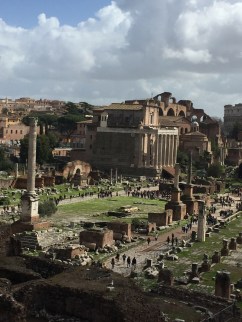
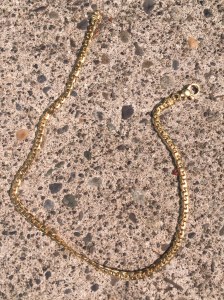
Will the loss of material things help prepare us for the loss of life?  Recently I lost a gold chain necklace somewhere on the cobblestones of Rome.  It was my favorite jewelry that I wore almost daily and perhaps had not secured properly.  I was in Rome with my granddaughter.  IMG_5249Greta and I had our own cozy VRBO apartment and had just settled in for our first night to adjust to jet lag, when I realized my necklace was no longer around my neck.  We both scoured the apartment to no avail.  I did not want to dampen the holiday by laying my grief on my granddaughter.  I made light of it all until she had fallen asleep.  Then I texted my husband back in Seattle, wailing in cyberspace about the loss, how I had loved that necklace he had given me for an anniversary gift.  I may even have asked his forgiveness for being so careless in fixing the clasp.  His response?  “Is that all, Mary?  Look now, you still have Greta.”  There he was again, my support in an unimagined way.
Just as the lavender vetch intuited the supporting tree, so we too may find a way to continue growth through the grieving season.  A life teaching and writing poetry supports me, for there is rarely an experience that does not call up a poem that holds me.  Here is a villanelle by Elizabeth Bishop.

IMG_6392

One Art

The art of losing isn’t hard to master;

so many things seem filled with the intent

to be lost that their loss is no disaster.

Lose something every day. Accept the fluster

of lost door keys, the hour badly spent.

The art of losing isn’t hard to master.

Then practice losing farther, losing faster:

places, and names, and where it was you meant

to travel. None of these will bring disaster.

I lost my mother’s watch. And look! my last, or

next-to-last, of three loved houses went.

The art of losing isn’t hard to master.

I lost two cities, lovely ones. And, vaster,

some realms I owned, two rivers, a continent.

I miss them, but it wasn’t a disaster.

—Even losing you (the joking voice, a gesture

I love) I shan’t have lied. It’s evident

the art of losing’s not too hard to master

though it may look like (Write it!) like disaster.

Elizabeth Bishop

From Elizabeth Bishop The Complete Poems (1926-1979).  Copyright 1979, 1983 by Alice Helen Methfessel. (Farrar, Straus and Giroux, 1983)


Interdependence Day

                                                       Interdependence Day

DSC_1692.JPG

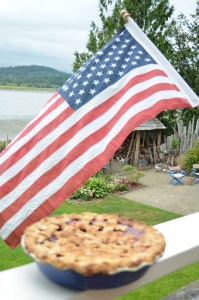
              Ashes settle on Quilcene Bay, acrid gunpowder seeping through the bedroom screens where our two cats huddle in terror under the bed:  Independence Day.  Few people call July 4th “Independence Day,” preferring. “The Fourth of July,” a fiery celebration, rather than a recognition of a significant event in our nation’s birth. It has become the night when all are free and independent to explode whatever they have purchased, usually at discount stands in a nearby Native American reservation, (irony intended).   It appears that Independence has morphed into “my privilege to declare my freedom with explosives.”

            Could we take the notion of Independence back to the birth of the nation?  From whom did the colonists want to be independent? The despotic King of England. Did the colonists want to cut off trade in tobacco and tea?  Of course not.  The colonists were dependent on trade.  Was the revolution waged as an Independent battle?  That is, did Massachusetts ever think of going it alone?  Not in a thumping heartbeat.  The colonies depended on each other to keep the stars overhead of one as well as the other, until they wove a common galaxy in the new United States flag.

            I love the evolution of language, — how “nice” in Shakespeare’s time meant silly, and now connotes kindness.  So, what about Independence in 2018 America?  The current president is off to Make America Great again.  In his mind, that means Independent of commitments to stand side-by-side with countries that have lain their young on battlefields years before we acknowledged that Germany or Japan may be dominating the planet. Have we ever acknowledged our dependence on England or France? Rather, our country has cast ourselves as the great liberators, the Independent nation on whom the rest of the Free World depends.

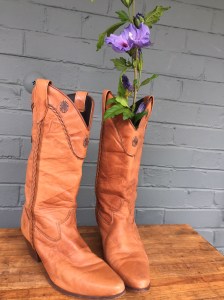
 IMG_6315For many, Independence has come to suggest self-sufficiency.  How many men (yes, it is more of a male thing) have boasted that they “pulled themselves up by their own bootstraps?” My love for figures of speech intrigues me to imagine some dude leaning over his cowboy boots and tugging on those side-leather extensions until he becomes entirely erect, feet shoved into the narrow toes, head shoved high into a ten-gallon hat.  Under that hat he has not imagined the person who made the boots, or even the parents who, at the very least, fed him for his early years, and likely purchased the first boots for his tiny toes.  No sir, he did “it” all alone, whatever “it” is.
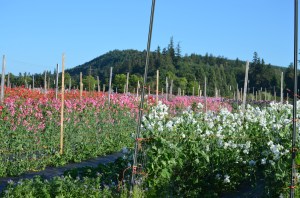
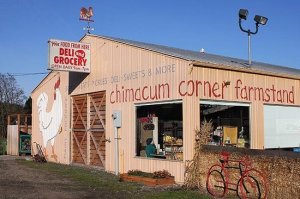
            It is time to assure our pets they are safe to come out.  It is time to trade in Independence Day for Interdependence Day, a time to celebrate how one gift, one gesture of kindness, fulfills another person’s life. The farm-bountiful Chimacum Valley is a testament to Interdependence.  Soil rich, green pastures are watched over by the snow-topped Olympic Mountains.  That valley could have gone the way of flat valleys East of Hood Canal and become a shopping mall. However, the Jefferson County citizens hailed their interdependence with agriculture. The Jefferson County Land Trust, supported by nature-loving citizens, funded small organic farms.DSC_4138

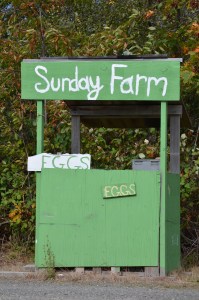
             In an abandoned shed at the crossroads between the town of Chimacum and those farms, citizens chanced a country farm stand, a place where farmers could sell their produce, where citizens could buy fresh food, where young people could find jobs in an employment-depressed community.  For eight years, the farm stand has expanded: fresh eggs, vegetables, plants, ice cream, pastries and bread.  The founders loved the gifted farmers of the area and wanted them to make a good living.  They cared about the youth who needed jobs.  They valued a local economy.  A “local economy” is not the same as an “isolated” economy. chimacum-corner-farmstand To celebrate success, the farm stand owners decided that the week after the 4th of July,  they would declare an Interdependence Day.  Over eight years, the celebration grew too large for the farm stand and its pebbled parking lot.  The party moved over the intersection to Finn River Farm and Cidery, today,  a million dollar business that started because one farm family and the Land Trust figured out a way to acquire land for orchards, and farm buildings for cider tastings and casual dining adjacent to fields along the salmon-running Chimacum creek  — where families could toss horseshoes, or play shuffleboard,  while local musicians tune up their fiddles in what once was a feeding trough for pigs. 
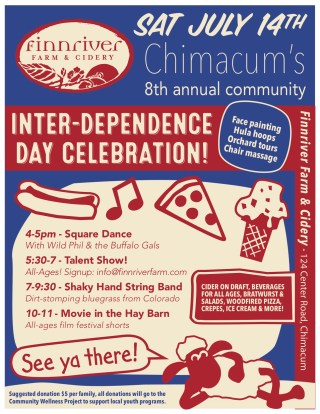
2018 Chimacum Interdependence Day Poster 2

          IMG_5826  Last Saturday, Allan and I sat at a round table we shared with new friends.  We drank cider, ate pizza and watched parents and children line up for the talent show.  Sitting under the late afternoon sun, families and friends applauded as each child stretched to the microphone with a ukulele, harmonica or their own sweet voice.  The audience whistled and clapped.  Children need that applause because they are growing.  They are growing, not by themselves, but with the love and support of that community on which so much depends.
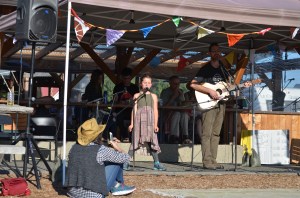
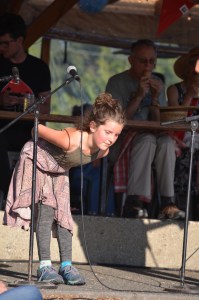
DSC_4130

While my musical nostalgia embraces Frank Sinatra, it is pleasing to imagine Old Blue Eyes stepping up to the Interdependence Day microphone to belt out, not ”My Way,” but “Our Way.” Interdependence Day — a day of music, good food, and connections with others who love life — not to be better than any other community, not to be proudly separate, but to be comforted in our connectedness.

DSC_4131

Vulnerable While Mating


IMG_4159

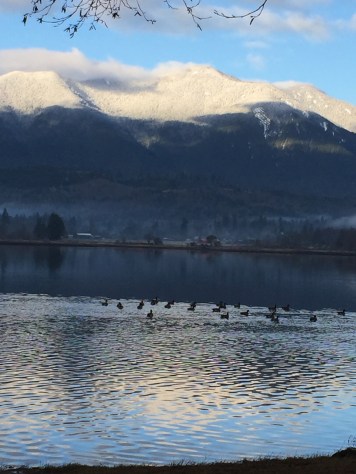
            From the second week in October through the end of January, wildfowl, flying above or riding the wavelets on Quilcene Bay, survive in the grace that falls between shotgun shells.  Mallards, pintail, buffleheads, and Canadian geese, known for pairing for life. Looking to the horizon above the tawny shore grasses and beneath the green and purple foothills of the Olympics, I try hopelessly to count the individuals in a flock, their migrations so wide and long, undulating like a flag in the winter wind.  There are hundreds, although plentitude cannot heal the stab in my heart with each blast that brings one down to the fetching dogs.  In my empathy, each fallen bird may as well be Icarus.  The loss cuts more cruelly in my gut when a goose falls, its life-long mate honking rage in the smoking gunfire.  For over thirty-years I have watched the flocks, as large one year as the year before.  I marvel that they return to the killing fields. IMG_5070 But they do.  Are they that foolish, or are they aware the odds are on their side as they are hundreds strong against a handful of hunters, hovering before dawn in a chilled swampland?
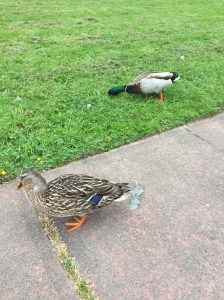
            Hold your breath between the end of hunting season and spring.  Where are the garrisons of courageous birds? In Seattle, they are walking down the center of the Burke Gilman bike trail, not a body of water in sight.  Mallards waddle in courting pairs, as dodging cyclists swerve around them, without a single duck pulling in a pin feather to avoid a crushing death. Oblivious. Completely oblivious, not only to cyclists, but to camera-toting pedestrians. I walk as close as I want to photograph a pair, their muffled quacks indicating more annoyance than fear. IMG_5768 And what comes to mind, is not the under-fire ordeal they may have experienced over a duck hunting winter, but how vulnerable they are when mating.
            Vulnerable when mating.  How true for us all.  I will not be too anthropomorphic about this.  Surely the ducks are following natural urges to reproduce; theirs is not human love.  Yet note how the drake puffs his breast, putting himself between the hen and the bicycle, as if to protect his lover.  Human love is just as vulnerable, with or without reproductive urges.

            Spring is the season of love.  As we leave the shelter of our winter homes, walking out into the first days when the temperature exceeds sixty degrees, we look both ways crossing the street.  Do we look both ways when approached by a potential lover? My twenty-something friend writes to me about her true love visiting from Ireland for a few weeks.  She has longed to see him, but casually mentions he wants to date other women as well as being with her.  I want to scream out “Look both ways!  A truck is barreling down the road and its brakes don’t work.”  I say nothing.

             Our mailbox usually holds a couple of 42138510-greeting-card-with-roses-watercolor-can-be-used-as-invitation-card-for-wedding-birthday-and-other-howedding invitations for the month of June.  We buy a gift, attend the wedding and listen to one more couple swear “’till death do us part.”  Having known divorce from life-experience, I wonder, sitting there in the church pew, “Does the covenant refer to death of the individuals, or death of the marriage?”  Either way, commitment leads to grief.  I bought an anniversary card for my husband last week.  Pictured on the front was a rustic couple in comical attire. Above the picture: “Marriage requires commitment.  But so does insanity.”  Inside, on a cheerier note: “Still crazy about you after all these years.”

            There is no armor to protect us from falling in love, save living a life of not having been loved.  Failing to be embraced may make us amateurs at stepping in to the vulnerable mating mess.  Or perhaps the unloved jump in more eagerly to fill the hole in their hearts.  We find ourselves in love like stepping unwittingly into consumptive quicksand. Any acceptance or rejection of advances will decrease or magnify the love, but won’t prevent it swallowing us like the invasion of the body snatchers.

call-me-by-your-name            Recently I saw the film Call Me By Your Name that depicted the infatuation of a teenage boy with a man about six years his senior.  How much more vulnerable could the boy be than to fall deeply in love with a person of his own gender, a man who would only be with him in the same Italian estate for a summer’s duration?  “Where is this going?” one partner often asks as they couple.  Here was a passionate love that showed no hope of continuing to a life of companionship.  Still, I (and probably lots of others) applauded as the romance intensified, sensuous and consensual.  Does love need a promise of security from heartbreak?  I doubt the young boy could muffle his desire, even if he saw the truck rumbling down the road.  Both partners could have chosen not to act on their love, though I doubt that too.  Passion becomes its own reason for being.  And even though the summer ended, and the older man married, there lingers a celebration as if the boy had an experience like climbing Mt. Everest, something the rest of us can only experience vicariously, looking on with envy.
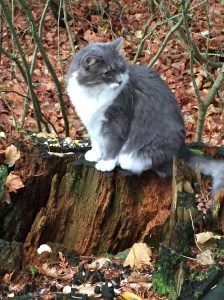
          My condolences to those who are “strong” enough to steer clear of love, even loving IMG_5052a pet. My friend who bonded with her cat for twelve fulfilling years, will not get another, now that beloved Chubby Toes is gone.  “I could never endure the loss again,” she explains, as I try to drop a soft kitten on her front porch.  My friend lives alone.  Surely another cat would offer companionship, but a pet also offers loss, death by vulnerability. 

            Here I go again, I hear those trumpets blow again.
All aglow again, takin’ a chance on love.


It is good that so many classic songs pull their lyrics from love’s risky business. Somehow it makes us one of a huge flock.  We may go by violence, but how much sweeter to be vulnerable to love. 

IMG_6141[1]


Memorial Day

Memorial Day

IMG_6034

The white lilacs intoxicate.

My shears snap off enough to mix

with newly blossomed chives,

plump and purple on their onion stems,

then finish out my sad bouquet

with columbine, resplendent in its grief.


It is a spring walk through the park

to Lake View Cemetery where I go to tell

my parents’ stone of the imminent

death of their first born.

On my path, lilac petals shed

like bread crumbs Hansel and Gretel

dropped to lead them back to home.


“It is good,” I tell my parents’ ghosts,

“you did not live to see your child die.”

I console them

knowing not the wisdom

for how to watch a brother go.


They might be on the lookout,

if our spirits hang around in

the gravitational pull of memory.

They might be on the lookout

for their son.  He will be the one

whose voice is new with love.


What he could not love in life

perhaps in death he’ll find

in the largeness of space

where damages drop like broken

branches from their own weight.

IMG_6150


Growing Memories

CIMG3836.JPG

Throughout his twenty-five year ministry at University Congregational Church, Dr. Dale Turner frequently distributed little cards with pithy sayings to the congregants as they lined up to shake his hand after Sunday service.  Our daughter was eight-years-old, when we stood in line together, I, waiting for the card, she eager for his hug. A sketch of a potted geranium illustrated the 3 X 5 card on which was written: “Bloom Where You’re Planted.”  That Sunday,  there was an additional take-home gift, because Professor Thomas of the UW Forestry Department donated trays of evergreens, each one seeded in a tiny test-tube for planting.  Our daughter clutched hers in her small fist all the way home.  No waiting for lunch.  First, we had to spot the perfect sunlit, but well-watered site in our back yard for her tree, a fir of nameless variety. We named it our Dr. Turner Tree.   Just like our daughter, the tree grew, and grew until we realized we had a fir of Pacific Northwest proportions. The Seattle backyard could not contain its potential. Within four years, we dug up the tree and transplanted it on our wooded Hood Canal property in Quilcene, where it could mature next to its Douglas Fir cousins.  Years have passed;  Dr. Turner retired, and has passed away.  His tree is over 40 feet high, spreading its evergreen limbs over the drive down to our cottage.  I rarely walk past, without looking upwards to remember the pastor who performed our wedding ceremony, who guided us and thousands of others on our spiritual journey.

IMG_5916

“Bloom Where You’re Planted” has returned to my restless mind often when I have leaned toward a geographical solution to a dilemma I would like to escape. What also roots me is my connection between plant and memory, a bridge that snugly holds me to home.  In 1975, we bought our well-lived-in house in Seattle. The 1906 house showed generations of child wear. The back yard served as playground for very large dogs. Its surface was clawed like a rugby field.

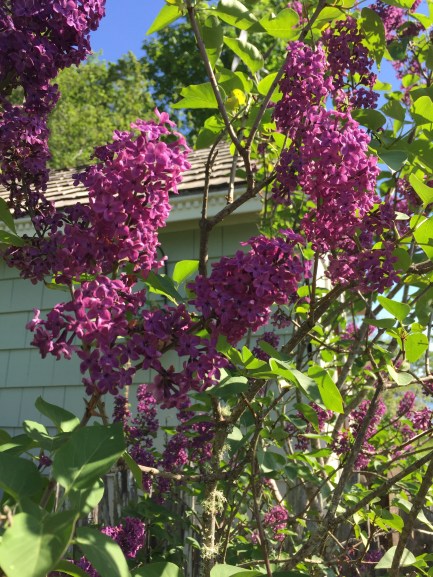
In the early ‘80’s a nurse who worked at the University contacted my husband about acquiring one of his prints. That exchange led to friendship with Mary Pearlman whose only son was serving in El Salvador to help with land reclamation for the citizens there.  When Mary saw our skinned back yard, she insisted that we take from her yard a Russian olive tree and a deep purple lilac bush.  I eagerly planted the lilac next to the back-porch stairs, so that coming and going I could recite to myself, “When lilacs last in the dooryard bloomed,” the opening line to Walt Whitman’s moving elegy for Abraham Lincoln.  President Lincoln was assassinated in April.  IMG_5905The lilac blooms in April, its intoxicating fragrance mourns with the hopefulness of spring.  Mary Pearlman’s 31-year-old son, Mark, was gunned down in a hotel in El Salvador, killed under the Duarte regime that could never conclusively bring any killers to justice.  Not a year passes without my thinking of all of this loss and all of the generosity, as the deep purple flowers bloom again.
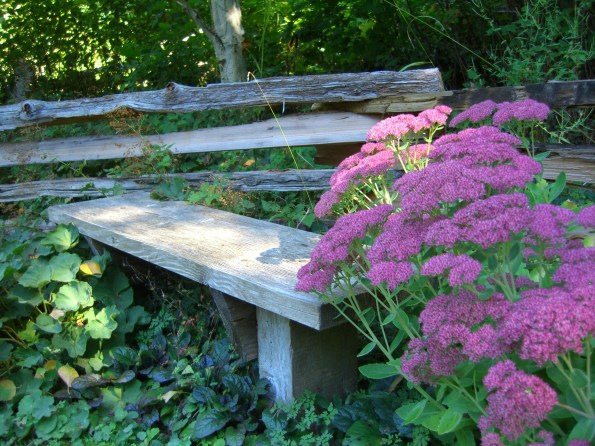
Objects also evoke memory: art, books, even furniture can bring back a parent sitting in a particular chair, under a framed portrait and reading Treasure Island.  However, the gift of living things, of plants and trees, not only holds memories of the giver, but the gifts themselves evolve.  Their very growth feeds hope for immortality.  Perhaps it is the English teacher in me who projects such import to my growing gifts.  Next to the bench where my mother loved to sit and watch ducks land on Quilcene Bay, I have planted a Lady’s Mantle her neighbor brought over the week my mother died.  A perennial, it holds rain drops in its plate-like leaves, drops I saw as tears.  In my mind’s eye, I can see my mother, tea cup in hand, sitting on that bench. Also, I recall her neighbor, Sharon, a woman whom I have not seen for decades.

CIMG0721.JPG

Down the hill from Mother’s bench, spreads a Texas maple my brother John sent from Houston twenty years ago.  It arrived in a narrow cardboard box.  The tip of the tree had snapped off in transport. Now, John brags that everything is bigger in Texas, so his maple should shoot up past the ancient Big-Leaf maple across the lawn, but Washington State won’t bow down to Texas when it comes to tall trees. This year, the Texas maple runs about fifteen feet, a spreading, delicate canopy. I wonder if the two maples talk to each other across the span of lawn. Scientists know that trees do communicate, if not by speech, by sharing nutrients and even warning signals when infection or blight is in the neighborhood.

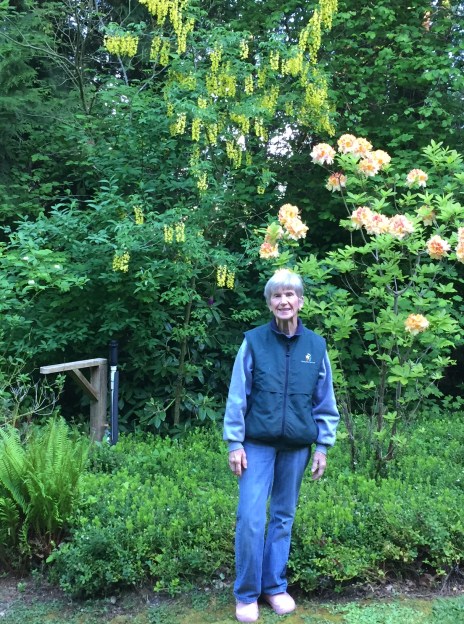
We are a transient people, packing up and moving around the globe. We may inhabit several homes before we die. As hard as it is to leave a house, to leave the plants around the home is more poignant.  A tree inhales and exhales just as we do.  It lives on.  And today my husband is holding up my I Phone to photograph me in front of a ten-foot chain tree in full golden bloom.  When my granddaughter was a little girl, we bought a six-inch stick of a thing at the Quilcene Village plant sale.  What fun to buy the smallest plant, the 25-cent thing for which we had to ask its name, and to gamble that we could help it grow.  It grew! I transplanted it at four feet when it needed more room.  A deer found it in the open yard and munched it back to two feet.  I am texting that photo to my granddaughter, a sophomore in college in New York City.  Remember our chain tree? Miss you. Love, Nana.

IMG_5829

City of the Lost Spring

IMG_5689

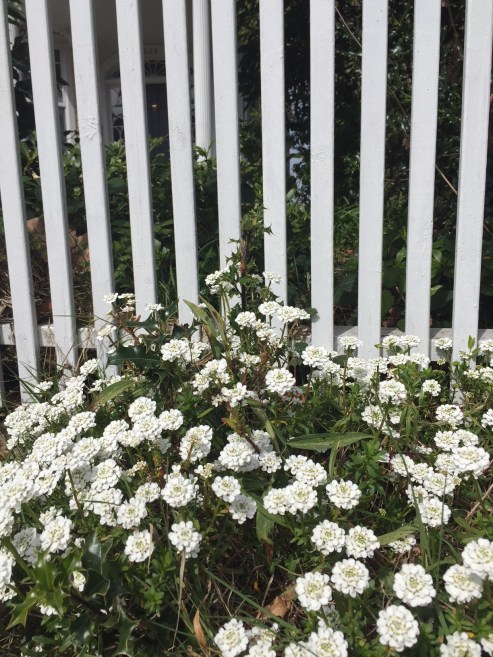
Candytuft against a picket fence.

I planted it there,

a sprig of a thing, fifty cents of a chance

that April would return

and the sun would warm the fence

you painted in August’s heat.


Like white coins, these flowers

where I walk through the gate, alone,

my ears tuned to the words

of one more Holocaust novel,

all despair thrown up against what

spring would want me to forget.


What I had forgotten was spring itself,

some faith that it would return

after you had gone.

I looked for you in the odd places —

the tool shed behind muddy rakes,

a corner of the shed where I stored seeds.


Loss is like that, fooling recollection —

where you last set a spade

before turning to another task,

or the combination to a lock

you thought you knew by heart.

It had always opened the door.


Now this two o’clock sun

on an April day calls out

White on white –

the candytuft,

the whitewashed fence.

I close winter’s gate behind me.


TWO APRILS (APRIL, 2018)

An April afternoon in 1956, I walked down Pigeon Hill where snowmelt still made the ground mushy beneath the trees, my sneakers sodden by the time I reached Betsy’s house, the last house on the road that dead-ended at the railway tracks from Boston.  I knocked on the front door, badly in need of paint and blackened by soot from the railway trestle.  I had come to see if Betsy could come out to play.  We didn’t say “hang out” then, though that is what my thirteen-year-old-self intended, for I had no particular plan other than a need for a friend to spend time with on a Saturday afternoon. Finally, more dressed-up than I had ever seen her, Betsy’s mother answered my knock. From within I heard a gathering of adult voices.

Betsy wouldn’t be coming out that day, Mrs. Watkins said.  She was being married.  Through the yellow hallway I could see into the living room lit with April light.  Betsy wore a white chiffon dress. Her older sister, Barbara, wore what looked like silk flowers in her hair.  There too were Mr. and Mrs. Purcell, recently divorced, sitting with their son Walter, my neighbor, who lived at the top of Pigeon Hill.  Walter was a thin boy, a year older than Betsy and I, and he was smart, very smart.  I remember that he wanted to be an atomic scientist.  We didn’t know any other kid who wanted to be an atomic scientist.

Thirteen and pregnant, though exceptionally young, was not unheard of in 1956.  Finishing high school was out of the question.  By the time Betsy would have been a senior, she had four children.  Walter got a job at a locksmith’s shop. Because he was resourceful, he eventually managed the place, and who knows, perhaps he ended up owning the shop or a string of shops.  What he didn’t do was pursue a career in atomic energy.  And that was tragic, my parents said, shaking their heads at the news.  What a loss for that young man because Betsy got pregnant. All the adults said, “Betsy got pregnant.” No one used the plural for pregnancy in 1956. Only girls got pregnant, usually by their own fault, as if, like Greek goddesses, they sprung children from their heads.  Boys, well, boys were unlucky.  At least Walter, even if coerced by his parents, at least Walter married Betsy.  No one discussed what career path Betsy would fail to walk.

juniorhigh
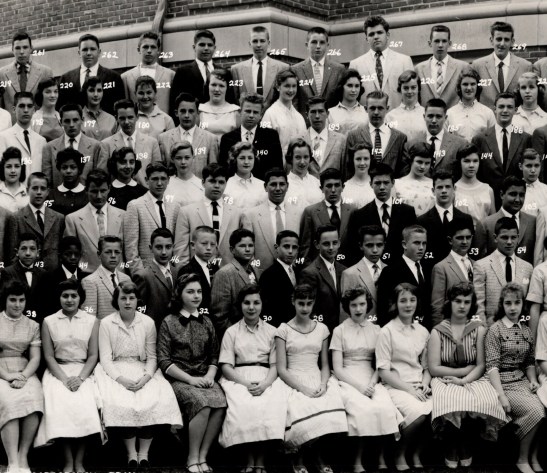
(Our Junior High 9th grade photo.  Both Betsy and I are shown)

Mine was a blue-collar, rather middle-class neighborhood.  I had a group of four fairly close girlfriends. I was the only one who would attend a four-year college.  Three of the four were pregnant before finishing their senior year. No one talked about abortions, not that they didn’t happen. They would be reserved for girls from more affluent families, not to mention the sudden six-month vacations in the sophomore or junior years of high school.

Here at my seventy-fourth year, these are memories of my adolescence.  It is not intended to suggest that this grandmother was more virtuous than her friends, just luckier. In spite of luck, or the lack of it, what I had in common with all teenagers who were sexually curious was the awareness that we were bad girls.  Only bad girls let boys touch them.  With a flashlight under the covers, we read Peyton Place, arousing our hormonal shame, eager to find a common badness in books that portrayed our summers on Cape Cod.  Because we were all bad girls, we sought out other bad girls to befriend.  And the bad boys could pick us out from a crowd of girl scouts selling cookies.  We knew nothing of the complexity of sexual lives.  Nothing about conjugal intimacy and certainly nothing about pleasure or mutual consent.

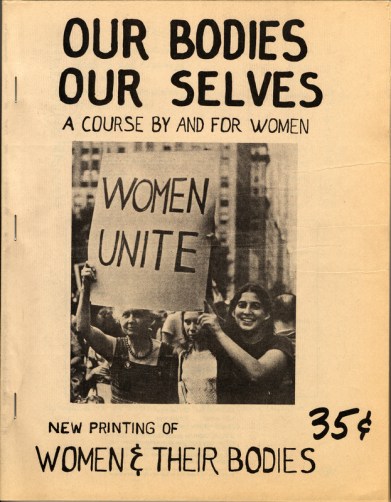
Where could we go for information other than to the bad girls who would talk? At twelve-years-old, I found brown spots on my panties.  Had I accidentally pooped?  Eventually the brown was more like blood, and I was certain I was dying from my insides.  This information I would take to my mother.  Wearing a sad look of resignation, as if I had told her I failed another Latin test, she gave me a little pamphlet that explained menstruation along with a blue box of Kotex, those bulky gauze bandages I had often seen in the linen closet and assumed were for really severe injuries.  Yes, I was that naïve.  There was no sex education in public schools.  Some girls may have been luckier to have mothers willing to discuss sex and puberty.  Looking back, I wonder if that sad look came from my mother’s realization that my days would be numbered until I too would be a mother, a celebration only in spite of her awareness that I would endure having sex. In 1971, The Boston Free Press published Our Bodies Ourselves.  It cost 35 cents.  A little late for me. By then I was twenty-eight years old with a two-year-old.

Women&TheirBodies

In the 1960’s, my college years, we had the pill, and of course it was a young woman’s responsibility to take it, for if she had sex that ended in pregnancy, it would still be her fault.  Teenage pregnancies dropped only inasmuch as those girls could afford to have access to the pill. Generally, it was the drug of choice for college girls and affluent white women.

My little memoir could end here, but not without one more memory of April 25, 2004.  The Bush administration, strangling access to reproductive health choices, reignited rage we hadn’t felt since the Vietnam era.  It was as if the taste of something bitter threw us hurtling back through time to the sour years before Roe vs Wade.  Here in Seattle, I joined my sixty-year-old lady friends, and we piled on planes that flew us back to Washington, D.C. to march.

“I can’t believe we have to do this again,” my friend sighed, as we buckled our seat belts.  All the gray hair in that airplane, you would think we were going to a convention of quilters.  But no, we were about a more serious fabric.  We arrived late on a Thursday, and Friday spent hours doing the touristy things one does in D.C.  In every museum, around every memorial, there were clusters of women our age, women in comfortable slacks and tennis shoes.

By Friday we heard each other mutter, “Where are the young women?”  We had our signs ready: Abortion Rights are Women’s Rights.  But where were the young women who couldn’t remember, but certainly must know?  Where were the young women?

The morning of the march arrived, (eventually a million-citizens strong). We walked from our hotel toward the Mall, and there we spotted streams of loaded busses pulling in from Smith and Barnard and Mt. Holyoke and NYU and Brown and Yale.  Out poured young women.  Out poured young men.  They wore t-shirts depicting clothes hangers, the symbol for self-mutilating abortions.   They had signs too:  Bush Get out of My Bush!   We sixty-year-olds blushed, we giggled, we wept.

Before the March


CHOOSING THE RIGHT POEM: POETRY AS ACTIVISM (FEBRUARY 2017)

I could tell you that the Swift Boat accusations against John Kerry were what tossed me into the drink that presidential election of 2004. But in spite of my progressive leanings, I will honestly say by October of that year, the Democrats crucified the English language as much as did the Republicans. Orwell was churning with the worms in his grave.

Those of us who were English teachers hung our heads in mourning, not only for the imminent death of our nation, but for the early demise of the English language. I felt helpless, wordless, as if my tongue were excised as much as my vote. Yet before I slipped beneath the stones, I passively struck out with a poem. It was October, and so my ears turned again to Robert Frost’s

O hushed October morning mild,

Thy leaves have ripened to the fall;

Tomorrow’s wind, if it be wild,

Should waste them all.

The crows above the forest call;

Tomorrow they may form and go.

O hushed October morning mild,

Begin the hours of this day slow. . . .

Just typing the poem, was a salve for my offended ears. I printed 50 copies, slipped them into a plastic folder, wrote Take One, and duct taped the folder to the wrought iron fence around my yard. The poems were quickly taken; I suppose passersby assumed the house was for sale. How were they to know the folder of Frost’s sonnet was my non-violent protest not only against a nasty election but against the demise of our language. Instinctively, I felt if I could remind others how beautiful words could be, they too would rise up against the cacophony of cronies.

October passed. The election failed to win the president I would have chosen. The Iraq war showed no sign of ending, and I stumbled across another Frost poem, November, that, if read closely, clearly indicates Frost was writing in opposition to war. December? Well my daughter mentioned how tacky the duct taped folder looked on the fence, so I removed it. In January, neighbors and folks I didn’t know (but who frequented the same coffee houses), asked me, “Where was December’s poem?”

Voila! After 30 years teaching high school English, forcibly stuffing poems down reluctant throats, I had finally an audience who wanted poetry. On January 1st, I replaced the plastic folder with a wooden box my brother built for me, the Poetry Box, and in it I put Emily Dickinson’s Hope is a Thing with Feathers.

Thirteen years later, I still approach the end of each month to consider what poem I will select for the following month. Over 300 poems are taken from the box each month. Never once has a crumpled poem landed on the parking strip. I have received notes of thanks, interviews on radio and newspapers, a little envelope with $5 from a teacher who knows what it cost to Xerox copies to disseminate to her students. And for those who do not live close enough to get a poem from the box, I have compiled a list of 44 emails to send out the poem, and usually a little something about why I chose the poem or some authorial background.

This month is February, a month I think of well in advance to choose a love poem. There are so many, and what fun to read and reread, to think which one feels right for this year. This February I did not use a love poem. After the first two weeks of Donald Trump’s presidency, as a good many Americans flail their arms to stay afloat in democracy, I turned to Wendell Berry’s Peace Among Wild Things. When despair for the world grows in me and I wake in the night at the least sound in fear of what my life and my children’s lives may be, I go and lie down where the wood drake rests in his beauty on the water, and the great heron feeds.

Within hours, my email fills with letters, “Thank you Mary, for the poem. I needed that.” I wasn’t surprised, but why is it true? Why do we need poetry? It is not a miracle drug. It will not cure cancer. Edna St. Vincent Millay wrote “Love is not all: it is not meat nor drink/ Nor slumber nor a roof against the rain…. Yet many a man is making friends with death / Even as I speak, for lack of love alone.” We can say the same thing about poetry. Poetry might not save the world but …What is there about a poem that helps us bear the weight of the world?

For the writer, the process takes her away to the shelter of her imagination. She puts herself in a garden or along a seashore. With the gift of remembrance, she sees the first daffodils blooming or hears waves licking the sand where her toes warm with each step. Escape? Yes, but in the process of getting away from the world, she returns to it with a greater understanding, as if she has larger hands with which to hold the worlds’ cares. Poetry gives her the confidence of quiet power — the greatest power known by the most courageous people like Dr. Martin Luther King or Ghandi.

For the reader, he too takes a walk from strife. In despair one feels there is no control. It is as if an old thermometer has broken on a tile floor and beads of mercury scatter everywhere. It is dangerous stuff, but there is no gathering it up. Poetry is concise; it has form and shape. The very economy of a poem informs the reader that life can be gathered up. You can carry a poem in your pocket, take it out when waiting for the bus. The bus may be delayed or not come at all, but you have those lines. You might memorize them. They lull in the music of their meters: Whose woods these are I think I know/ His house is in the village though/ He will not see me stopping here…

And there is the conclusion to Wendell Berry’s poem.

I come into the presence of still water. And I feel above me the day-blind stars waiting with their light. For a time I rest in the grace of the world, and am free.

There is hope. The poem asks nothing of the reader but to hang in until the final lines that bring understanding of the world by asking beauty to step up and hold us in her palm.

And why does one poem a month, taken from a box make a difference, when any one of us could open a book and read a hundred poems, or surf the internet to find lots of sites for a poem? I can only guess, but here goes.

“Where was December’s Poem?” Having shared in the expected by two months of a poem each month, people like the anticipation of a gift. More gifts would lessen the gratitude. One gift, thirty days apart, makes the waiting worth it. Few people who take the poem know me. I do not know them, but we are a community of feeling. I have had many positive responses to that poetry box, but here are two of my favorites. One showed up on a blog I stumbled across about Seattle neighborhoods. My poetry box was discussed in the context of Capitol Hill and the writer called in a “carefully curated poetry box.” A curator is someone who consciously cares for art. The phrase suggests caring, caring for the poem, caring for those who might read it.

The second compliment was by an 8 year old boy who had to write for his school class about his neighborhood and what made it a community. He chose to interview me about the poetry box. Though intended by me as a soft political protest, for him it was the glue of his community. I have seen many children over the years take a poem from the box and read it, either alone or to their parent walking them to school.

These are tough times for those of us who identify as progressives. We are fearful for what we might lose at the whim of a president who has a vocabulary of a drunken sailor, whose depth of articulation goes no farther than the number of characters allowed in a tweet. He is an office holder, albeit a rather powerful one, but he is not the people. He is not the voice of the people. As long as there is poetry the language of the people will have form and melody. The people are the poem. The poem is the people. Walt Whitman knew it, and his words will endure long after any readily regurgitated hate.

Let us write our poems.  We will write them in journals, on sidewalks, on the posters we carry in marches for our democracy.  Let us read poems, and in the reading hang our livelihood on concise words that lead us to understanding, the penultimate destination before transcendence.

GETTING REACQUAINTED WITH OURSELVES

Moving into our 70’s we still listen to our 16 year-old self sleeping in somewhere behind our hearts. It is the adolescent fame-future voice that promises some day to star in a film or rescue a child clinging to a rooftop while floodwaters rise. We feel we have the talent or the hero within, as soon as we decide to call it out of hiding. After seventy, we shed one goal at a time, after first allowing old-age wisdom to acknowledge those ambitions are now fantasy as if they were not always. I have concluded that I will never climb Mt. Rainier. Even nudging 50 years of age, I thought I might do that some day, would sign on to a group tour led by Jim Whitaker, who still ascended surrounding peaks well into his geriatric years.

I also allow other voices to encourage me to loosen my grip on that climb. “Mary, “ my husband reminds me, “you have Raynaud’s Syndrome so that you can’t walk by the frozen food section at QFC without your fingers freezing stiff.” Experience convinces. I have never climbed a glacial peak, but I have arrived at the checkout stand where I struggled to withdraw my credit card from my wallet because of frozen fingers. Some other physical feat will have to substitute.

Why physical ambitions? Soreness reminds us that we are still alive. Muscle soreness from physical exertion differs from the joint pain we feel now just by standing quickly at intermission, after sitting through two acts of King Lear. Active muscle soreness feels rejuvenating, not debilitating. So last year I decided to run a 10k race in our hilly community on the Olympic Peninsula. I have not been running regularly for years, but I figured I could train for it starting with a three-mile run of the course and building from there. Honesty suggests I insert here that it wasn’t just completing a 10 k that attracted me. I guessed I would be the only woman over 70 running the 10k and thereby would receive a first-place medal in my age category. I knew more than one woman over 50 who competed in races, winning first or second places, especially after moving across one age category to the next. There, it became a bucket-list thing, although I didn’t think of it that way at the time. What I wanted was that first place medal. In my younger years, I had run a 10k. I never had won a medal. Voila! I would get that medal at 73. The monkey wrench came twisting in when I went to pick up my race number the evening before and learned there were no age categories for the 10 k race, only for the half marathon – yes 13 miles, not 6.

“How much more do I pay to register for that?” I asked.

“Twenty bucks.”

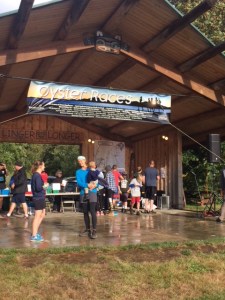
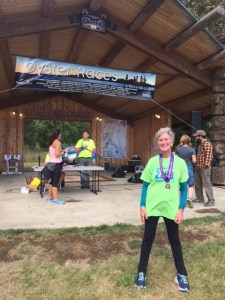
I paid it. The next cool September morning, my husband dropped me off at the community park where runners gathered, pinning their numbers to their shirts, stretching their legs against pine trees growing up from the dew-damp grass. I pinned on my number, plugged my I-phone in to the tunes that sang me along on my training runs, and started, shifting one foot ahead of the other up the steep 3 ½ miles ascent on Center Road until it peaked at Tarboo Road where race helpers pointed me towards the crescent logging road that would take me most of the ten miles further until I could finally descend steeply, foot numbingly, to the park again, where other runners had long since grabbed their Gator aide, oranges and yogurt and were already settled in the beer garden. I arrived just as medals were being distributed, a shiny faux silver oyster shell. First place for women over seventy, Mary Kollar, second to last over the finish. Yes, the only woman running over seventy. Maybe the only one running over sixty, but the woman I beat was fifty-six. Success! Was it not?

Was it the feel of the heavy medal on my sweaty chest? What made me feel most alive was the soreness of muscles, the labored inhales and exhales, that lifted my ribs as I lay on the cool quilt of our cottage an hour later. That is the pushed-to-the-limit soreness that rejuvenates, as in “makes young again.” Did I become a new person, thus far only fantasized? No, I became more of the same person, one competitive woman whose challenger is not the fifty-six –year-old running behind, but myself. After seventy I was getting to know me.

Yes, from seventy until the day the lights go out, we are still getting to know ourselves. I cannot recall when I realized the mileage needed for the journey of self-knowledge. Nonetheless in this 7th decade I am thinking a lot about who I am at the same time that I chastise myself for not having that inner dialogue more often in my younger years. Perhaps in the midst of becoming, I didn’t take time to contemplate who I was becoming. I either thought I knew, or would figure it out soon enough. Now I have the leisure to watch that becoming, in the way that I can watch my grandchildren grow through my philosophical eyes; whereas when I was raising my daughter I didn’t have time to philosophize about development. I was trying to keep one diaper, one meal, ahead of the next.

Should we spend our last decades wondering who we are? Can we do so without praise or blame for the person we discover? Imagine those teeter-totters you used to run up and down at the playground. Wasn’t it fun when you were the only one on board? When you stood on the balancing point, one foot on each side, holding the board in perfect balance? That is my image of taking time to self-explore without tears or applause. Running down one side of the board, you have self-deprecation. Running down the other, narcissism.

There are certain givens we accept to who we are. Some might be linked to particular gifts or occupations. I make excellent pies. That skill I acquired in the process of attracting my husband whose mother made a pie crust so flakey you could cut it with a piece of parchment. Changing a few ingredients for the crust and enhancing many of the fillings, depending on whether the pie was cream or fruit, I eventually matched and exceeded Eva Kollar’s pies. So the joke followed, that whenever my husband and I started musing “Why I married you . . “ he would laugh and say my good looks were fine, but he really married me for my pies. Being just fine with that, I too would tell others that my husband married me for my pies.

Then one evening out to dinner with friends, Allan told my friend’s husband, “You know I married Mary for her opinions.” Had I heard that correctly? Yep, he nailed me. I am one of the most opinionated persons I know, something I always thought could be modified a bit, but holding my tongue is not my strongest suit. That dinner moment was pivotal. Could I own it? Here was a self-revelation I could live with, and perhaps living with it, I might be in a better position to withhold excessive opinions, while accepting God’s grace for the ones that slip out.

Back on the teeter totter. Am I apologetic for freely sharing my opinions, or am I proud? Although my husband may have said it tongue-in-cheek, in fact he often seeks my opinions whether in selecting a work of art for our collection or marking our ballots for mayor and city council.
?Knowing myself as competitive and opinionated, being able to write that at this moment, is significant in these over-seventy years.

Several weeks ago, I wrote a blog post about wanting to be known, especially as the lights of life are flickering. Being known to oneself is perhaps more significant than being known to others. It is attributed to Socrates,:“The unexamined life is not worth living.” He meant philosophy in general, not only examining one’s own life. Were he to point to the value in self-examination, “worth-living” justified living on into the 7th, the 8th, maybe even the 9th decade with surprised discoveries of who we are, perhaps tweaking a bit toward self-improvement, perhaps accepting the friendship of the one person to whom we can talk and who is always listening. That is our talking/listening self.

You have to be of my generation to remember the RCA Victor ad with the spotted dog’s ear tilted to the trumpet coming from the record player. What if that record player were our inner self? Would we tilt our ear to listen to its music?

From the time of birth, our self-knowledge comes through the reflection of others: our parents, our peers and our teachers. My father so often called me a brat, that by the time I was ten years old, I knew I was a brat. Sad, but true, I did talk back to my parents and showed a strong will for my own way, unlike my brother, the Eagle Scout, who wore gentility like a badge on his sleeve.

My parents are long dead, allowing me time to disregard the white noise and tilt my ear to my inner self. Who were my literary heroines while my father was calling me a brat? They were the brats: Pippi Longstocking, Scout in To Kill a Mockingbird. Even Nancy Drew attracted me because she would forge out on her own, without her conservative father’s approval, though I read two Hardy Boys for every one Nancy Drew. The boys’ risks were closer to my own.

May 23, 1953, the cover of the Saturday Evening Post. A skinny freckled girl, pig-tails crooked, ribbons untied, knees knocked in and shoes unlaced, sits outside the principal’s office. Her left eye sports a shiner. As roughed-up as this soon-to-be-punished girl is, she is smiling, the most delicious smile of a winner. I was ten-years-old when Norman Rockwell illustrated that magazine. I thought it was a portrait of me. Today the famous painting is in the Berkshire Norman Rockwell Museum, but the postcard image is under the glass of my writing desk. My competitive, opinionated “Tom Boy” looks back at me every day. The delightful thing in taking that journey of self-awareness to this year is envisioning what I might once have seen as warts on a frog, as perhaps rather artistic.

A time machine could take us back to any year for a second look at the way we developed our self-image and came to know who we are. Without that machine, even a photograph won’t do. We rely on what others tell us who we were. There is a certain freedom in our senior years to be selective in judging who we were and settling on who we are at this moment.

Next best thing to a time machine is the memory of others who knew us way back when . . . A few years ago I met up with two high school friends I had not seen in years. They reminisced about how every weekend we would get together at Sally’s house to play pinochle, drink coke and smoke cigarettes. I remembered that too. What I didn’t remember was their recollection that as soon as the hour got rather late, I would stand up, say I had to go home to wash my hair, and leave. They laughed heartily at that memory. Now I don’t doubt its truth. What I am learning about myself, looking back as best I can through the smoky telescope, is that I likely had ADHD all my young life, long before anyone named the condition. Result? A nervous brat who couldn’t or wouldn’t sit still at any activity for any time. Stories help us remember what we did, but not who we are. The stories are useful in helping us understand with our own loving acceptance who we are and maybe who we were.

Perhaps what we all could use is a wedding commitment ceremony with ourselves every ten years. Do you take Mary for who she is? Knowing oneself must progress to accepting ourselves. Personal peace is enough. Just enough.