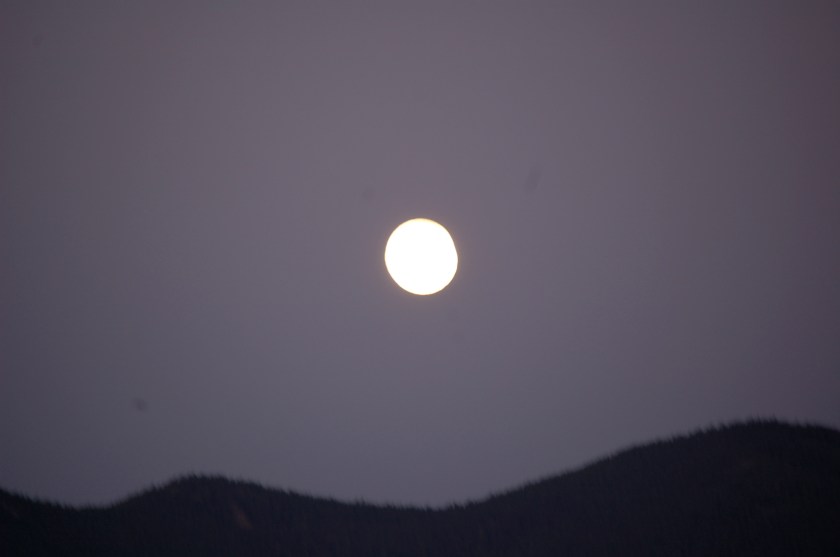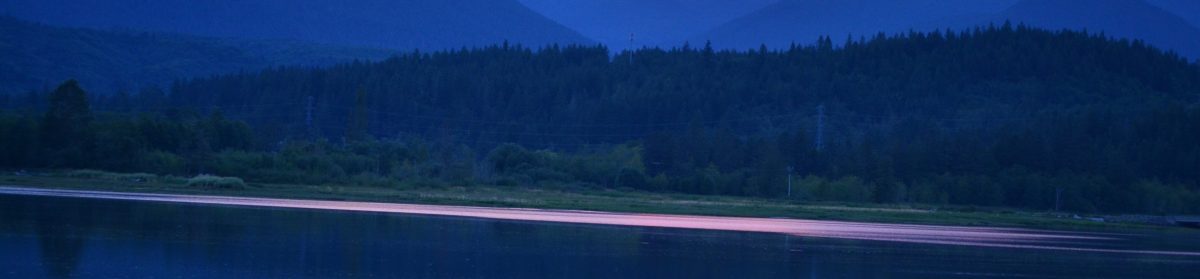

Our cottage sits on a tidal bay, a thumb, if you imagine Dabob Bay as an open hand, one of many large bays on Hood Canal. Thirty years ago we looked every summer for a low-bank waterfront property we could afford, and curiously settled for a tiny cottage on Quilcene Bay where there is water in front of us for only half of the day. Summers, when the sun warms the tidal flats to swimming temperatures, we are “tied” to the tide book.  No matter what tasks we are doing, we stop to run through the open gate and plunge in for a swim, push out in a kayak. or balance on a paddle board as soon as a chart in that book registers eight feet or more. Winters, the high tides can exceed 13 feet, and when married to high winds, the sea trespasses, often knocking out the gate with a floating log, white caps swamping our lawn.
Before purchasing this waterfront property, I lived blissfully unaware of the moon and the tides. I didn’t think about highs and lows, not to mention high low tides and low high tides, abbreviated by locals as High Lows and Low Highs. This morning my husband looked through the window as the tide seemed to inhale from the shoreline, revealing mud flats gleaming in the early morning sun, with intricate patterns of streams that ribbon across the shining silt. These streams are the terminus of two rivers and an old creek, all delivering salmon fry in the spring and welcoming returning fish in the fall.
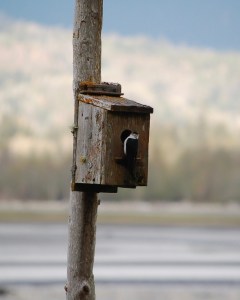 “I love the low tide, as much as the high tide,” he said, reaching for the binoculars to spot heron tiptoeing between the streams and the violet green swallows checking out the boxes he has raised on poles along the shore.
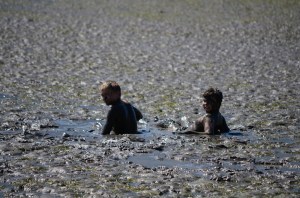
More of a swimmer than bird watcher, I am happiest when the tide is in, but I have memories of my grandchildren flailing joyfully in the warm mud, emerging like faceless sea creatures to be vigorously hosed off before permitted inside the cottage. I too have ventured out on the flats where my feet sink, then my knees, until I fall helplessly in the sucking mud, leaving no option but laughter.
Before inhabiting our tidal bay cottage, I did not imagine the allegorical truths inspired by connecting with those fluctuating tides. In the past thirty years, by connecting to what the tides are communicating, I am discovering revelations of life itself.
Near dusk a few years ago, my brother and I shared a canoe we had paddled a few miles south of the cottage. As the sun continued to set, we turned to paddle back home. Sitting in the bow, I lengthened my stroke while I visited with my brother. He paddled deeper and harder from his seat in the stern.
“How do you think we are doing?” he asked.
Proud of my stroke, I answered, “We should be home soon.”
“Look to the shore,” he said, indicating the oyster company where the lights had just turned on. I looked. I paddled. I looked again, and I paddled. The oyster company lights remained fixed in place. The tide was retreating so fast, that if we didn’t double our efforts, we would make less distance forward than backward. The strength of the tide, accompanied by an expanded vision, remind me that all effort may be relative to some fixed reality.  Changing tides inspire humility, helping me to accept what gifts I didn’t know were coming. Just as high winter tides carry a battering ram of a tree trunk to wipe out our driftwood fence, so the water retreats, dumping our fence and stairs at the end of the bay. Neighbors help us retrieve what is ours, and in our scavenging, we find even better planks for restoration. Low tides uncover oysters and clams: a table-is-set ebbing of culinary fame. Even baby crabs scramble along the shore. In late August, salmon return along the streams that lace the flats. Salmon battle determinedly up those streams between lines of families fishing for a big one to take home for dinner. The tides give and take away, like the hand of a natural god.
How do I answer the ubiquitous question, “How are you today?” Ninety percent of the time, I answer, “I am fine, or I am well.” Perhaps, it has been a good day, or I may venture to say a “bad day,” – if the one asking is a friend whom I can trust will hang around for sorry details. Certainly, our days are never all good nor bad. I like to think the condition of my days parallels the tides.  If it is a Low – Low, I may forget that there ever were welcoming waves in front of our cottage. If it is a high tide day, I know I am riding a surface on a paddle board, head-high enjoying the sunset sink behind Mt. Townsend. Most days are those Low Highs or High Lows, but nothing is stagnant. All life is movement. We know the moon will turn from crescent to full, and the bay that emptied all but bubbling craters where clams breathe, will within hours, cover meandering streams with salt and sea.
 Barack Obama based his drive to the presidency not on a slogan to “Make America Great Again”, but on hope. The Barack Obama “Hope” poster is an image of President Barak Obama. The image, designed by artist Shepard Fairey, was widely described as iconic.

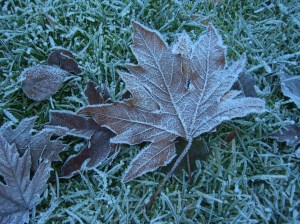 Archibald MacLeish writes in Ars Poetica, “For all the history of grief / An empty doorway and a maple leaf.” What profound absence he expresses in one metaphorical image, so that my heart hollows out with sadness as I picture that open doorway beyond which there is absence. In defining grief, a dictionary would settle for “deep, sadness, often lasting a long time.” The dictionary is accurate enough but cannot replicate the feeling of grief defined in MacLeish’s open door or the falling maple leaf.
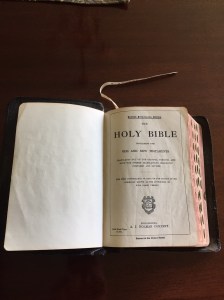 Many Americans have left religion altogether because the Bible remains the cornerstone of churches, and in an empirical age, people will not subscribe to a belief in miracles such as virginal birth. Others, in some fundamentalist churches, turn off the reality button, permitting their literalism to deny what science disproves. The Bible itself abounds in contradictions, making “the word of God” as evasive as mercury spilled from a broken thermometer. For me, literal readings can make the Bible as shallow as a puddle in which we look no deeper than the reflection of our own face. Metaphorical readings expand in lakes and oceans, often feeding channels between islands no one mapped.
  Christ does not have to resurrect in the flesh, offering his wounds to Thomas or anyone else in doubt. Christ can “come again,” among his followers who, despairing his death, realize his teachings never left them, but will endure. Christ had risen!
 These are facts about Ms. Obama’s life there, but it was her metaphorical descriptions of her life from the South Side of Chicago to 1600 Pennsylvania Avenue that helped me to feel what she felt. Metaphor opens the envelope for empathy. What a wonderful organ our brain is that we can look at the moon while Alfred Noyes describes “the moon is a ghostly galleon tossed upon cloudy seas,” and we can see a full sail sailing ship in rough seas and at the same time a real moon, flitting in a tumultuous dance among clouds.
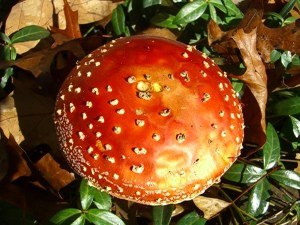 In “retirement,” I became the nanny as well as Nana, to my grandchildren, reading them books, instructing them on names of mushrooms on our walks to the park, and later pressing their chubby palms in to dough as we kneaded loaves of bread.
 Fantasies serve to get us away without getting away. Once retirement comes, we have finally escaped those parts of our jobs we didn’t enjoy. Yet clinging to those displeasures like a demanding child, are those tasks that actually fulfilled us. In teaching, fulfillment might be that very clinging child whose progress depended on our support. From serving others, our work and ourselves gain importance. I confess that upon leaving Woodinville High School, I couldn’t imagine how seniors unable to take my college prep English class would ever survive in college. (Time here for laughter)
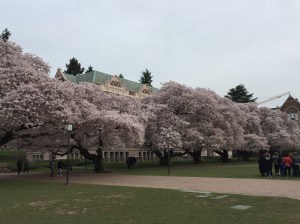 I walked to and from the University of Washington my final years teaching on campus. I walked down the hill each morning, stopping for a latte and scone on the way. At the coffee shop, Jackson, a garrulous Scottish baker, swapped stories with me as I bit into one of her jam-filled scones she pronounced as “Skhanz.” On the way home, I took the opposite bridge across Lake Washington’s ship canal and back up Capitol Hill. Seasons blessed my exercise with meditation on falling chestnuts and blooming early plums. In retirement, I missed that walk, though I could still walk down and around the university whenever I wished. But without a purpose? Years passed until I began offering to walk my daughter’s golden retriever down the hill and through campus, where the dog’s “I love people” expressions and wagging tail attract undergrads who miss their dogs left at home. Now the walk resumes with “purpose. ”
 I email the monthly poem to those not close-by to take a poem from the box. On telling those folks this is my 15th year with the poetry box, my husband’s niece wrote, “We appreciate the lessons and places you’ve taken us with your 15-year commitment to the Poetry Box. Roger and I would likely never discuss poetry without the Poetry Box so thank you for this gift!”
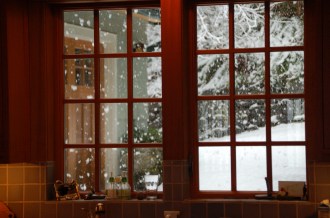


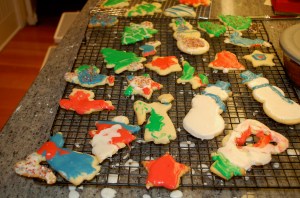 Today, some may be frosting cookies to set on a plate by the fireplace for when Santa descends. The custom may continue each year, long after the children have left for college. Many families either follow established traditions or stumble on to their own, without realizing a little habit or ritual grows like a child whose appetite wants feeding.
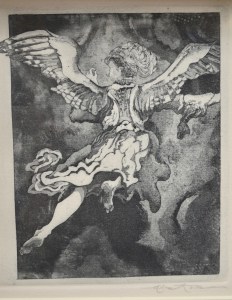 Influenced by the etchings of Rembrandt, Allan drew an elysian image of a descending angel, etched it in a metal plate, and ran twenty-five original prints for those to whom we wanted to send our Christmas greeting. We made no commitment to ourselves or to others that there would be another the following year.
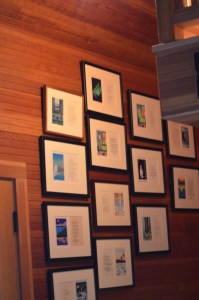 Inevitably, we needed to trust the reproducing work to a professional with a large studio. Allan still creates the image and cuts the stencils before passing on the stencils to Tori, our third professional printmaker.
 Then there is the Washington Athletic Club group. What started as a small gathering of early-morning athletes celebrating a Holiday Season breakfast, grew to sixty strong. Gordy dresses as Santa. After handing out our cards, Allan describes the artistic process, and acknowledges the fellowship of starting each day with a workout among friends. I read the poem aloud. Each year, we wonder if maybe we should forego the task of contacting catering, renting a room, taking sign-ups in the locker rooms. But each year, club members ask, “What is the date of this year’s breakfast? We love that tradition.” Suspending a “Tradition” can feel like desertion.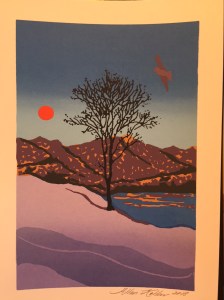


 I jumped to Obama’s defense. “Are you aware?” I asked my friend, “that you regularly disparage people who have money, although you are quite wealthy by any standards?” My words reduced her to tears. I felt as if I had wounded my sister.
 Do Americans more freely offer opinions than people from other countries? If so, perhaps there is a link to the way we teach our students. When teaching high school English, I may have started the class with “What happened” questions just to review the plot of our current book, but I soon moved on to the Why questions, those asking for opinions, granted opinions backed up by the text. We call it critical thinking, and American schools pride themselves in educating not only willful students but also ones who think critically.
 So many balls in the air at one time. Then back to Fox News, or CNN, or any other show touting itself as a news source. Good luck at finding anything approaching factual news. A body lies on the pavement, a VW in the ditch, but the commentator is rushing around with a microphone asking twenty people what they THINK happened.
 Later in the morning I meet with a woman I have known for twenty-five years. She asks to meet with me to discuss a sadness in her life for which she believes I might have a shared experience. We have family and friends in common, and they are the subject of her grief. First, we catch up on little things we do to fill our days. Then, testing a shared comfort, she begins to tell her personal story of a loss she experienced years before we met. She pauses. Because I know the Girl Talk script, I sense she is waiting for me to tell of my own loss years before we met. From our stories, there might not arise exact similarities, but there will be a kind of universality of experience that brings understanding to a sad occurrence. People seek reasons for their pain, but will settle for parallels, if reasons can’t be found.
 Gossiping is inherently judgmental, and I regret that it is more often associated with women. But men gossip too. They tell about a business rival who cheats on his income tax. Men’s Sports Gossip (sometimes referred to as “Locker Room Talk”) can be as rough as the sports they discuss.
 The stand-up comedian, Hannah Gadsby from Tasmania, based her humor on the awkward lives of lesbian women. A lesbian herself, she told about her own experiences suffering criticism and misunderstanding. As the show continued, what was at first humorous, became tragic. Annoyance grew to righteous indignation. What she said was no longer funny. The show was, however, profound. My husband didn’t enjoy the show, because of Hannah’s expressed anger, even though he sympathized with her many grievances. If she had spoken softly and slowly, her voice not pitched in indignation, I wonder if he would have more readily accepted the truths she offered.
 . And there you are — all stories are love stories, because through them we bond as we walk along the tangled paths of our human condition.
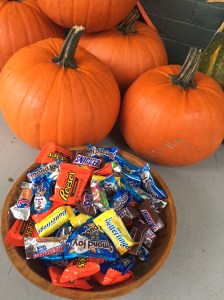 How many Snicker Bars or Peanut Butter cups does one child need? Does any child remember what house gives out Milk Duds and which Nestles Crunch? Little distinction, even less distinction in flavor or freshness. Super markets shove bags of Halloween candy on their shelves in late August.
 Below them we dumped the unfamiliar, and therefore suspect, sopping honey confection. My adult self longs to return to the front door to be given a second chance. From many houses we got apples, always apples, barely welcomed in our greed for sweets. Mom separated them out from our Trick or Treat bag, parsing them out for school lunches. She also saved the nickels given by those unprepared to bake. Once there was a quarter among the change.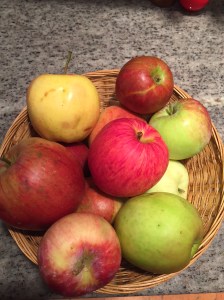
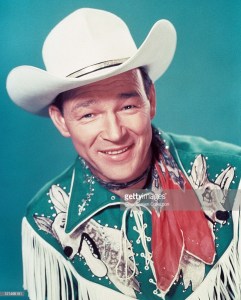 I borrowed my brother’s leather cowboy vest, redolent with his own sweat that I identified with horse flesh. His cap gun hung heavily from my non-existent hips. If I were lucky, he would share a red roll of caps, their explosive pops filling my lungs with sweet sulfur.
 It is only an occasional child, usually a young one, who has changed identity for the night, who growls like the furry beast it is. I long for role-playing, for the ferocious tiger who will dare me to open the door wider. I hold out the wide wooden bowl brimming with mini Snickers and Tootsie Pops. Each year the packages shrink, but the kids don’t seem to notice. Their plastic pumpkin carriers are brimming with replicas of what we are giving. Over their shoulders, the little monsters thank us as they race back down the stairs to the sidewalk where an adult or two waits to escort them to the next house. As they secure their children’s sticky hands, does their tongue remember the taste of their own childhood? Gone are the days when children ran out the front door as soon as dusk swallowed the maple trees, to tag along with older siblings, combing the darkening streets until the soiled pillow case, filled with treats, weighed them down. Then it was time to return home to parents, unconcerned about absence after dark, sitting by a lamp reading until their costumed children had played out their one-night characters and were ready for sweetened sleep.