On occasion, do you discover a book you didn’t know you owned? Last week, I opened an ignored desk drawer to find five, small, unread books published in an American Poetry Project, 2003. One was Poets of World War II, a collection containing poems, several whose poets I knew, but hadn’t associated them as poets of war. The book contains poems inspired by several aspects of war, many conscience-rending accounts.
Within its pages, I found some poems I had taught when I was teaching high school English, such as The Death of the Ball Turret Gunner by Randall Jarrell. I put this poem in the hands of seventeen-year-olds who might within a few years find themselves in the military, their lives precariously flying among the clouds. It occurs to me now, what an assertive lesson by including a poem that concludes, “in the end they washed my body out of the turret with a hose.” Poetry is a powerful voice, one that inspires patriotism, comforts despair, incites romance. Surely all rhetoric could and will accomplish these outcomes. Yet poetry, for its condensed form, its rhythms aligning to meters akin to heartbeats, grabs us and stays with us for our entire lives. Perhaps you recite nursery rhymes today, poems you haven’t read for decades. Yet the verses elicit within you deep connections to people and places. That truth reminds me of the power, the usefulness, the responsibility of poets and their poems
I grew up in Virginia and then Massachusetts where history, particularly colonial history, dominated the curriculum. Students were expected to memorize poems arising from those histories. One was Paul Revere’s Ride, by William Wadsworth Longfellow. The poem gallops along between stanzas just as Paul Revere galloped between Boston and Concord, warning: “ The British are coming.” Revere’s ride alerted colonists who rose up in time to defend their land, so the poem ends in triumph. What could make us more patriotic? We associate with winners, yet the Revolutionary War continued for years of death and destruction. Somehow the bitter gall of war was not fed to school children. Instead, we fed on heroism and military pride. Only later, in the Civil War poems of Walt Whitman, did teachers expose battlefield suffering. Yet the Whitman poems we recited were Captain My Captain, mourning the death of Lincoln and likewise When Lilacs Last in the Courtyard Bloom. Those elegies were nationalistic in bringing together a shared loss for most Americans
Poetry is still politically powerful. John F. Kennedy was the first inaugurated president who invited a poet to read at his inauguration. He chose Robert Frost. Since then, there has been an invited poet at almost every inauguration that I can recall. It is a custom, more than a tradition, and Donald Trump did not invite a poet to read. Joe Biden did. Amanda Gorman was the poet who read at President Joe Biden’s inauguration on January 20, 2021. At 22 years old, she became the youngest poet ever to perform at a presidential inauguration, where she recited her original poem, The Hill We Climb. As I recall, her poem and her delivery upstaged the entire ceremony. The poem sold thousands of copies following her reading. Her poem focused on themes of hope, healing, unity and resilience. These themes can still be our history, themes that could inspire a history of which we would be proud.
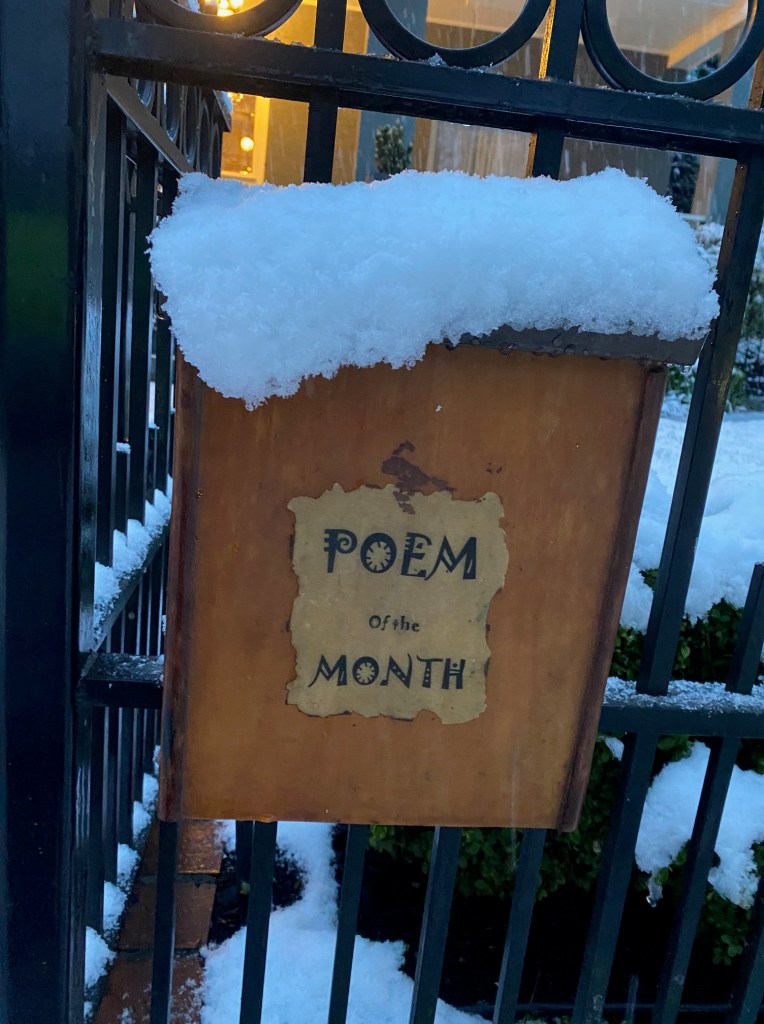
Poems from World War II capsulized in often a few stanzas the reality of the time, teaching what might take chapters in a history text. Every month, I put copies of a poem for the month in a wooden poetry box affixed to the fence surrounding my home. In selecting the monthly poem, I consider the time of year: a winter poem could bring out Stopping by Woods on a Snowy Evening. For March, I planned to choose a spring poem, yet this month I was reading those World War II poems. What called to me was a poem by Wilfred Bynner and first published in The New Republic, 1944, written about American soldiers returning to the Southern States after fighting and dying side by side on the European front. The soldiers are accompanying German prisoners of war:
                                    Defeat

On a train in Texas German prisoners eat
With white American soldiers, seat by seat,
While black American soldiers sit apart,
The white men eating meat, the black men heart.
Now, with that other war a century done,
Not the live North but the dead South has won,
Not yet a riven nation comes awake.
Whom are we fighting this time, for God's sake?
Mark well the token of the separate seat.
It is again ourselves whom we defeat.
American armed forces were not integrated until 1948. In ten lines, a poem gives a lesson in history. A poem teaching history evokes questions we ask today: “Whom are we fighting this time, for God’s sake?”
I am aware that the current administration discourages teaching about our nation’s responsibility for enslaving people and for the Jim Crowe segregation of citizens. The president’s argument asserts that this history “makes young white children feel guilty.” I was a young white child schooled in ignorance in the segregated South. When I was twelve, my parents moved from Blacksburg, Virginia to Newton, Massachusetts. I begged my parents to let me visit my Virginia friends over Christmas holiday. Raising the $50 round-trip train ticket by hours of babysitting, I earned permission to ride coach from Boston to Christiansburg, Virginia. When the train stopped in New York City, a Black man boarded and sat beside me. Having been released from the hospital after a long illness, he was headed to family in South Carolina. We visited pleasantly until we crossed into Washington, D.C. Then Mr. Moses was gone, though I knew he had miles to go. There were no more passengers of color in my car. We had crossed the Mason Dixon line, and I had not been taught about its significance. I could have used a history poem, for in all my studied poems of American history, not one taught me about Jim Crowe. Did I feel guilty? No, I felt curious. I felt untaught. I wanted to know what happened and why I no longer had this traveling companion. Without embracing ALL of our history, how could I grow up to work for a more just society?






 Mary's Room With a View