
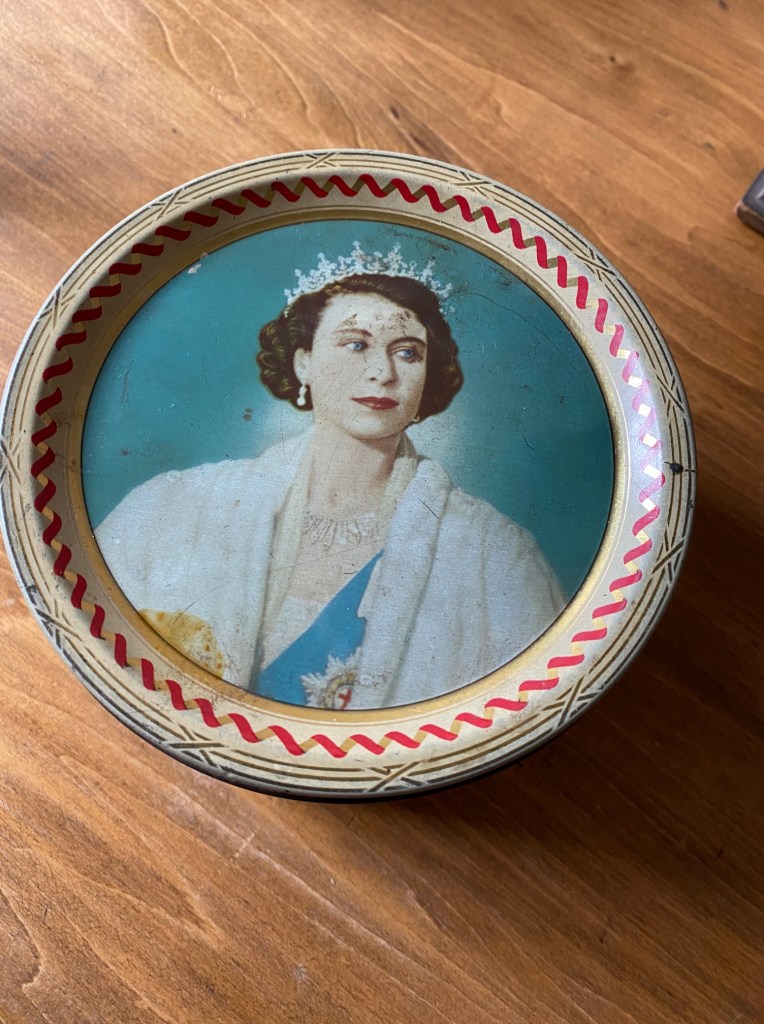
My mother was an Anglophile. With only a rural high school education, she read herself through English history, starting with Sir Walter Scott through Dickens, British history (fiction and non-fiction), until she could recite with ease the lineage of English aristocracy starting with Alfred the Great on down to the reigning Queen Elizabeth. When meeting someone new, Mother acquired an affected British accent. How the practice embarrassed me until I matured to find it endearing.
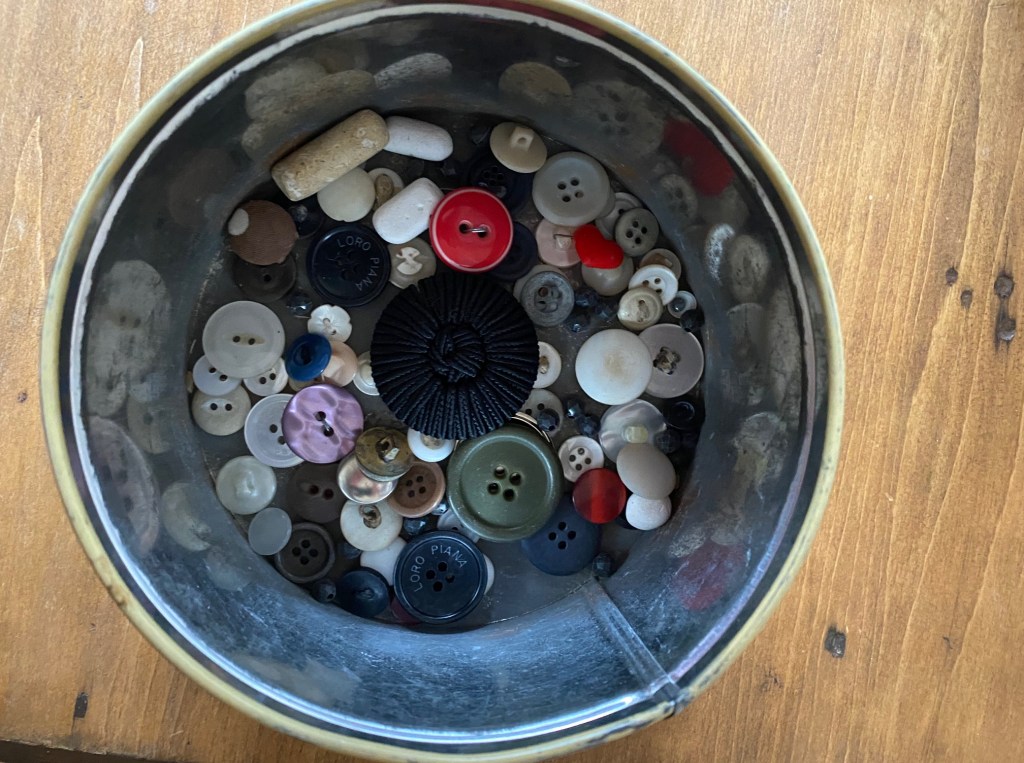
As with all idiosyncrasies of one’s upbringing, I thought her knowledge of the British monarchy was common. I didn’t question it any more than I found unusual the numerous mugs or dessert plates emblazoned with images of King George or Queen Elizabeth. They fit perfectly with Beatrix Potter animals lined on the sideboard or ceramic hot plates with Old Fezziwig dancing under the mistletoe. Most of these treasured keepsakes have disappeared, but today, a day after the death of Queen Elizabeth, I take out a tin button box painted with Elizabeth’s coronation picture from the 1950’s. It had been a tin of Mackintosh toffee, always a favorite, and certainly a treasure the year of the coronation. Long after the sweets were consumed, Mother used the tin to store errant buttons—buttons lost, buttons saved in anticipation of loss, buttons purchased because they were oh-so-lovely and may someday be of use. I lift the button box from my sewing basket, shake it for its pleasing sound and admire the photo of the young, newly crowned queen, all the while missing my mom.
Mother and I were glued to our small black and white television set for Elizabeth’s coronation. Elegant and somber, the young queen accepted the heavy crown, its weight Shakespearian in significance. Crowds swarmed London, a city still darkened in the aftermath of World War II. Mom and I cheered along. And years later, then on color television, my attentive daughter would sit with her grandmother, filled with celebratory joy for the wedding of Prince Charles and Diana. Mother, newly widowed then, recently adopted a white kitten found wandering in the neighborhood whom she immediately named Prince Charles. Charlie grew fat and affectionate for her until her death.
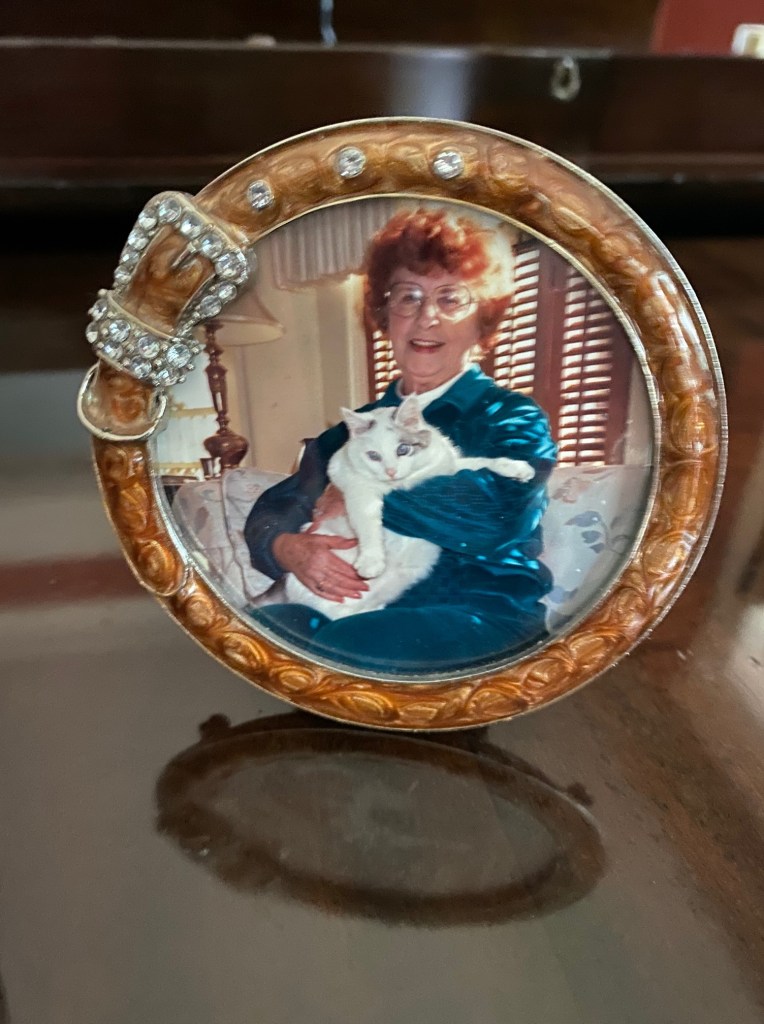
“Oh Mom,” my daughter called yesterday, “Has the queen really died?” Together, my mom, her grandmother, arose in our memories.
And today, I reacquaint myself with my mother, seeking an explanation for her adoration of the British royalty. On the surface, they could not have been more dissimilar. My mother grew up on a struggling farm in northern Wisconsin. Her greatest goal was to flee the farm, which she did. Elizabeth grew up with affluence and privilege, although any urge she might have had to flee was stifled her entire life. My mother had little power or influence. Elizabeth had significant influence, but constitutionally curtailed power. And if you have watched The Crown, you will realize her boundaries were set by a corporate monarchy, right down to her pastel suits that framed her image.
Yes, humans reach for heroes; for example, in pop culture and sports, but I don’t think it was the grandeur that Mother might have hoped would spill over into her life. What she had in common with Elizabeth was fulfilling a promise, as unforeseen as it might have been. At eighteen, my mother pledged herself to our father. Although not always bad, the marriage was unstable. My mother endured economic and emotional instability that she mopped up with the same determination she showed when cleaning the kitchen floor. She took a secretarial job to support us, one where she worked with such perseverance that she became, and proudly to her, the executive secretary to the bank president. Today she would have been called a vice president, or at least a loan officer; however, the glass ceiling was concrete and exactly at the height of her braided hair. She would not leave her husband or her home for more opportunity.
At twenty-one years old, Elizabeth publicly declared her commitment to serve the British people for her entire life. And she did that, although many can rightly argue that her labors were not always on the side of the common good. Yesterday I emailed my young Belarusian friend, Hanna, who is doing graduate work centered on social injustice in countries such as Belarus. Since she is in London at university, I asked her what it was like to be there on the day the queen died. She responded forcefully with multiple citations of the queen’s suppression of human freedoms, especially in former colonies: “You might expect what my opinion on the monarchy is. Putting a bunch of people above millions, and billions of others by birth… I find there are few systems as unfair as monarchy,” she wrote.
So much for my nostalgic musings of Mother and Queen Elizabeth. Was my mother unaware of racism in Buckingham Palace? Certainly, she recognized the long silence after Diana’s death. What I am seeing now is a mother who wanted for her admiration a human being such as she was. Elizabeth make mistakes, ones plastered across tabloids. Mom made mistakes not significant enough to attract attention. Elizabeth stuck to a pledge made when she was too young to imagine its consequences, as did my mother. They endured. Perhaps it makes sense that among all the royal keepsakes I kept the button box. With effort, I pry open the tin lid. Inside there are common black and white buttons I will never use. But there are also those worth saving and some oh-so-lovely.

 Mary's Room With a View
Great insights into your mother, and what a good, decent, intelligent person she was.
My grandmother was born into a wealthy English family, but she was disowned when she eloped with a commoner and moved to Victoria, B.C. She did keep her English ways despite living in poverty. For example, she drank tea every day at 4:00p.m. and always had a tea cozy on the teapot. My mother carried on the cultural ways of my grandmother, and I relate to your experiences around the Coronation. I agree with your friend regarding the Queen’s unfairness and disregard for dignity of all people. Also, while the Queen exhibited remarkable leadership skills, she did not have to deal with the everyday stresses and annoyances that we commoners face everyday.
Sylvia
LikeLike
Good one!
>
LikeLike
Such a wonderful piece, Mary about the things in history that affect our lives–even if they seem somewhat irrelevant to us as children. QE II was big in my family too because my paternal grandparents were British and Irish. We had tea cups with the Queen on them and when I moved my mom I gave them to the Goodwill. Now I kinda wish I had them. Thanks for your post.
LikeLike
Thank you Debra. I am grateful for my young Belarusian friend who lifted me from nostalgia to understand the complexity of those we admire.
LikeLike