After dessert at a dinner for University of Washington supporters, our host asked each to say what we love about the UW. “I appreciate the Access Program,” I said. “With the permission of the instructor, senior citizens can audit any class for only five dollars.”
“Are you taking a class this next quarter?” she asked.
“Yes, The Philosophy of Feminism.”
“Isn’t there a course in Masculinism?” quipped the man next to me.
“Sure,” I said, “It’s called The History of the Last 2,000 Years.”
 Everyone laughed.
So began my thinking about the Philosophy of Feminism a week before I walked into a lecture hall with 140 undergraduates. I was prepared for Female vs Male. I was prepared for Slam the White Patriarchy. All of this without giving time to define Feminine or Masculine.
The professor, an exceptionally thoughtful woman, began the class asking each of us to write down our name, what pronoun we preferred for addressing us, and any needs that might affect our equal access to the class.
Ah, the pronoun thing. I was ready for that, even though my English teacher identity cringes when a single person selects they. Needs? Well, vision and hearing. What if the students felt they had no needs worth noting? “Everyone has needs,” the professor explained, “so if you are inclined to say you have none, please say, ‘I anticipate my needs will be met.’”
Got it. If I say I have no needs, while the student next to me announces her deafness, she is cast as “other,” or “outside the norm.” This class practices inclusion, and so it did, all the way to the final exam.
When I told my friend Bindy I was taking The Philosophy of Feminism, she asked how Feminism can be a philosophy. I looked up philosophy, and among many definitions is “the way one looks at the world.” Then if we can have Marxism, named after a man, and Socialism, named after an economic structure, both recognized as philosophies, a Feminist lens can be a philosophy as well.
As the class progressed, I noted the elasticity of gender. We read essays by noted Feminists and women who struck out for equal rights to vote and work, but we also studied other marginalized groups, many ethnicities and all genders. Starting with oppression, the professor invited volunteers to tell about occasions when they have felt oppressed. 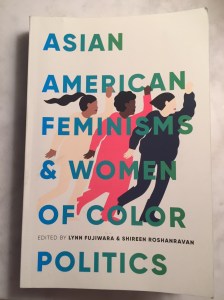 A young black woman raised her hand. “It is mostly older white people who say this,” she explained, “but I feel oppressed when people think they are flattering me by commenting on how articulate I am.” What she heard in that compliment, was “You are a black woman and so I am surprised that you speak so well.” The black man sitting next to her added he was tired of representing to others the conditions of a black man in America. “Just read the front page of your newspaper, if you want to know what it is like to be a black man in America. It is not the job of the oppressed to educate the oppressor.” Although that quotation came from one of our readings, hearing it from him, I heard it as Truth.
I was learning from these young, progressive students to view a world that I had not experienced in similar ways. I reflect on the fewer opportunities for women when I was a coed in in the early ‘60’s. Yes, I was marginalized as a woman, and now may be marginalized as a senior citizen. When a student saw a solution to many of our country’s issues in eliminating congressional representatives over 60 years of age, I raised my hand — Ageism, the one marginalized group not yet addressed in the class. After class, he apologized to me, the one over-sixty student among them. I accepted his apology and thanked him for all the words his generation gave me that were not available when I was nineteen: sexual harassment, date rape, non-binary, intersectionality micro aggression.
Our language stretches every year to better accommodate events, debates, and feelings. If I had thought Feminism simply concerned advocating for women, by the end of the class, that definition was too narrow. I grew to see that Feminism represents advocacy for a world where every person has an equal access to well-being and to power. It is personal and it is political. It is a philosophy ready for the embrace of all people who see the world as a community with differences, but ones that do not elevate a group at the expense of another. Anyone can be a Feminist.
This summer the UW does offer a class in Masculinism. Yes, a class to discuss what it means to be a man. I wish I could attend that class too, but it IS summer, so I am at our cottage on Quilcene Bay, not in a campus classroom My student desk is replaced by an L.L. Bean rocking chair on our deck where I can read and reflect on my connection to others – even the violet green swallows flitting over nesting boxes and swooping up bugs for their babies.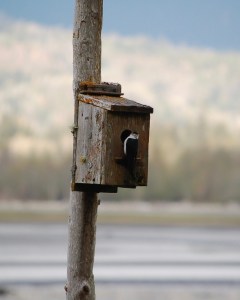

 Mary's Room With a View
Beautifully said, Mary. If only we all could be “people who see the world as a community with differences, but ones that do not elevate a group at the expense of another.” While the roots of Masculism sharply differ from (are the opposite of?) those of Feminism, ideally the two philosophies would end up being the same.
Enjoy your time at Quilcene!
Sylvia
LikeLike