In a college linguistics class, my professor explained that idioms make American English a challenge to learn. “For example,” he illustrated, “how can a person who understands the separate meaning of put, up, and with, infer put up with means to endure?” Likewise, understanding pay and attention, why would someone combine them for pay attention, as in to notice, or to focus on something? Pay suggests debt and remuneration. Could it be that paying attention is a choice to purchase, or a willingness to invest something of yourself?
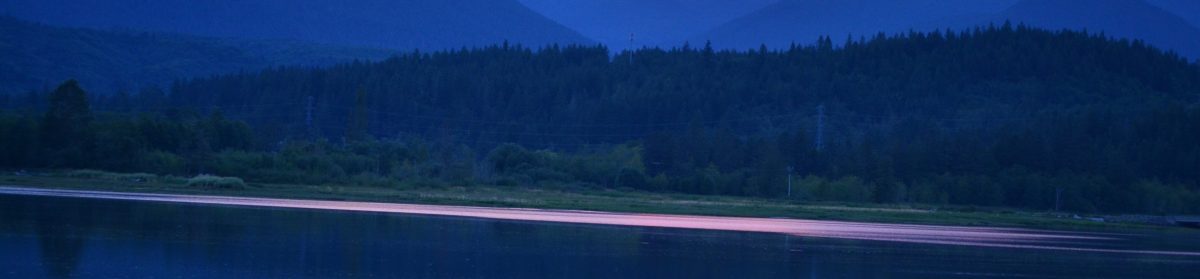
Yesterday morning, driving my grandson to school, I was attentive to his lively accounting of his weekend’s crew regatta. Showering me with details of the course, wind and water, he suddenly excused himself to change the subject.  Then he began, in acute detail, to describe the sunrise over a semi-cloudy horizon above the Cascades. The scene called for his attention as we drove at 55 mph over the Ship Canal bridge. I remained attentive to cars ahead. Max described a ribbon of light between mountains and clouds, a “urine yellow beneath a black cape.” Mid-range, between Lake Union and the Cascades, he noted marshmallow clouds hovering at vacillating heights opening to reveal snow-spotted peaks. “ It seems even more dramatic,” he said, “because we are driving past.”
“Like performance art,“ I offered.
“Yah,” he agreed, then returned to telling about the regatta and medals won by his team.
“My medal for Max,” I thought, with a grandmother’s pride “how he notices the world. He pays attention. His is an investment in creative consciousness.”
Surely spring seduces our attention, a welcome price to pay for warm sunrises, the embryonic unfurling of ferns in early May. 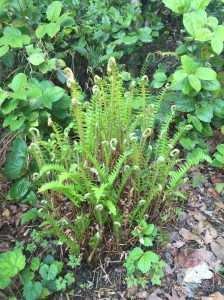 We notice each new flowering dogwood tree or rose, pausing because we know the blossom will not last for weeks.
Yet every season, I cannot think of paying attention without recalling the evocative plea of Linda Loman referring to the decline of her husband, Willy Loman, in Arthur Miller’s Death of a Salesman.
“Attention must be paid,” she demands in a prophetic voice that mourns the waste of a human being by the crushing jaws of capitalism.
 My generation sometimes boasts that it is The Greatest Generation and romanticizes cruising Route 66 in gas guzzling cars. Our generation paved miles of farmland for highways to take us to strip malls cemented over where valley farms once stood. Were we so inattentive to the environment we took for granted? Now we foresee a great debt called in for our children and grandchildren to pay.
Two afternoons a week, I audit The Philosophy of Feminism at the University of Washington. Surrounded by a hundred students between the ages of 18 and 22, I am hearing where they are attentive. Yes, cords connect their smart devices to their ears, so folks from my generation assume young adults are inattentive to all but their own music or messages. However, in class discussion of generational differences, these students are paying attention to my generation’s arrival at journey’s end, with remaining years of dependence on social security that these students’ salaries will fund until Social Security is depleted, likely before today’s youth reach retirement age.  Especially in Seattle, they are aware that student housing costs as much as their tuition, in a city where the two richest men in the world live in mansions. Unlike our generation, these young adults do not expect to surpass the prosperity of their parents. As Max focused on the beauty of a sunrise, they are paying attention to climate change and the very air they breathe.
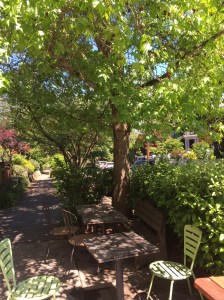
This morning, the sun spills through Volunteer Park Café where I sit attentive to long shadows cast by the fully leafed-out sweet gum tree outside the café window. I remember that we are exhorted to “live in the moment,” inviting me to drink in the loveliness of the leaves. At the same time, human consciousness sweeps my attentiveness to years spent and years to come. When I was teaching high school, if my students tumbled into pleasurable distractions, I would say, “Listen up,” another curious idiom. At the end of this day, I want to recall how I cashed in my hours paying attention.

 Mary's Room With a View
Mary, you are an expert at helping us pay attention, especially through these blogs that bring us to focus on important topics — feminism, language, nature, family, and community, to name a few. I especially appreciate your keen sense of what is going on and openness to expressing your views. Your outstanding communication skills guide us to see the point you are making and encourage us to ponder further . We pay attention because you clearly share your thoughts and truly listen to ours.
LikeLike
Mary,
What a lovely, thought-provoking post. In early human history, survival depended on one’s ability to pay attention to signs from Earth and sky. In the 21st century, paying attention is optional – lobbyists tell us how to live, media tells us what to think, religion tells us what to believe. Mindfulness classes are gaining popularity to learn once again the skill of paying attention. I’m glad Max is observant; perhaps his generation will save us. “By the way,” it sounds like Max was “on cloud nine” about the regatta. I feel sorry for people trying to learn English; we have many bizarre idioms.
LikeLike
Mary, what a wonderful commentary on both language and creative consciousness. Where did “pay” attention come from? I mean, from whence it came? I love that your grandson interrupted himself to point out beauty. Bravo!
LikeLike
This is absolutely stunning, Mary! One of your best. I, too, savor spring and the opening of the leaves and blossoms. I know the blossoms won’t last, so I look and smell.
Your grandson sounds amazing, just like you.
LikeLike