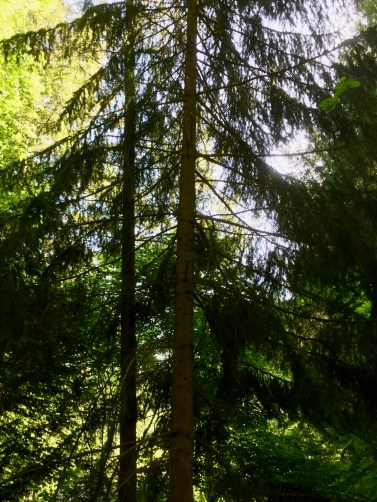
Throughout his twenty-five year ministry at University Congregational Church, Dr. Dale Turner frequently distributed little cards with pithy sayings to the congregants as they lined up to shake his hand after Sunday service. Our daughter was eight-years-old, when we stood in line together, I, waiting for the card, she eager for his hug. A sketch of a potted geranium illustrated the 3 X 5 card on which was written: “Bloom Where You’re Planted.” That Sunday, there was an additional take-home gift, because Professor Thomas of the UW Forestry Department donated trays of evergreens, each one seeded in a tiny test-tube for planting. Our daughter clutched hers in her small fist all the way home. No waiting for lunch. First, we had to spot the perfect sunlit, but well-watered site in our back yard for her tree, a fir of nameless variety. We named it our Dr. Turner Tree. Just like our daughter, the tree grew, and grew until we realized we had a fir of Pacific Northwest proportions. The Seattle backyard could not contain its potential. Within four years, we dug up the tree and transplanted it on our wooded Hood Canal property in Quilcene, where it could mature next to its Douglas Fir cousins. Years have passed; Dr. Turner retired, and has passed away. His tree is over 40 feet high, spreading its evergreen limbs over the drive down to our cottage. I rarely walk past, without looking upwards to remember the pastor who performed our wedding ceremony, who guided us and thousands of others on our spiritual journey.
“Bloom Where You’re Planted” has returned to my restless mind often when I have leaned toward a geographical solution to a dilemma I would like to escape. What also roots me is my connection between plant and memory, a bridge that snugly holds me to home. In 1975, we bought our well-lived-in house in Seattle. The 1906 house showed generations of child wear. The back yard served as playground for very large dogs. Its surface was clawed like a rugby field.
In the early ‘80’s a nurse who worked at the University contacted my husband about acquiring one of his prints. That exchange led to friendship with Mary Pearlman whose only son was serving in El Salvador to help with land reclamation for the citizens there. When Mary saw our skinned back yard, she insisted that we take from her yard a Russian olive tree and a deep purple lilac bush. I eagerly planted the lilac next to the back-porch stairs, so that coming and going I could recite to myself, “When lilacs last in the dooryard bloomed,” the opening line to Walt Whitman’s moving elegy for Abraham Lincoln. President Lincoln was assassinated in April. 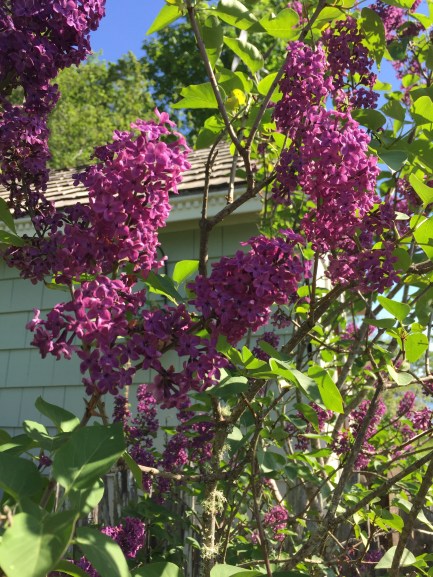 The lilac blooms in April, its intoxicating fragrance mourns with the hopefulness of spring. Mary Pearlman’s 31-year-old son, Mark, was gunned down in a hotel in El Salvador, killed under the Duarte regime that could never conclusively bring any killers to justice. Not a year passes without my thinking of all of this loss and all of the generosity, as the deep purple flowers bloom again.
Objects also evoke memory: art, books, even furniture can bring back a parent sitting in a particular chair, under a framed portrait and reading Treasure Island. However, the gift of living things, of plants and trees, not only holds memories of the giver, but the gifts themselves evolve. Their very growth feeds hope for immortality. Perhaps it is the English teacher in me who projects such import to my growing gifts. Next to the bench where my mother loved to sit and watch ducks land on Quilcene Bay, I have planted a Lady’s Mantle her neighbor brought over the week my mother died. A perennial, it holds rain drops in its plate-like leaves, drops I saw as tears. In my mind’s eye, I can see my mother, tea cup in hand, sitting on that bench. Also, I recall her neighbor, Sharon, a woman whom I have not seen for decades.
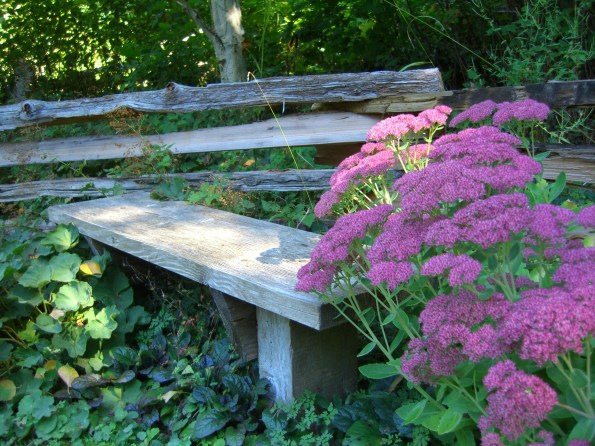
Down the hill from Mother’s bench, spreads a Texas maple my brother John sent from Houston twenty years ago. It arrived in a narrow cardboard box. The tip of the tree had snapped off in transport. Now, John brags that everything is bigger in Texas, so his maple should shoot up past the ancient Big-Leaf maple across the lawn, but Washington State won’t bow down to Texas when it comes to tall trees. This year, the Texas maple runs about fifteen feet, a spreading, delicate canopy. I wonder if the two maples talk to each other across the span of lawn. Scientists know that trees do communicate, if not by speech, by sharing nutrients and even warning signals when infection or blight is in the neighborhood.
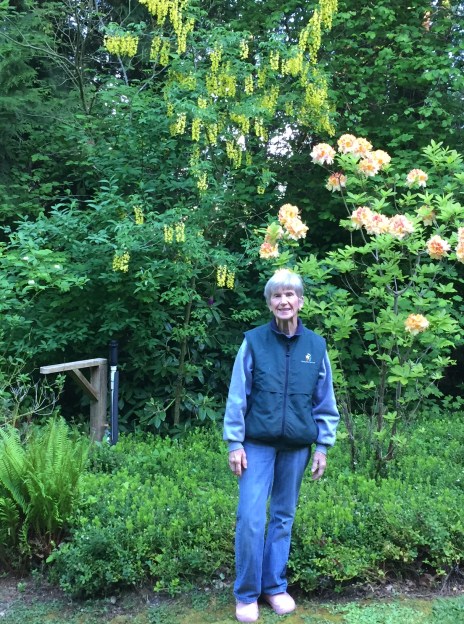
We are a transient people, packing up and moving around the globe. We may inhabit several homes before we die. As hard as it is to leave a house, to leave the plants around the home is more poignant. A tree inhales and exhales just as we do. It lives on. And today my husband is holding up my I Phone to photograph me in front of a ten-foot chain tree in full golden bloom. When my granddaughter was a little girl, we bought a six-inch stick of a thing at the Quilcene Village plant sale. What fun to buy the smallest plant, the 25-cent thing for which we had to ask its name, and to gamble that we could help it grow. It grew! I transplanted it at four feet when it needed more room. A deer found it in the open yard and munched it back to two feet. I am texting that photo to my granddaughter, a sophomore in college in New York City. Remember our chain tree? Miss you. Love, Nana.


Mary, I always enjoy your writing and adding photos to it makes it even more amazing. Thanks for this.
LikeLike