The Bucket List


            Last year, a group of my longtime women friends gathered for an every-two-month Zoom chat.  Joined in friendship for having exercised between 5:30 and 7:00 AM at the Washington Athletic Club, and having shared the same mirror for applying make-up before heading off to various jobs, we remained friends through ensuing decades and retirement.  Now we exercise in Seattle, Sacramento, Billings, Newport – all separated from the communal mirror, but we remain a supportive group, encouraging one another as we move past “significant” birthdays.  It was while we were cheering on Sylvia, walking across her 80-year milepost, when we recalled all she had done in her productive life, yet also what she had not done. In all of her eighty years, Sylvia had not attended a rock concert.
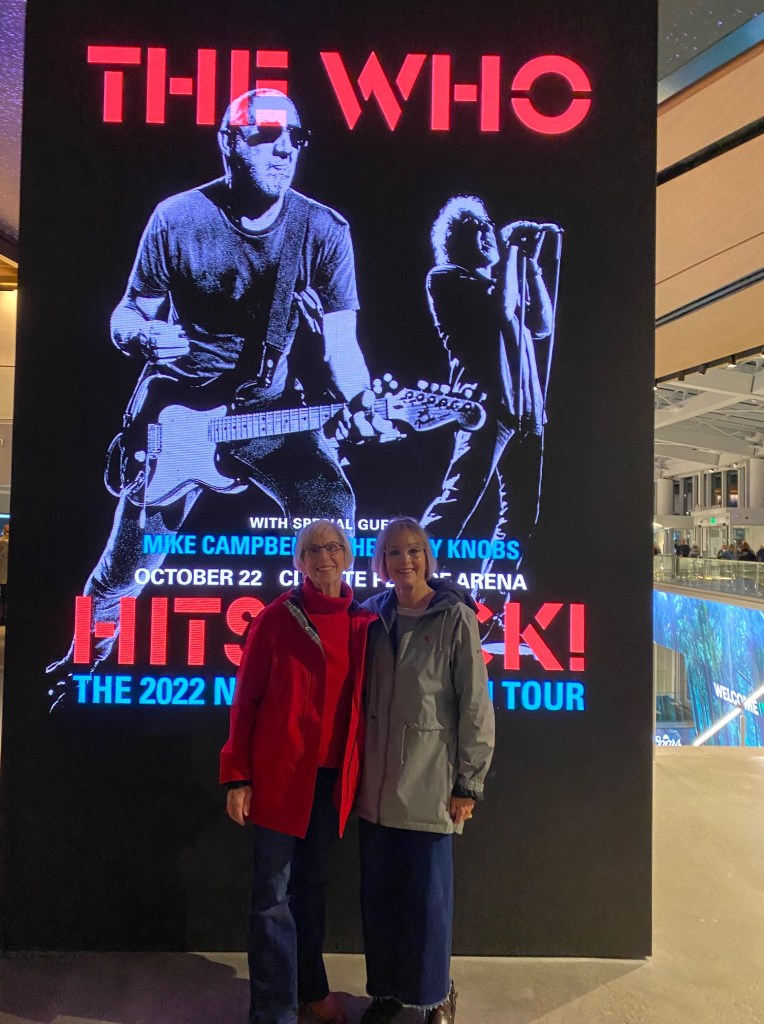
            “That’s it,” Nikki chimed in.  “We have to take Sylvia to a rock concert, a critical item for her bucket list.” Sylvia has been a parent, wife, Director of Children and Family Services for the State of California, just one of many social agencies she headed up. There isn’t much Sylvia has failed to accomplish nor experience.  Yet, within minutes, the group was assigning each other to locate accessible rock concerts that would not involve too much travel or expense, and then to acquire tickets.  We settled on The Who, a rock-concert scheduled a year down the road in Seattle’s newly refurbished Climate Pledge Arena.  Since some of us still live in Seattle, we could host those who had moved away.  Perhaps committing to such a distant date made it easier for me to go along, not being inclined to expose myself to decibels of ear shattering instruments nor crowds of baby boomers trying to rock back into their teens.  I agreed to go, because it would mean a weekend with my dear friends, women with whom I share a history.

            Here I am, having survived the rock concert, yet still reflecting on the notion of a bucket list.  I sought out Wikipedia for a definition, even though it is a common idiom made popular by the Jack Nicholson/ Morgan Freeman movie.  We know it evolves from the phrase “kick the bucket,” ie. die.  And “kicking the bucket” for death goes back to the 1700’s when it may have referred to a condemned man standing on a bucket before the gallows.  When the bucket was kicked out from under him, the noose gripped and ……

            A bucket list is a list of experiences one hopes to experience before death.  But why?  What is there about our society that expects death to be more palatable if it is preceded by a life filled with random experiences: travel, childbearing, financial success, sports, hobbies , attending rock concerts?   Or is having a bucket list a way of forestalling death?  “Can’t go now, Grim Reaper.  I have a rock concert to attend.”

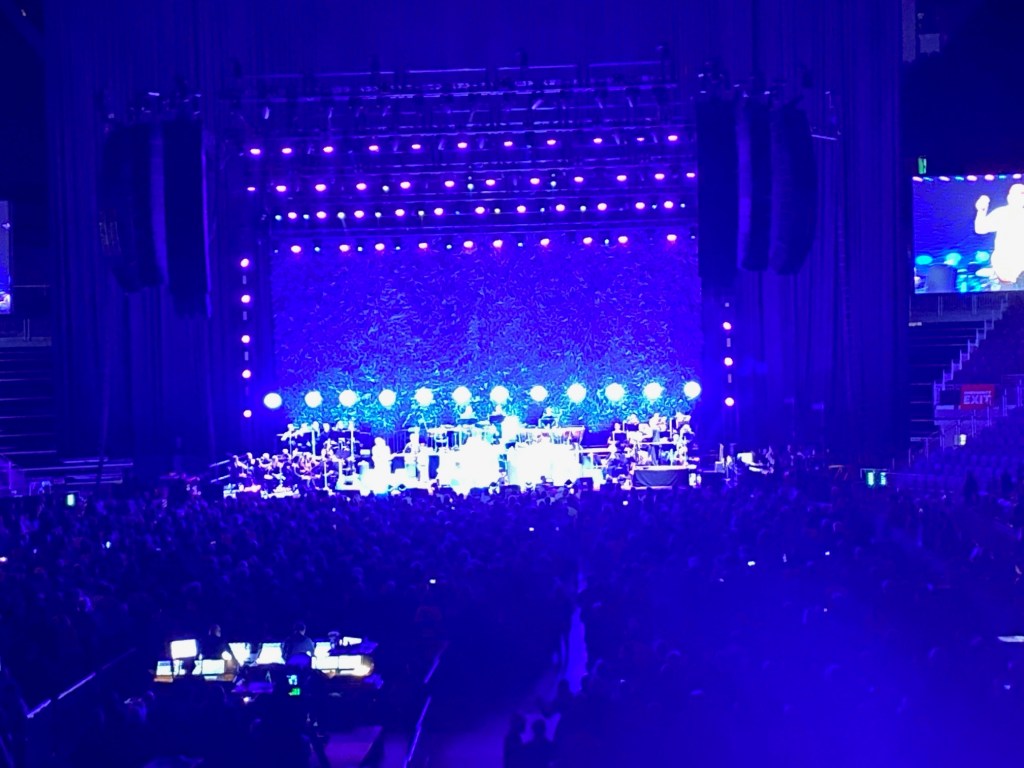
            The bucket list allows a forward gaze.  Who doesn’t like to have something for which we can look forward?  Yet let’s look at the attendance at the Who concert.  There were no teenagers jumping, waving arms, throwing themselves on the stage.  Surely there were teenagers in the audience, but many were brought along by their parents or grandparents.  From where we sat mid-center across from the lights flashing on stage, I have not seen so much gray hair — gray hair for those who still had hair.  I should confess here that although I was vaguely aware of the Who in the 1970’s, I was preoccupied as a single parent with a toddler and teaching high school, so that I was oblivious to popular music beyond the Beatles.  Yet there I sat surrounded by folks my age who were mouthing lyrics I could not discern through the amplification while they thrust out their arms in remembered gestures that accompanied those songs, gestures made when both the Who and the audience were much younger. The opposite of looking forward, is looking backwards.  Surely, we were looking both ways.
            Americans are proudly always on the move.  I have the attention span of fly in a sugar factory, so I understand this split between “the good old days,” and “what’s next?” Yet one of the benefits of aging is the way the body slows down.  How comforting to do nothing but sit, observe, feel.  In Milton’s sonnet “On His Blindness,” Milton despairs that his fading eyesight prohibits him from writing; whereas writing was his vocation, literally his calling to serve God.  After bemoaning his blindness in the first eight lines of the poem, Milton arrives at an understanding that God doesn’t need Milton’s gifts, that “Those also serve who only stand and wait.”  I keep that line in my pocket, even when stuck in a sluggish line at a grocery store.  How obsessed I can be with Chronos, with sequential time, years passing; whereas, Kairos focuses on qualitative time.  Was the Rock Concert important to do before death?  Certainly not, but qualitative time with my friends is a treasure.  
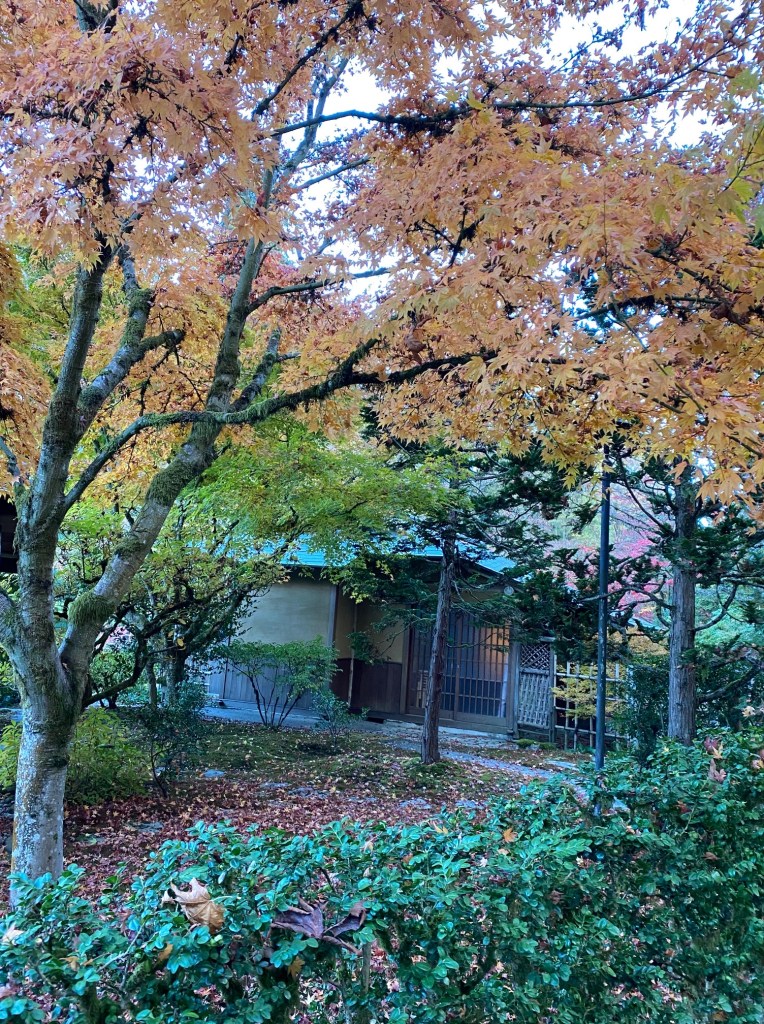
Japanese Tea House. Arboretum, Seattle
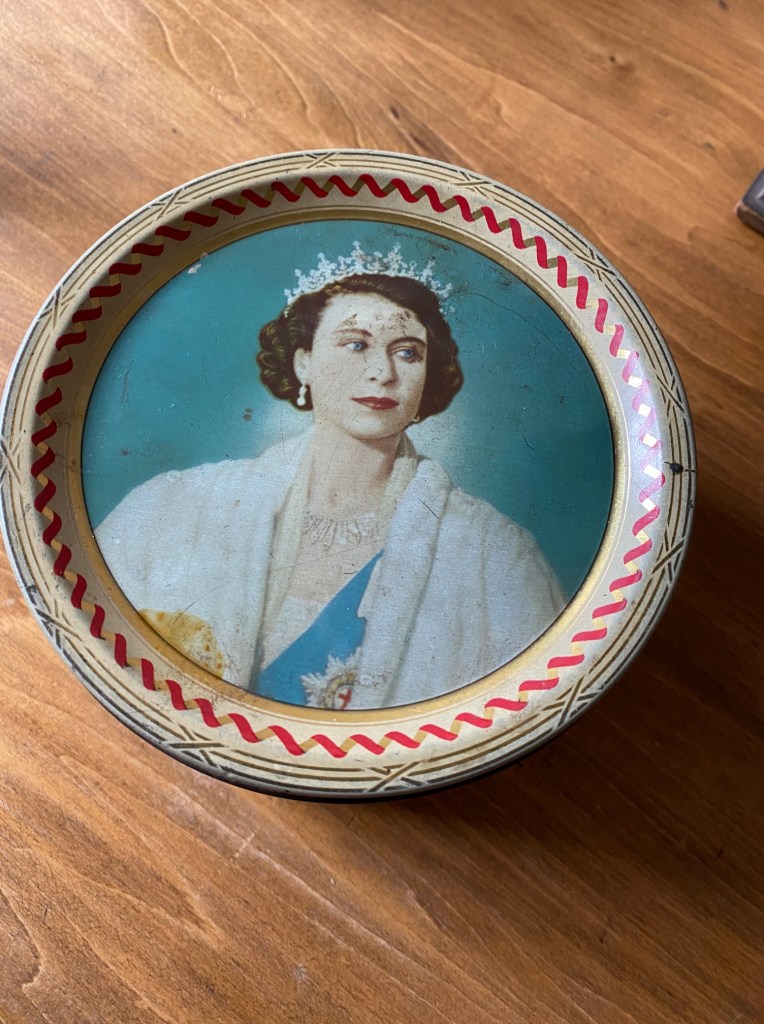
Queen Elizabeth and the Button Box


            My mother was an Anglophile.  With only a rural high school education, she read herself through English history, starting with Sir Walter Scott through Dickens, British history (fiction and non-fiction), until she could recite with ease the lineage of English aristocracy starting with Alfred the Great on down to the reigning Queen Elizabeth.   When meeting someone new, Mother acquired an affected  British  accent.  How the practice embarrassed me until I matured to find it endearing.

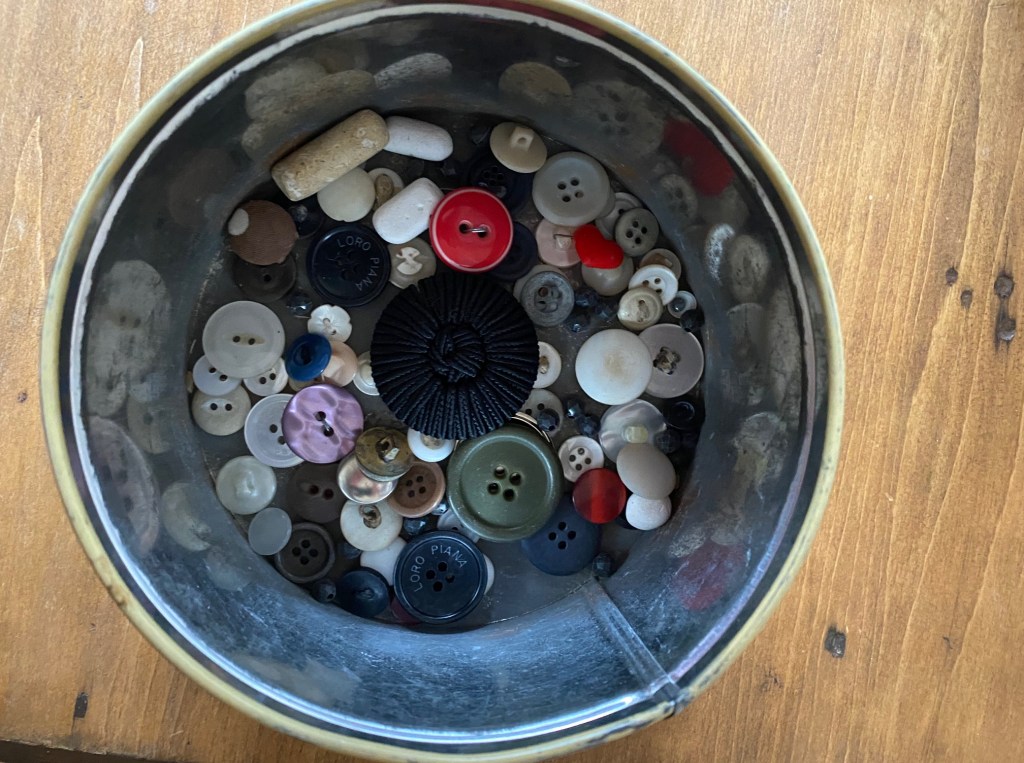
As with all idiosyncrasies of one’s upbringing, I thought her knowledge of the British monarchy was common.  I didn’t question it any more than I found unusual the numerous mugs or dessert plates emblazoned with images of King George or Queen Elizabeth.  They fit perfectly with Beatrix Potter animals lined on the sideboard or ceramic hot plates with Old Fezziwig dancing under the mistletoe. Most of these treasured keepsakes have disappeared, but today, a day after the death of Queen Elizabeth, I take out a tin button box painted with Elizabeth’s coronation picture from the 1950’s.  It had been a tin of Mackintosh toffee, always a favorite, and certainly a treasure the year of the coronation.  Long after the sweets were consumed, Mother used the tin to store errant buttons—buttons lost, buttons saved in anticipation of loss, buttons purchased because they were oh-so-lovely and may someday be of use.  I lift the button box from my sewing basket, shake it for its pleasing sound and admire the photo of the young, newly crowned queen, all the while missing my mom.

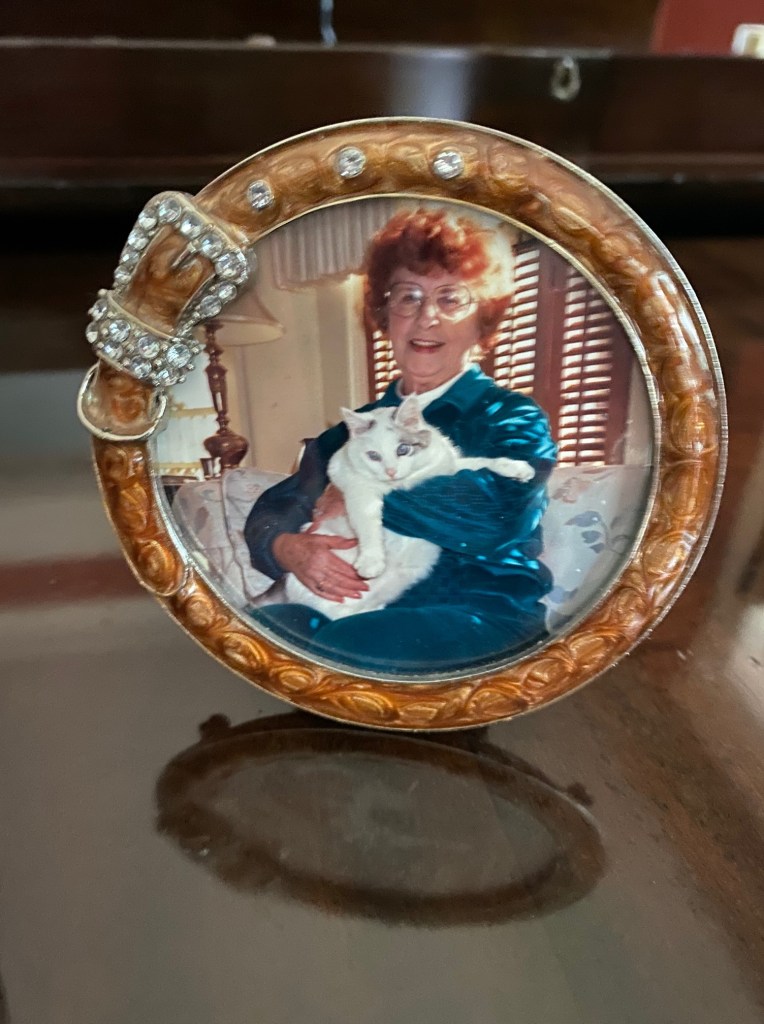
            Mother and I were glued to our small black and white television set for Elizabeth’s coronation.  Elegant and somber, the young queen accepted the heavy crown, its weight Shakespearian in significance.  Crowds swarmed London, a city still darkened in the aftermath of World War II.  Mom and I cheered along.  And years later, then on color television, my attentive daughter would sit with her grandmother, filled with celebratory joy for the wedding of Prince Charles and Diana.  Mother, newly widowed then, recently adopted a white kitten found wandering in the neighborhood whom she immediately named Prince Charles.  Charlie grew fat and affectionate for her until her death.

            “Oh Mom,” my daughter called yesterday,  “Has the queen really died?” Together, my mom, her grandmother, arose in our memories.

            And today, I reacquaint myself with my mother, seeking an explanation for her adoration of the British royalty. On the surface, they could not have been more dissimilar.  My mother grew up on a struggling farm in northern Wisconsin.  Her greatest goal was to flee the farm, which she did.  Elizabeth grew up with affluence and privilege, although any urge she might have had to flee was stifled her entire life.  My mother had little power or influence.  Elizabeth had significant influence, but constitutionally curtailed power.  And if you have watched The Crown, you will realize her boundaries were set by a corporate monarchy, right down to her pastel suits that framed her image.

            Yes, humans reach for heroes; for example, in pop culture and sports, but I don’t think it was the grandeur that Mother might have hoped would spill over into her life.  What she had in common with Elizabeth was fulfilling a promise, as unforeseen as it might have been.  At eighteen, my mother pledged herself to our father.  Although not always bad, the marriage was unstable.  My mother endured economic and emotional instability that she mopped up with the same determination she showed when cleaning the kitchen floor.  She took a secretarial job to support us, one where she worked with such perseverance that she became, and proudly to her, the executive secretary to the bank president.  Today she would have been called a vice president, or at least a loan officer; however, the glass ceiling was concrete and exactly at the height of her braided hair.  She would not leave her husband or her home for more opportunity.

            At twenty-one years old, Elizabeth publicly declared her commitment to serve the British people for her entire life.  And she did that, although many can rightly argue that her labors were not always on the side of the common good.  Yesterday I emailed my young Belarusian friend, Hanna, who is doing graduate work centered on social injustice in countries such as Belarus.  Since she is in London at university, I asked her what it was like to be there on the day the queen died.  She responded forcefully with multiple citations of the queen’s suppression of human freedoms, especially in former colonies: “You might expect what my opinion on the monarchy is. Putting a bunch of people above millions, and billions of others by birth… I find there are few systems as unfair as monarchy,” she wrote. 

            So much for my nostalgic musings of Mother and Queen Elizabeth.  Was my mother unaware of racism in Buckingham Palace?  Certainly, she recognized the long silence after Diana’s death.  What I am seeing now is a mother who wanted for her admiration a human being such as she was.  Elizabeth make mistakes, ones plastered across tabloids.  Mom made mistakes not significant enough to attract attention.  Elizabeth stuck to a pledge made when she was too young to imagine its consequences, as did my mother.  They endured.  Perhaps it makes sense that among all the royal keepsakes I kept the button box. With effort, I pry open the tin lid.  Inside there are common black and white buttons I will never use.  But there are also those worth saving and some oh-so-lovely.

Hear Me! Hear Me!

If you are of my generation, and have an ear for familiar sayings, you have read the title of my blog, and your ear remembers “Hear Ye!”  “Hear Ye!”  That was the call for emergent attention that preceded an important announcement, anything from “The British are coming” to “All those coming on board… the train leaves in five minutes. “  I can’t recall the last time I actually heard that familiar and urgent call.  Besides, who has used “Ye” in the last few decades outside of scholars of the King James Bible? Nevertheless, exclamations to be heard are as loud any time in history.

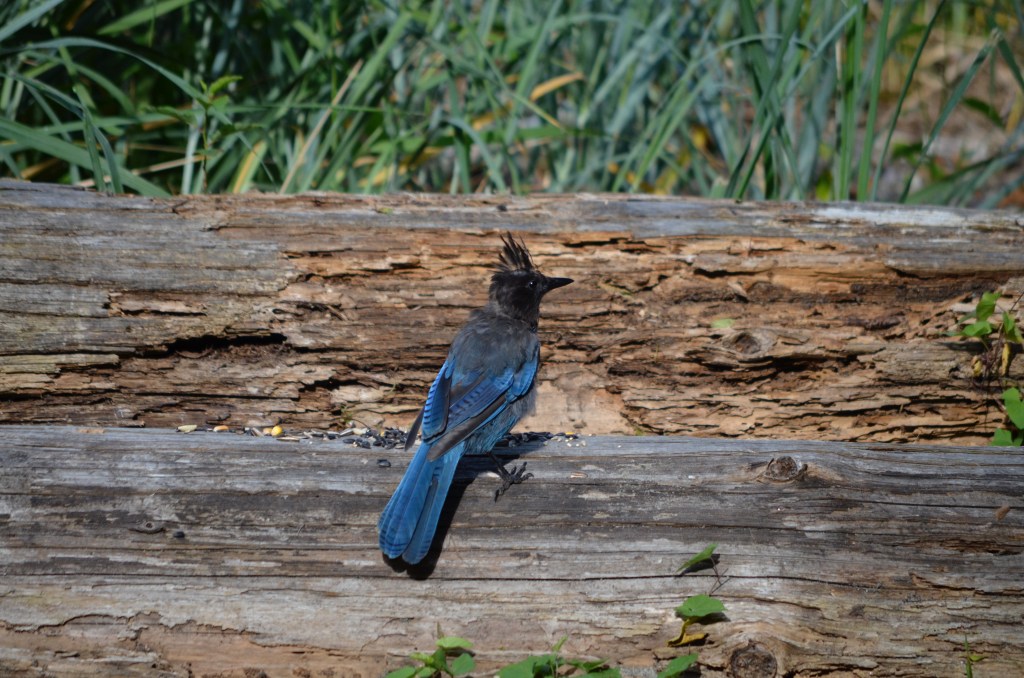
Mornings on the kitty walk around our Hood Canal property, the jay is screaming, expecting a peanut my husband has set on a log lining a trail.  The jay has a broad vocabulary, and if you are lucky enough to have their blue presence on your property, you too might distinguish a whistle for jay companionship, a scolding squawk when a squirrel gets the nut first, or an unrelenting chatter that lets you know the bird is there with breakfast expectations. Usually,  their voices are rewarded with nuts and seeds, but not always.  A loud chatter is no guarantee that food will soon rest on a convenient post.

So too our vocal cat, Winslow Homer. He meows or whines or clicks at passing birds.  At feeding time, he meows non-stop for a meal he knows by his internal clock is a few minutes late.  Or having mounted a fence and once there finding the going rough for his unwieldy weight, he lets us know by a few meows that he would rather be lifted off than jump down.  We hear him and respond.

We hear a honking flock of geese when the tides change.  We hear the ravens kaaing among themselves high in the cedar trees along the shore.  They ask nothing of us, but nonetheless we hear them. It interests me that there are calls for the sake of calling and calls with expectations of reciprocal action. 

Now to jump from our animal kingdom to our human “kin-dom.”

My father, a garrulous man who enjoyed his own humor more than any other person in our family, often egged me on to a debate, usually a political one.  Then when I expressed my deeply held views, he grunted, “Children should be seen and not heard.”  One of his favorite axioms, up there with “Spare the rod and spoil the child.” He was not a physically abusive parent, but his sayings reminded me that he undervalued my ideas.  When it comes to being heard, children are among the most marginalized populations.  A walk through any grocery story can confirm this, as an exhausted parent heading for a box of detergent ignores the pulling on her shirt from her child who has just walked by a neat stack of Hershey bars.  Yes, there are reasonable times to ignore a childish “Hear me,” that we have all experienced from our years as the pleading toddler to becoming the harangued parent.

On the opposite end of life, are the elderly, euphemistically called “senior citizens” to disguise their insignificance.  As their culture melts from all they had known as comfortably familiar, they feel as if they are not heard, or if they ARE heard, they are misinterpreted.  Consider the technological changes and social media in the past ten years alone.  Having spent fifty or sixty years dialing a phone, they are pushing letters with their swollen fingers on a gadget that “upgrades” so often they have no time to internalize the new terms included in the small print to which they must agree for service to be continued.  Having learned their English grammar and usage under strict instruction, they must recalibrate their ears to allow for a plural pronoun to represent a single person.  All for good reasons they can understand because that elderly person may not intend to insult someone who is offended by a binary pronoun.  Then there are the words for which they would have been reprimanded, such as “queer,” now embraced by the very community they did not wish to offend. 

Some seniors feel as if the most vocally rewarded populations have no interest in the stories of their lives.  What happened to the Norman Rockwell portrait of a child perched on a footstool  attentively listening at the knees of a grandparent?  Unless they are collectors of American Art, I would guess that most Americans have long forgotten Norman Rockwell, and never knew The Saturday Evening Post Magazine. Is there any interest in the grandparent’s life?

Last week I was one of those senior citizens demanding to be heard.  Swimming at the club pool between 7:00 and 8:00 AM, as was my decade’s long custom, I was instructed by the twenty-some-year-old lifeguard to give my lane to a man who paid $80/month extra to have Master Swim at that hour. The schedule change from 5:00 PM Master Swim hour to 7:00 AM occurred because that lifeguard was the coach, and the most convenient time for him was in the morning.  Before leaving the pool, I told the young man of my 40+ year membership and my history of morning swims.  He shrugged and walked off to the swim office.  My parting words: “You’ll hear from me.”   And yes, he did hear from me, after I emailed the Club Athletic Director. There will now always be a lane available for me to swim at 7:00 AM.   That is what is called economic power regardless of age, a reality of which I am not proud, but I used it. 

Whether or not someone is heard depends not only on age but on power.  Who around you is asking to be heard?  What is that person’s access to power?  One of my earliest blog posts featured the importance of remembering names.  Who does not want recognition for having spent a lifetime on Earth?  Sometimes that recognition comes during one’s life, and the name is noted.  Other times the story appears in an obituary, so persons who felt unheard during their life will never know that their voice was heard.

Voices matter.  Sometimes they are heard, and what a reward when they are, such as in Psalm 116: 1-2 “I love the Lord, for he heard my voice;/he heard my cry for mercy./Because he turned his ear to me,/ I will call on him as long as I live.”

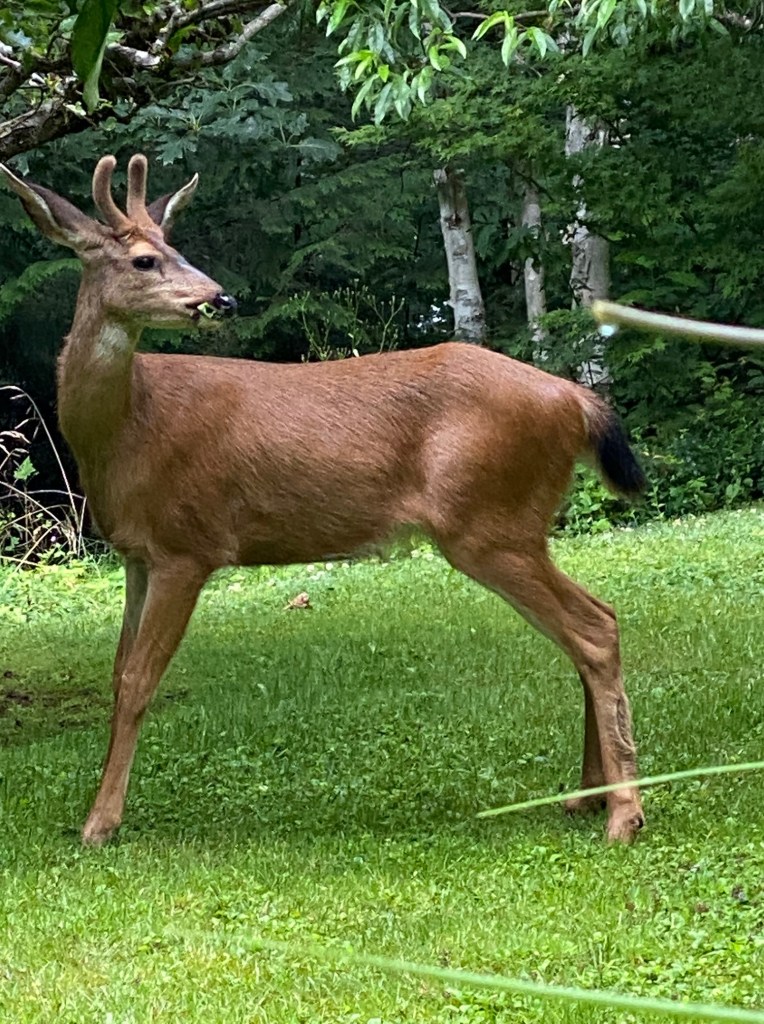
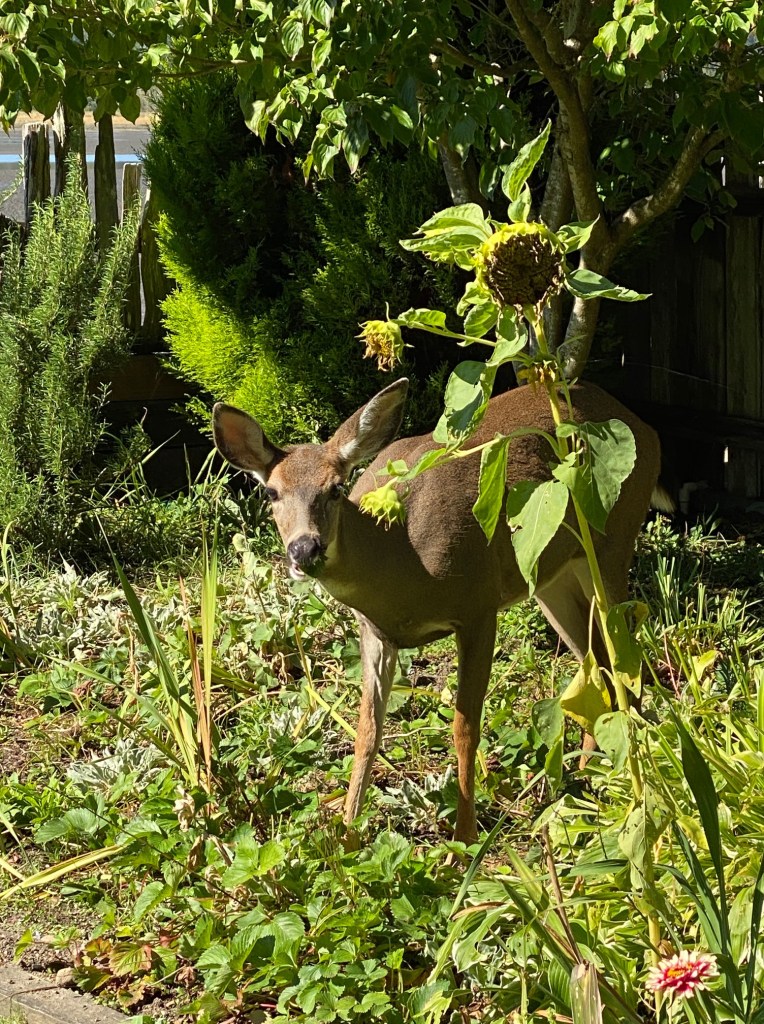
Curiously, silence may also be the tool for getting what we seek, such as this stunning young buck crossing beneath our fruit trees.  The hungry deer surprised us, and ignoring our presence, munched his way to satiated delight – all without a sound.  

LAWN DAISIES

When I am feeling low, to lift my spirits I head for the garden – any garden — my vegetable garden, or this weekend, the square of earth surrounding a dogwood tree that might bloom pink any day now.  Around that tree, wild grasses, forget-me-nots, dandelions and escaped strawberry plants elbow for space around lavender and rosemary, even a large hydrangea we surrounded with seasonal bulbs for daffodils and tulips.  That square is a melting pot of chosen and undesired intruders that all stake their claim on an eight-by-eight-foot square that suffers intrusive saltwater damage in winter when high tides seep over our driftwood fence.

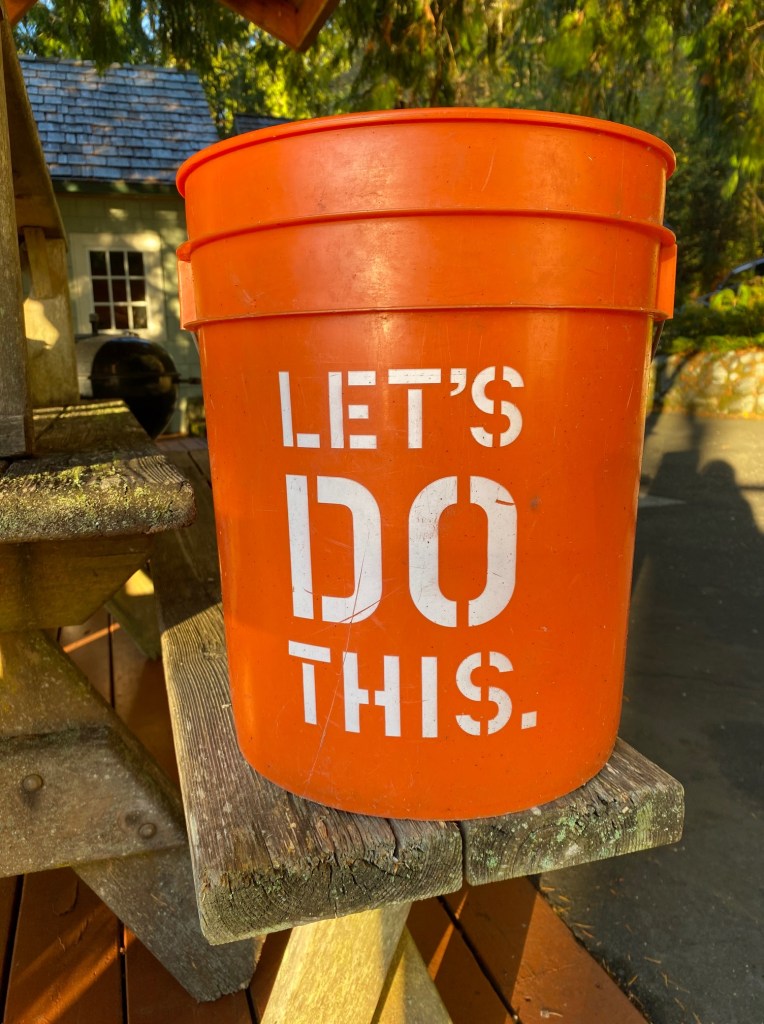
Last weekend, I carried a big orange bucket holding spades and clippers, plopped it alongside the wooden boards that separate the garden from our lawn and dropped to my knees to begin weeding.  My knees sunk into the soil, a rather soft landing that came to meet me in my sorrow.  I had taken with me feelings of despair following recent weeks of gun violence.  Despair would not let go its grip on my helpless heart.  Perhaps, unconsciously, I expected that spading and pulling out those weeds would lift me into hopefulness, the kind of hope that springs from an illusion of control.

How did my mother deal with sorrow? It was always clear when my mother was troubled.  I would find her on her hands and knees scrubbing the kitchen floor.  When she aged and housekeeping challenged her arthritic limbs, I offered to pay for a housekeeper to do that hard scrubbing.  She dismissed the housekeeper after one cleaning, because the woman used a mop at the end of a stick, refusing to get down on hands and knees.  I should have known, however, that the task was never about cleanliness.  It was keening, the kind of rhythmic movement made by Irish women when a death has occurred.   That back and forth, the reaching into corners with sore fingers, the scraping with fingernails a stubborn gooey blob under the kitchen table.  When my parents were not getting along, our kitchen floor was an advertisement for Aero Wax. 

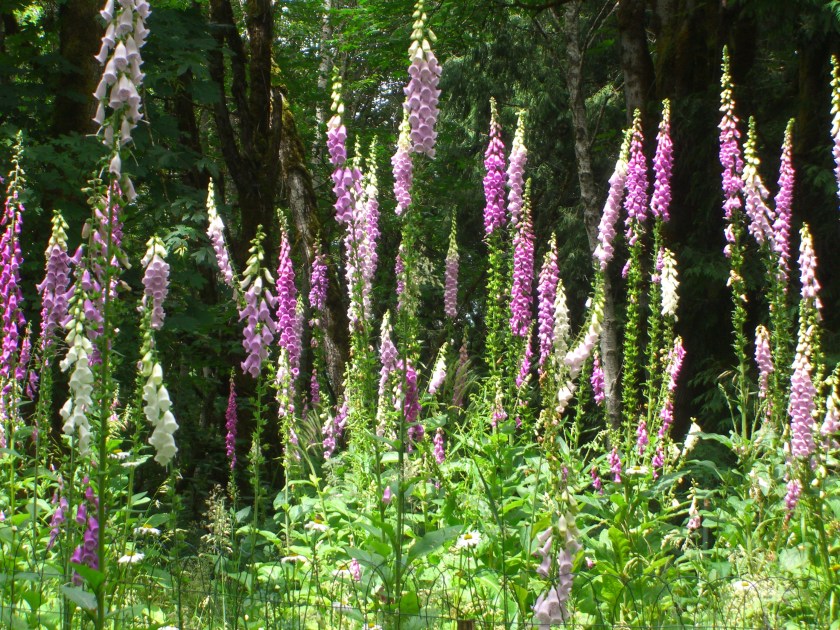
What kind of humility, what kind of praying is the down-on-knees pulling of weeds?  I was not there to rescue the children.  I too was a teacher back when school shooting was so unheard of it would never reach my imagination.  I get down on my knees where I try to discern the weeds from the wildflowers, what to pull out, what to save, because even though self-seeded, the poppies are joyful orange and yellow, the foxglove a vibrant pink, and when clustered, they wave a snappy salute across the lawn. 

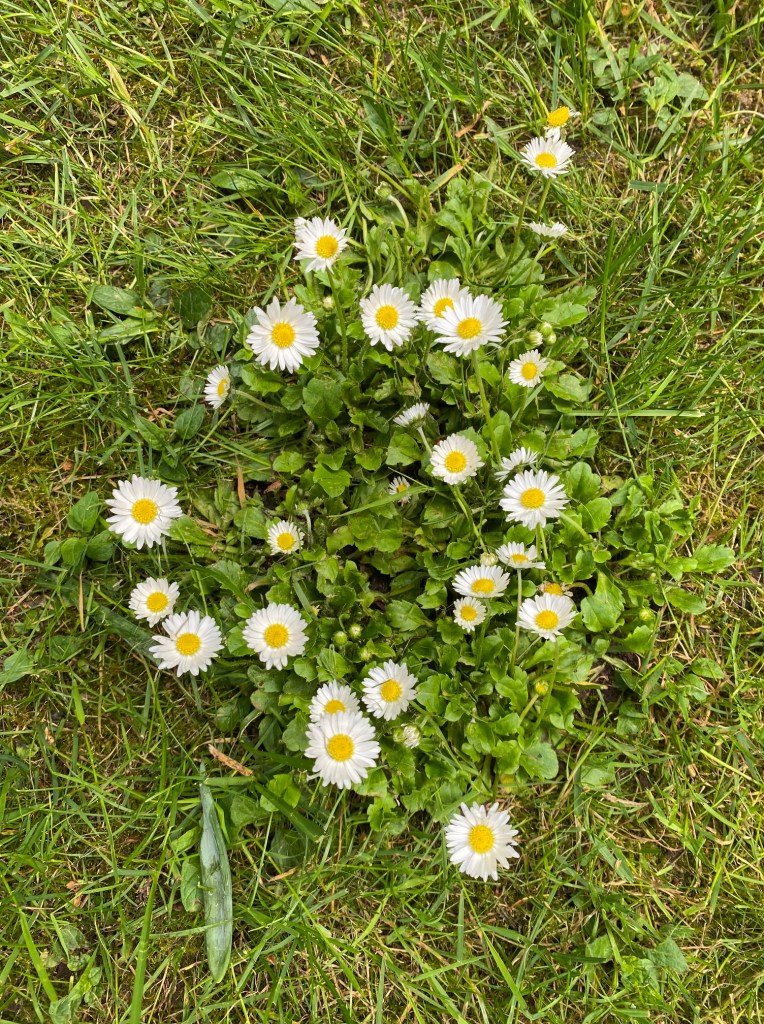
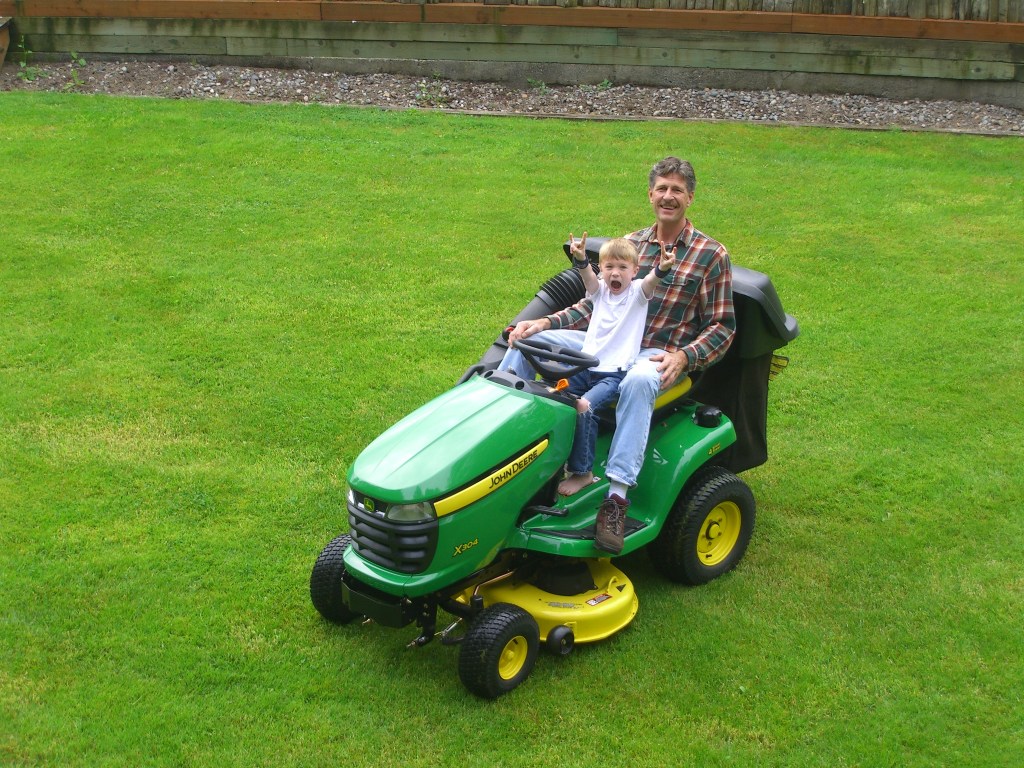
Today, while I am purging my grief with what are becoming sore fingers, I hear the familiar hum of the John Deere lawn mower.  Allan, perched like a prince on a dais, is riding around the yard cutting the rapidly growing grass.  I stop to watch him speeding around in circles or diagonals, clearly enjoying himself, little filaments of green flinging from under his machine.  He is headed toward a patch of small white daisies clustered mid-lawn.  “Lawn daisies,” I called them when I took my grandchildren to the park, and we found them salted across the park lawn.  So many, surely our picking a handful would not diminish their plenty.  We picked and we laced them together, making bracelets for small wrists.  Or we took one separately and plucked away –one white petal at a time, chanting “She/he loves me . . she/he loves me not” until we felt loved or rejected for one moment on a spring day.

Allan and grandson Oscar years ago

I yell at Allan to stop, but he is wearing ear protectors.  I jump up from my weeding and race to the confident green mower just as it bore down on the circle of daisies. 

“Please,” I shout, circling the daisies in a protective dance.  He cannot see me, but understands he is to leave the flowers.  Perhaps they were his weeds in the lawn.  He stops, and the daisies live on now, white and fragile as remembrance.

MID MARCH


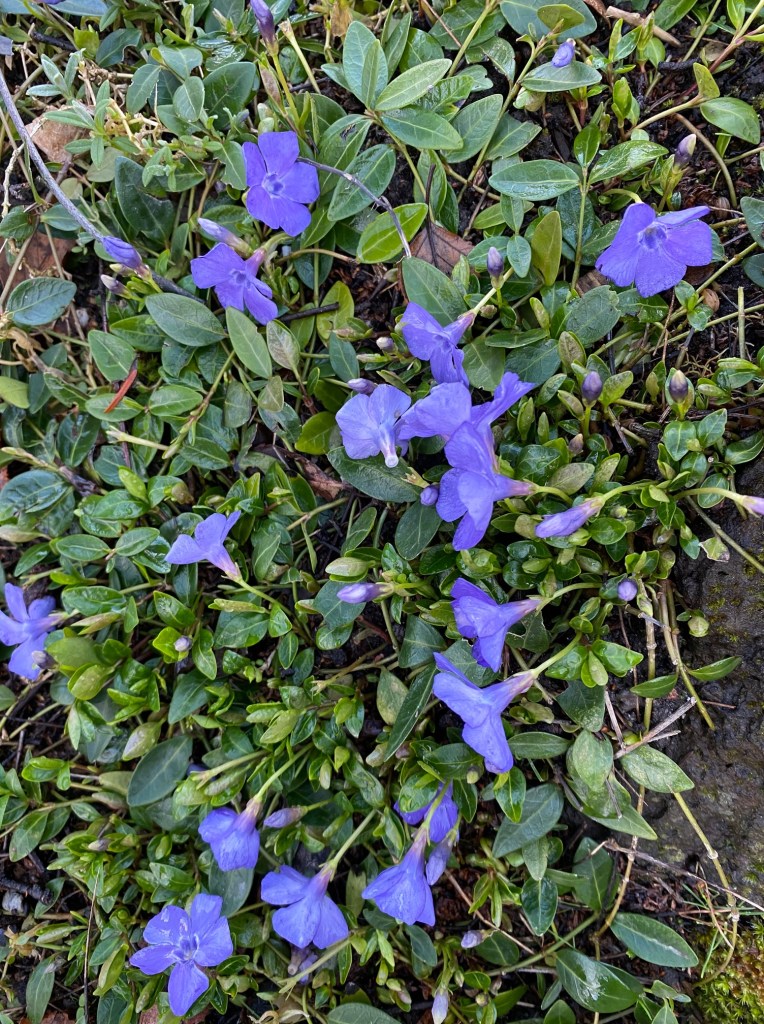
In March I scrape a metal rake down periwinkle hill
lifting off the crisp brown leaves 
that maples dropped in their autumnal parting.
For half a year leaves lay flat like wide brim hats
tossed atop the vinca minor
and would disguise the yearning there
for purple spring.  Such fragile flowers
that want to paint the hill . . . and will
if all the leaves that warmed them winter long
are gone, as a secret reveals itself
after cloaked in silence. 

Early spring is such a stealthy time
a surreptitious mime on mid-March days
when winter would just as soon 
grab us by the collar 
and throw us to the wind.
Covert buds cling to wild plums
and we’d be done with chilling rain
if only flowers would return again.
Now ferns want clipping of their drooping fronds
and moss in thick disguise consumes the lawn.
My interventions with rake and shears
may bring spring near, may bring it here
sung closer by frogs beside the pond.  

Mary Kollar
Copyrighted 2022


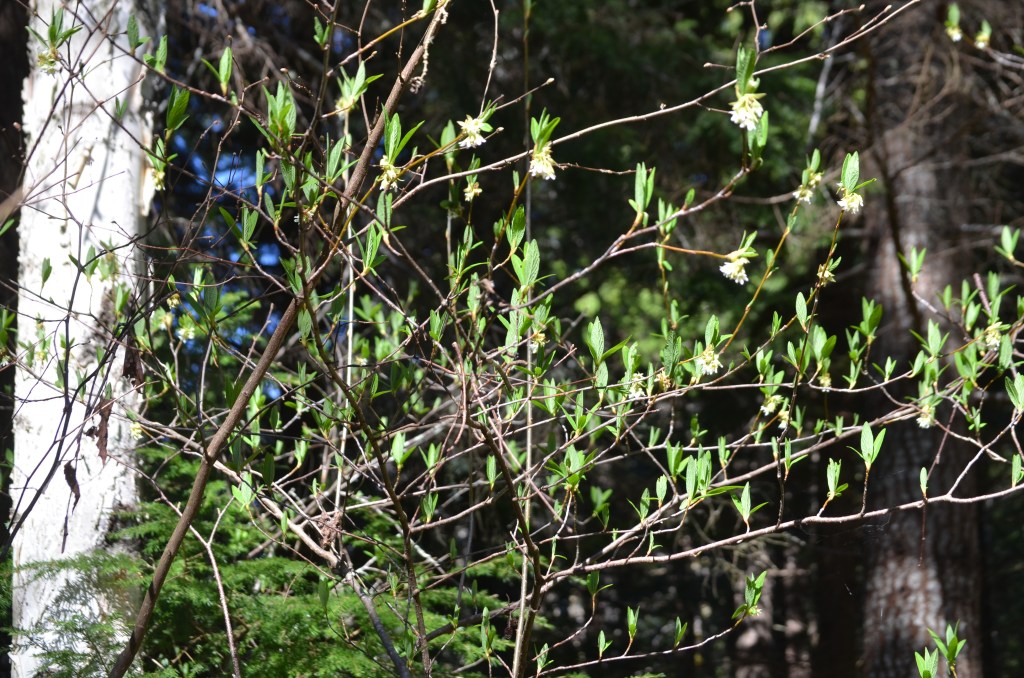
Wild plum blossoms

Without a Name

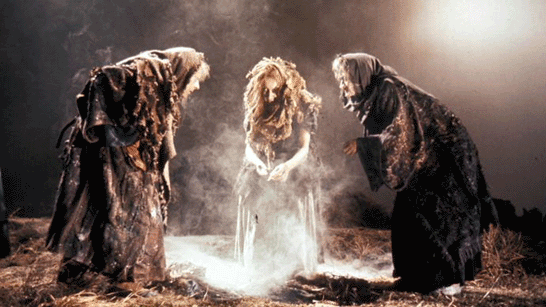
Macbeth:
How now, you secret, black, and midnight hags.
What is't you do?
All:
A deed without a name.

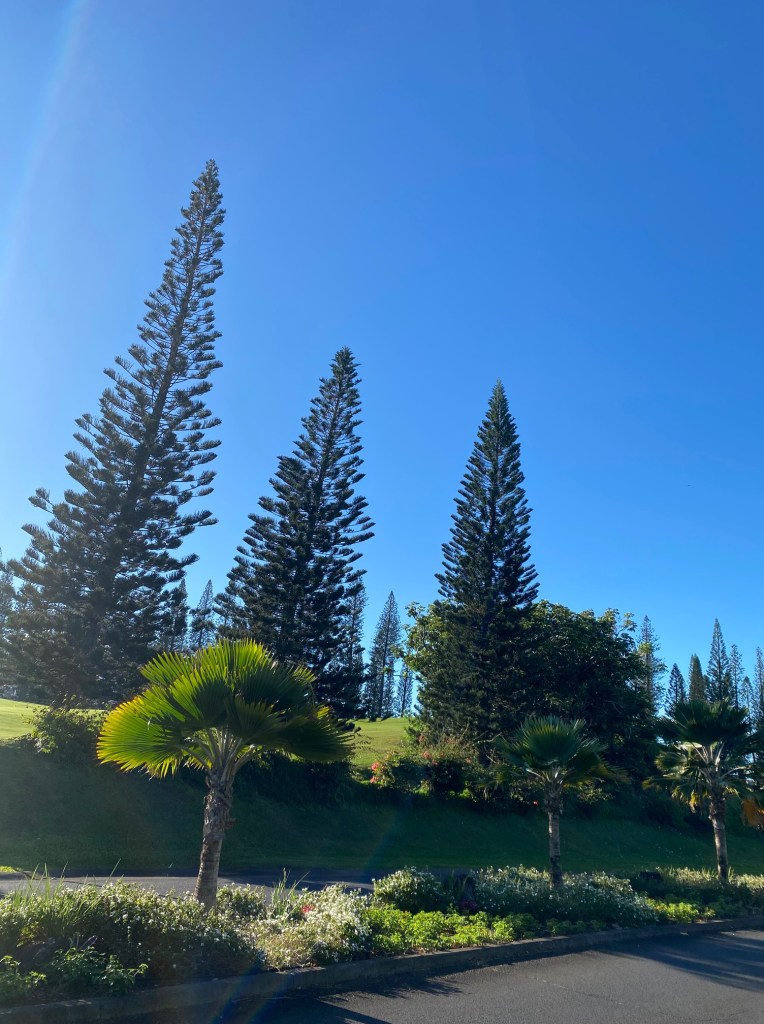
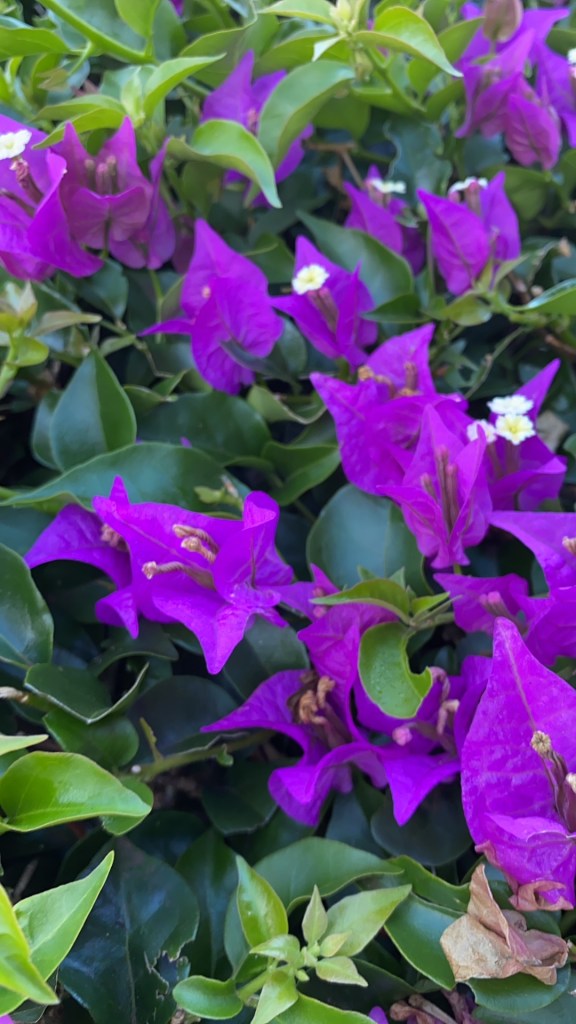
On this morning’s walk from Kahana to Kapalua, I watched the sun rise over tall evergreens lined up between golf courses.  My path followed low hedges with delicate purple flowers, their soft yellow stamens pointing out to the sun.  If I were walking along my road in Washington State, I would be spotting cedars, Douglas firs, spring daffodils, vegetation for which I have a name.  But I knew none of the names of the trees and shrubs I passed on my walk in Maui. 

Was the scene less lovely?  More intriguing because I couldn’t name what I passed?  What echoed in my mind was “without a name.”  Here Shakespeare joined my walk calling up that phrase.  Next followed a quotation from Romeo and Juliet, when the lovers realize their surnames are enemies, and Juliet challenges the feud: “What’s in a name? That which we call a rose/ By any other name would smell as sweet.”

            My fascination with language kicks in with thoughts of naming and being known. When I began my blog, Thoughts After Seventy, I hoped to contemplate that desire to be known.  I had recently attended memorial services where I listened to stories of the departed’s identity.  In the narthex before entering the sanctuary for the service, I passed opened photograph albums covering the deceased’s life from birth to death: schooling, careers, family, travels.  Some memorials included slide shows or short videos, the soundtrack composed of voices and favorite songs from previous decades.  If I didn’t completely know the person before attending the memorial, on leaving I came closer to kinship.  But what is the connection between naming and being known and remembered?

            There is value in namelessness.  The Tomb of the Unknown Soldier would not be embraced by millions of descendants of fallen soldiers if we knew who was buried there. Anonymity allows us all to identify with the pervasive sacrifice of war.  Romeo and Juliet fell intuitively in love until the name issue arose.  Fortunately, their love surpassed the significance of Montague  and Capulet.  However, what about the names Republican or Democrat, Russian, American?  As soon as those names attach themselves to someone, kinship is tempered with judgement.

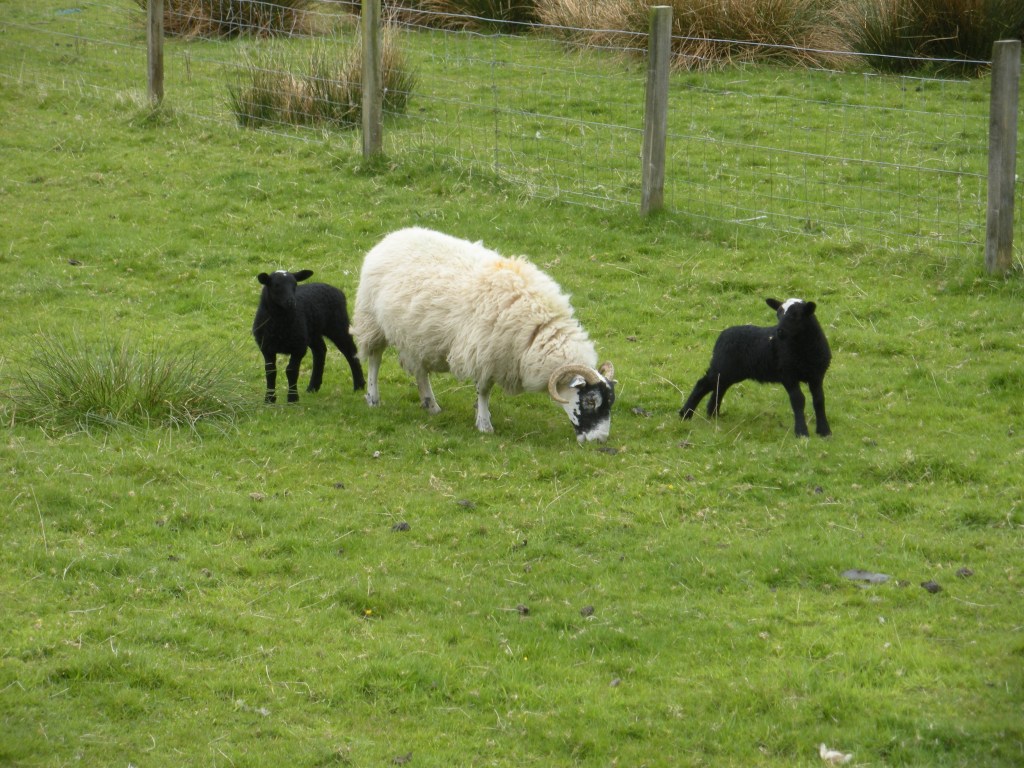
            Catherine is a shepherd whose lambs are sent for lamb chops.  On visiting her farm, and delighting in the frolicking lambs, the first thing we want to know is their names.   “I can’t name them,” she explains.  “If I named them, I couldn’t send them to slaughter.”  At best, they have numbers.  My husband tells a story from his childhood when he had a pet duck his father plucked for a Sunday dinner.  Enjoying the tender meat, Allan asked his mom what it was.  She explained it was duck.  That was tasty, until he learned it was Huey. 

            Is there any doubt why people marching for racial justice chant “Say their names!” followed by a litany of Breonna Taylor, George Floyd . . . ?  Names add sanctity to the cause; they personalize it.   George Floyd is someone we feel we know, and so by extension we can advocate for racial justice in his name.

            Back to my Maui morning walk, I feel pulled to know the names of the trees and flowers I admire as I walk along, serenaded by mynah birds and doves.  I have an app on my phone that I can use to photograph a plant, even a leaf, and learn the name and genus of vegetation.  I give in to it.  That delicate purple flowering bush: Lesser Bougainvillea.  Here the language addict in me jumps to ask,  “Why lesser?”  Is there a Greater Bougainvillea?  Without a name, would I enjoy the shrub’s beauty more or less?

            As soon as I returned to my laptop, I searched for “without a name,” adding Shakespeare to my search because I was certain the phrase floated in my ocean of Shakespearianisms.  There I found it in Act IV, Scene 1 of Macbeth.   Macbeth has once again sought out the witches for their prophecy.  They are tossing in their cauldron newts, thumbs of drowned sailors, all sorts of spine-chilling ingredients, when they answer his question:  “A deed without a name.”  Searching further for literary analysis of the speech, I came across an interpretation that reminds us in a Catholic society, a child is sanctified at baptism when he/she is baptized with a name.  No name equaled a destiny that didn’t include heaven.  Thus, to the Elizabethan audience, the namelessness of the witches’ activities would signal their damnation.

            We will continue to embrace naming.  We name children after ancestors that might insure their belonging.  Perhaps we can continue to name with cognition and empathy with what we are naming and why, always considering the community within which the name will exist.  Naming is one of my greatest pleasures, particularly naming a cat.  I could adopt another one just for the pleasure of naming it.  Thus far, we have named two cats after artists:  Toulouse Lautrec and Winslow Homer. Our creative cats have yet to learn to paint, but we have loved them for their purring heritage with those names.


Up From a Stump


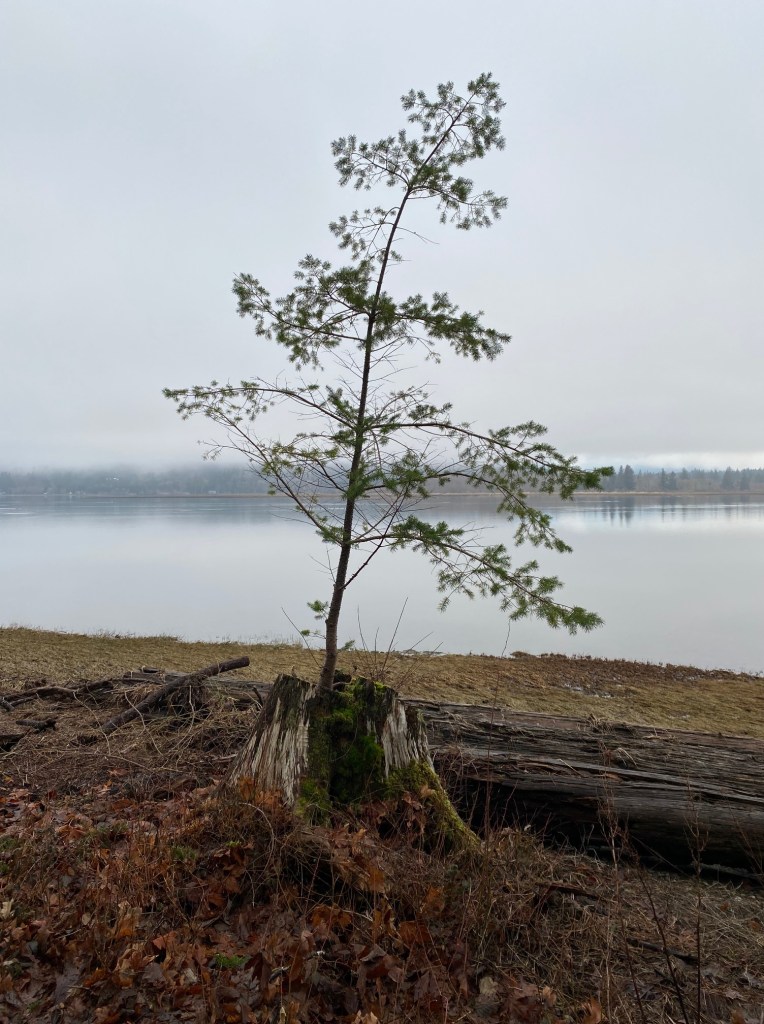
One of the stops on our morning walk is a bench at the edge of a sandy beach, facing west across Quilcene Bay.  The former owners clear-cut the property before we purchased it, carrying off magnificent Douglas firs, yet many of the stumps remain hugging the shoreline, where they witness the rise and fall of seasonal tides.  Recently the beach and the bay endured subnormal temperatures and above normal tides, what is called a King Tide, adding two feet to water already at thirteen-foot peaks in winter months.  Much of the beach is littered with detritus from the risen tide, something to rake away before spring. Smack in the middle, blocking what would be an unimpeded view of Mt. Walker is a stump from which rises a thin child of a fir.  How vulnerable it appears, as if holding its breath until spring, all seven to eight feet of it.  We recall when it was but a slight green burst, inches high erupting from the stump.  We watch it.  We let it grow, although were we to cut it down, a panoramic view of the bay and Mt. Walker would open before us.

This New Year’s month, I sit on the bench arranging my thoughts about ways to embrace another turning of the calendar.  Some people meditate on the year that passed.  I could do that, but let’s face it . . . last pandemic year was disappointing.  I could reflect on what was lost, or who died, just as I could mourn what appears to be a dead stump of a tree whose grandeur I never witnessed.  Instead, I am admiring this skinny Doug fir that chose the fractured stump for its foundation.

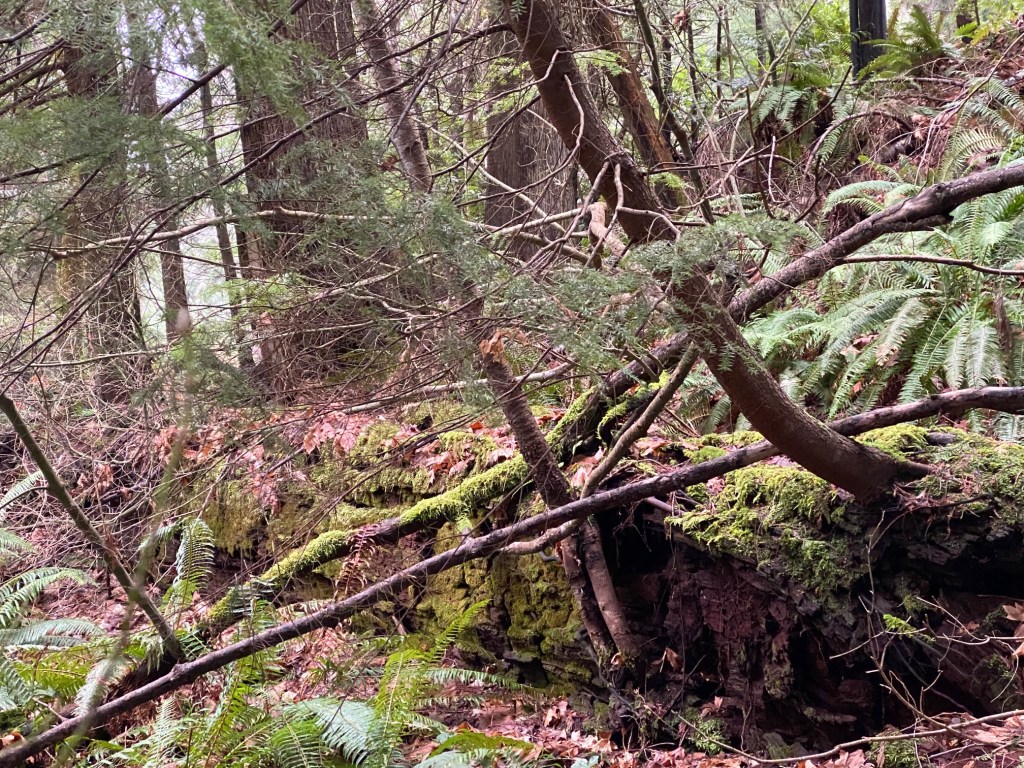
After that clear-cut, we left most of the acreage to restore itself without landscaping.  So many trees in various cycles of life provide a sermon of hopeful resurrection.  The loggers left one massive cedar to decay, covered with pernicious English ivy that we removed as an invasive growth, each sawed off end baring deep cuts as if made by the incisors of determined beavers.  Its rippled bark, spread with a patina of soft moss like a birthing blanket for vine maples and fir seedlings.  Thus, the name “nurse log” botanists give to downed but still nurturing trees.

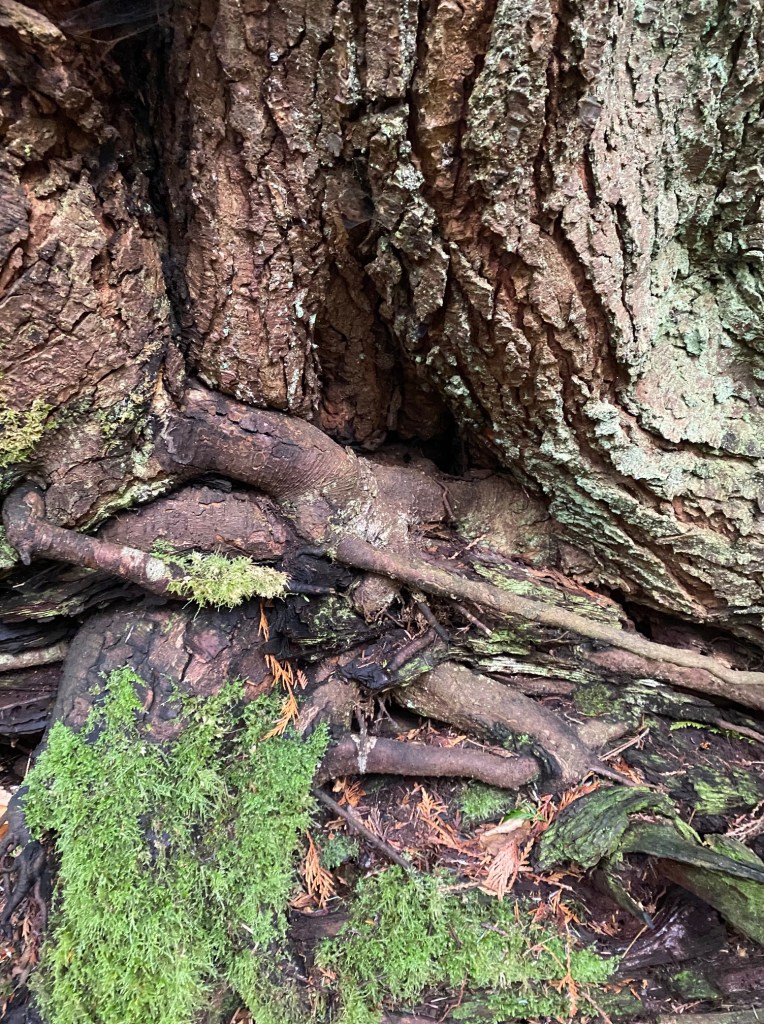
    When I take time to examine most of the trees along our path, few seem to have rooted solely from soil.  The main trunk grips a gnarled fist of former life as if the decline or apparent death of the former is necessary to generate new growth.  Here my poetry memory kicks in, and I think of Shakespeare’s 73rd sonnet: “In me thou see’st the glowing of such fire /That on the ashes of his youth doth lie.” If not ashes, there were certainly gnarled branches from which I matured.

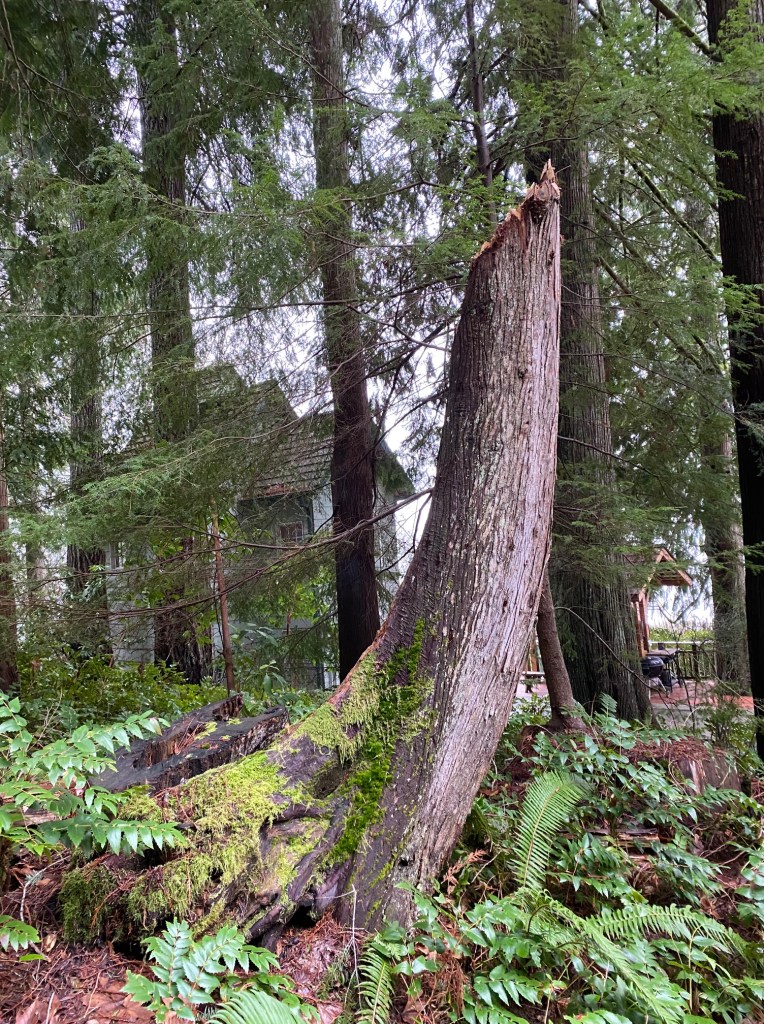
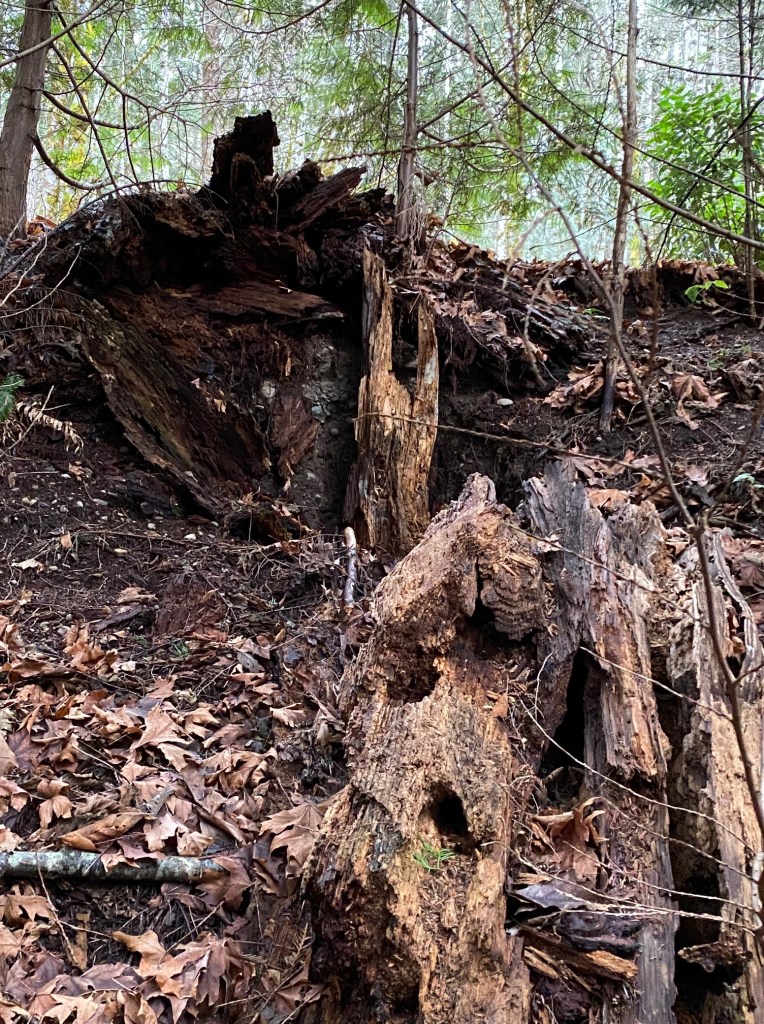
    Trees decay, they topple in windstorms, they need topping to prevent branches from falling on power lines.  If one needs to be cut, we don’t saw at its base but leave ten to fifteen feet for a natural decay. Over ensuing years, woodpeckers hammer through bark for bugs, and small birds nest in remaining cavities.  Nonetheless, even that tall stand will topple, as one cedar did last weekend, its big root pulling up in the collapse and leaving a large cavern on a bank beneath the road. The large hole might risk erosion, because that tree could have held the bank in place.  Perhaps the hole will become a winter home for squirrels or raccoons feeling the slow burning warmth of decaying cedar.   

    Time to leave my bench where I seek philosophy among the trees.  There are the day’s promises to keep as I walk uphill from 2021 toward 2022, not to escape the gnarled roots of a pandemic year but to imagine wherein resurrection grows.  A short prayer for the expanse of all time to secure understanding as we take root from a disappointing year toward a hopeful new one.  Reflection and prayer.  I recall Ralph Waldo Emerson’s definition: “Prayer is the contemplation of the facts of life from the highest point of view.”

Who’s Calling?

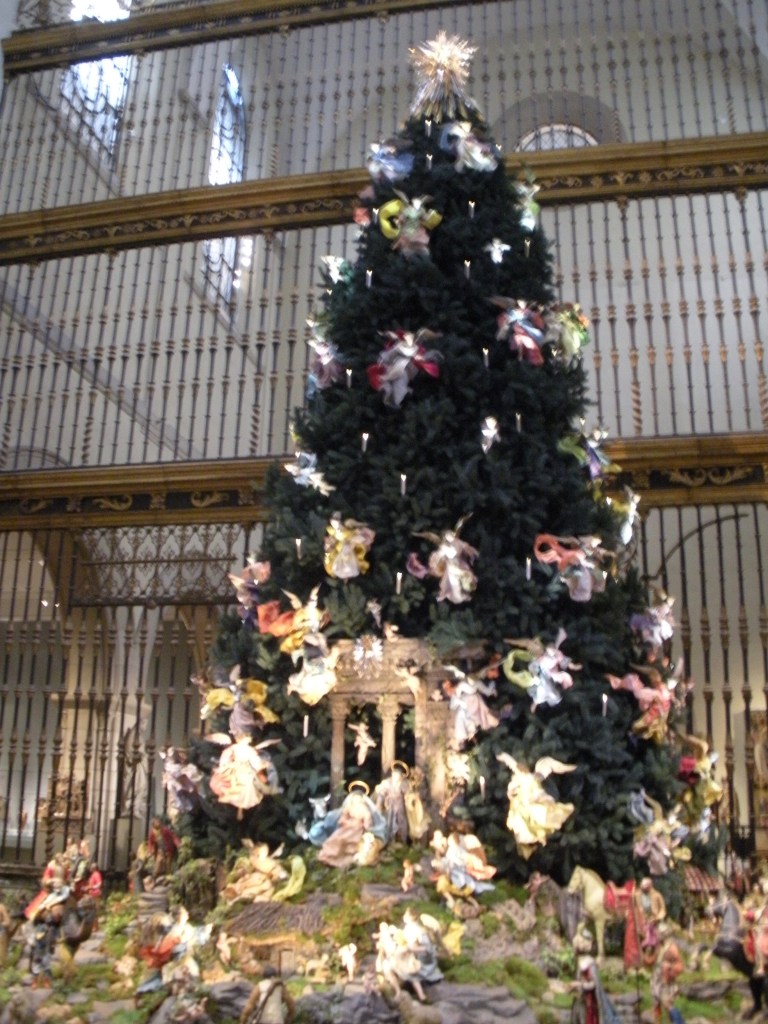
Metropolitan Museum of Fine Art, NYC

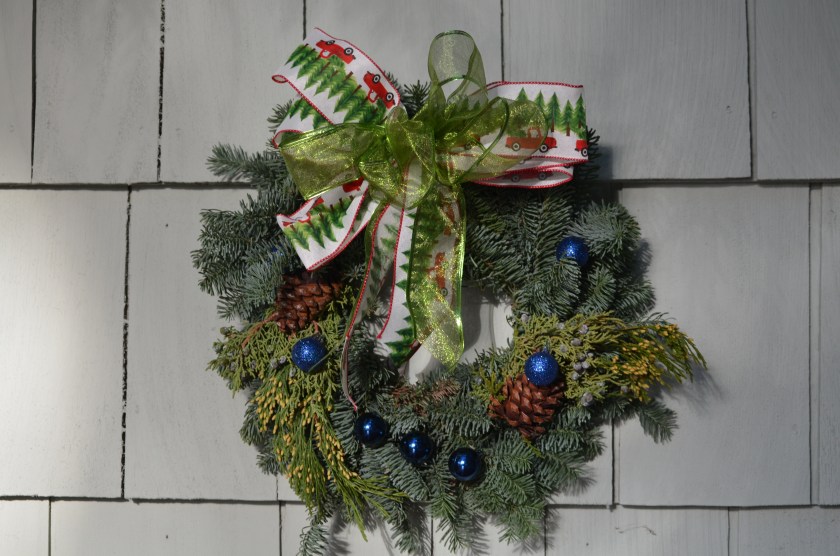
        Wednesday I was in full assembly-line gear.  My Christmas shopping list tacked to my brain, I set out first to buy a wreath for us and for our daughter at City People’s Garden Store.  It would be a short drive from there through the Arboretum to the University District and the bookstore where I would find gifts for our great niece and my nephew, then order the gifts wrapped and shipped.  Viola! I would have completed gift shopping two weeks before the 25th.  Leisure would follow to bake Christmas cookies and bread, to bathe in the nostalgic warmth of a season I love in ever-darkening days.

            There I stood surrounded by sparsely decorated wreathes ranging from eight to sixteen inches.  Settling on two, I moved on to select premade bows or choose among a colorful assortment of red and gold ribbons for a customized job.  My cell phone rang.

            “Hi Mary.  This is Vicki from church.”  Her voice tingled with apologetic enthusiasm that presages an Ask.

            “ I know this is short notice, but would you write a poem for the church Christmas card and email it to us by Friday?  And, if possible, link it to the upcoming sermon series on Light.”

Copyrighted Rebecca Rickabaugh

            “Oh Vicki,” I laughed into my phone.  “I love you!”  (Translated: OMG, one more thing to do under pressure. )  Last month the request was for a poem to read at our pastor’s retirement celebration.  I truly am honored to be sought out.  I can’t recall when I first heard myself dubbed the church’s “Poet Laureate.”  Nonetheless, any artist knows that art-on-demand is tough.  Vicki, a soloist, commiserated, sharing her anxiety when asked with short notice to sing a solo at a memorial service. With the same close deadline, Rebecca Rickabaugh agreed to paint a picture for the cover of the card.  All of which got me to thinking of how Vicki’s call disrupted my efficient plans for my day.

            The poet in me tosses around literal and figurative speech.  I had literally responded to a call. As for churches, we often hear pastors explaining their job as a response to a call.  Even as a child, I wondered if one day that pastor, as a young adult, headed off to be a firefighter or college professor but heard an imaginary phone ring.  My young imagination heard a deep voice:

            “Hello.  God here…”.

            I understand that the call, is more a felt mission, rather like Jesus summoning the fishermen, who were immersed in gathering food for their families, to drop their nets and follow Him.

            Here we are in Advent.  The Annunciation has occurred when Mary, probably immersed in preparations for her upcoming wedding to Joseph was sidelined by an angel telling her she was pregnant with the son of God.  Not the call she expected.  But she answered.

            Seems reasonable in the Biblical context, yet these interruptions to change direction in our everyday lives don’t always feel inspired.  We are nabbed when busiest doing something else. Then if we submit to the distraction, we scold ourselves at bedtime for not accomplishing the things we penciled on the “to do” list earlier in our day. 

            Back to the Bible.  How often do the prophets advise being still so as to hear the word of God?  Modern day gurus advocate for meditation so we can open to the Word.  I failed at meditation, never getting to the state of nothingness that would erase trying to remember what I needed at the grocery store after the meditation sessions.

            Let’s hope interrupting calls come from a place of goodness.  We have seen enough violence in our country from folks who think they were called to perform acts of destruction.  I prefer to keep the call connotion as a beckoning to something good, something creative, something to build community.

            As for the church’s call to write a Christmas card poem, I agreed, hoping short and meaningful lines would drop into mind.  By the end of Wednesday, I had scribbled a few images of candles and flames and holes in the darkness.  Rebecca sent her completed image. Wow!  it was beautiful and fit well with what I hoped to say poetically.  One of the rules I am breaking again is to send out a poem that has not rested in a drawer for at least six weeks.  But here I am Friday afternoon pushing send on my computer, the poem skimming through cyberspace to the church office.  No time to revise it.  My husband is calling: “When’s dinner ready?”

Fiat Lux

On the day of Christ’s birth,

light a candle.

Let it burn a hole in the darkest night.

His birth warms us through winter.

His birth is our Vision and Light.

Feel the flame in His name.

Through the Woods

=

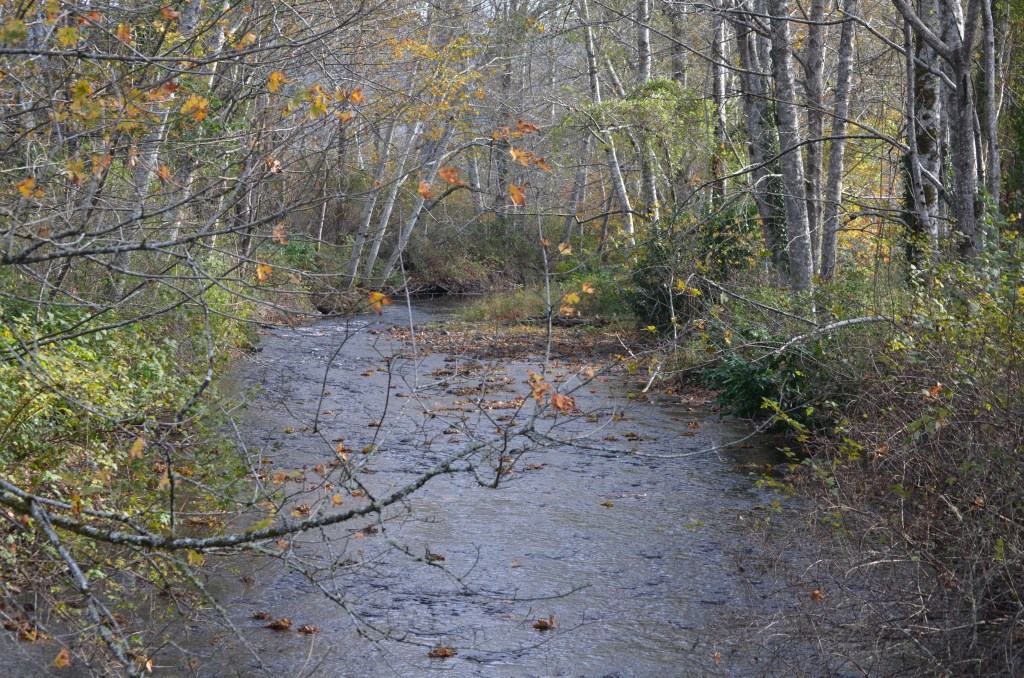
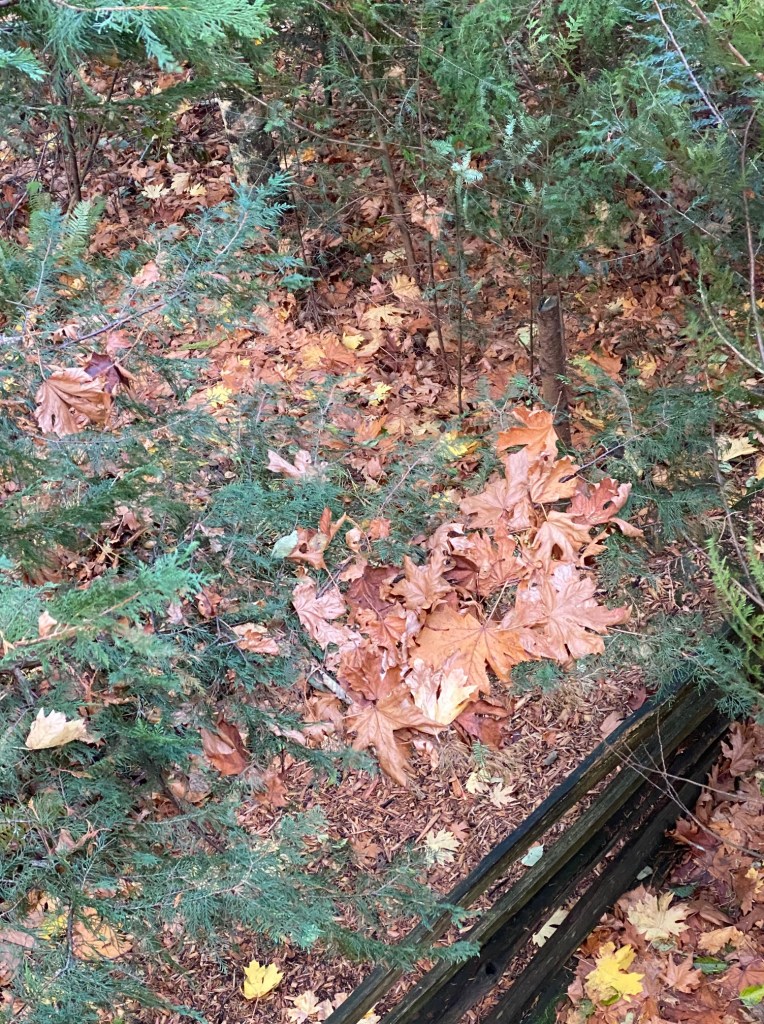
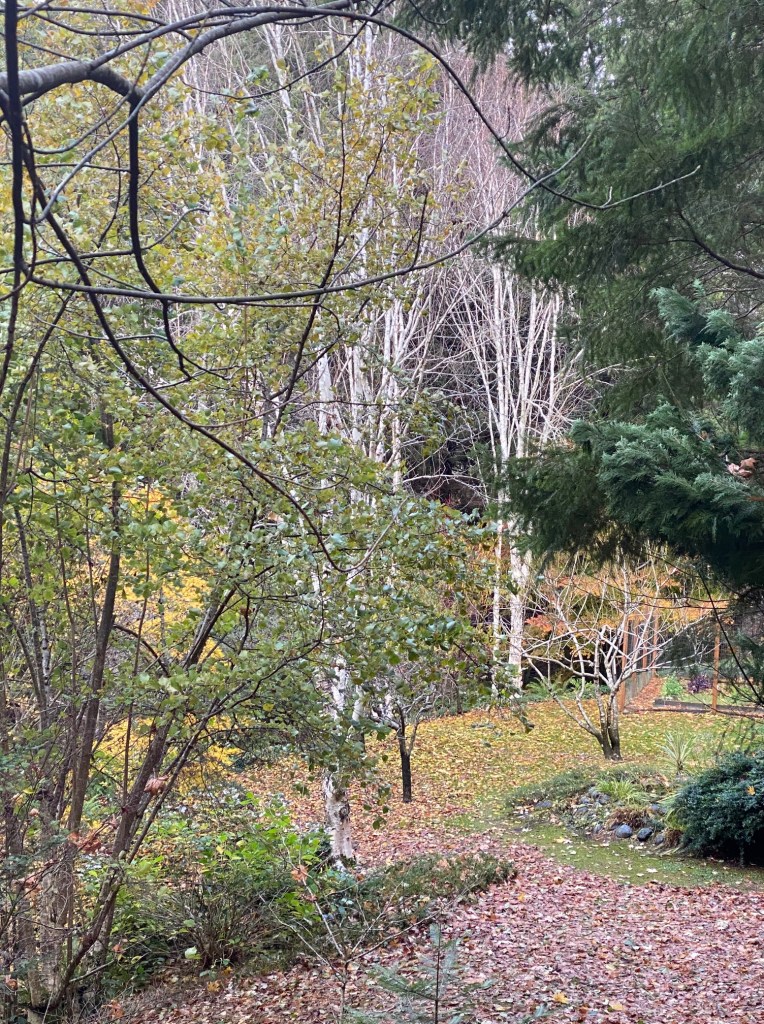
This mid-November day, the leaves have blown from most of the deciduous trees. The wind surges as if it needs no time to inhale before blowing again.  A young cedar flips its boughs northward, showing off the lighter green undersides.  Stepping carefully down the trail to the treehouse, I look back from where I came, through the woods.  Now with so many bare trees I can see through the woods, can admire the ferns surrounded by a thick layer of maple leaves.  There is the split rail fence on the other side of the trail, and white birches, like candles thrust into the hill frosted with a mosaic of leaves. A panorama opens because the leaves have left, and I ponder the coincidence that the plural of leaf is leaves, and that is exactly what has happened.  Things are leaving: leaves, songbirds, the very year itself.  One month left of 2021.

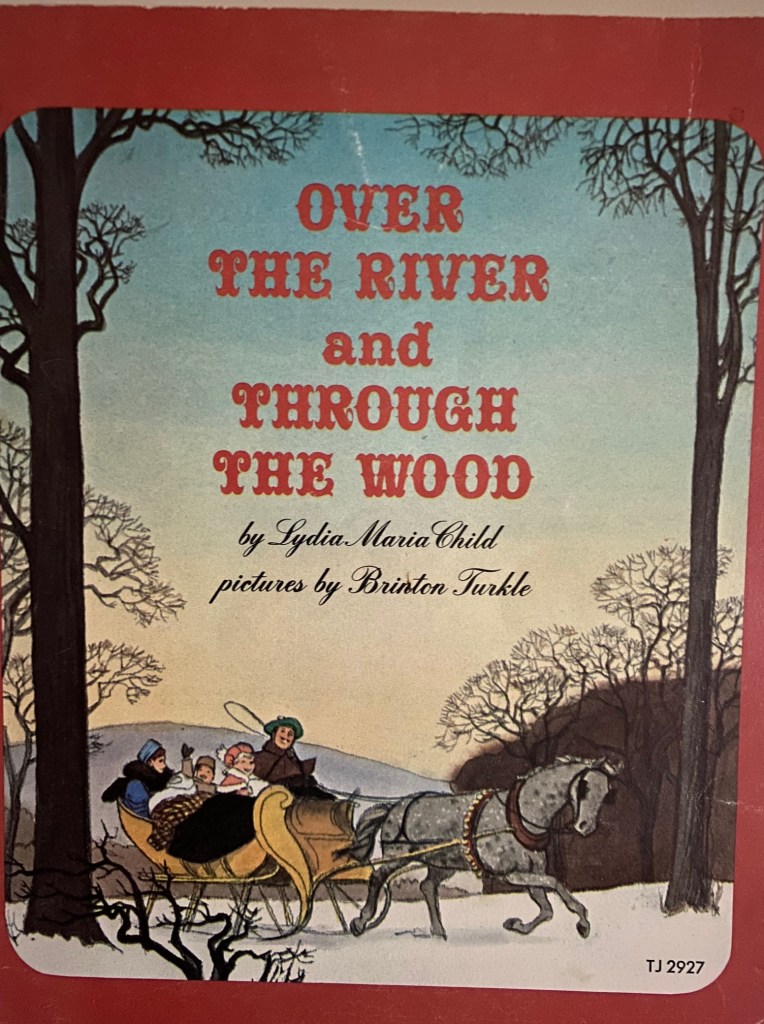
Through the Woods.  I begin to sing with the wind: Over the meadow and through the wood, to Grandmother’s house we go.  The horse knows the way to carry the sleigh…” As a child, I had a picture book that accompanied the lyrics.  It opened with colorful illustrations of a bountiful sleigh piled high with laughing children snuggled under blankets.  Turning the page, I found Grandmother in her apron fronting a bountiful table laden with roast turkey and pies.  Clearly it was worth going through the woods to get there.  And how fortunate the horse knew the way to carry the sleigh.  My wandering mind sets on Robert Frost’s Stopping by Woods on a Snowy Evening.  Frost pauses before progressing through the woods, his horse giving “his harness bells a shake to ask if there is some mistake.”  Once more, humans are leaving to a horse the directions for going through the woods. 

Childhood tales prepare us for crossings through woods,  cautionary tales for the remainder of our lives.  Little Red Riding Hood, confident as she is, must walk through a wolf-inhabited wood to reach her grandmother.  She enters fearlessly, even joyfully, stopping on her way to stoop for a patch of wildflowers that might delight her aging grandmother.  We fear for her more than she fears for herself, because we are more experienced.  We have traversed the wooded way frequently enough to suspect what lurks there.  Then there are Hansel and Gretel, also innocently confident enough to escape through a wood.  A little more experience here with caution, they drop bread crumbs to follow on their way back.  We all know this isn’t the best REI advice for hiking, and surely Hansel and Gretel were lost, the birds having eaten the breaded trail with which they hoped to retrace their journey.  Woods equal lost, equal witch and possible death.

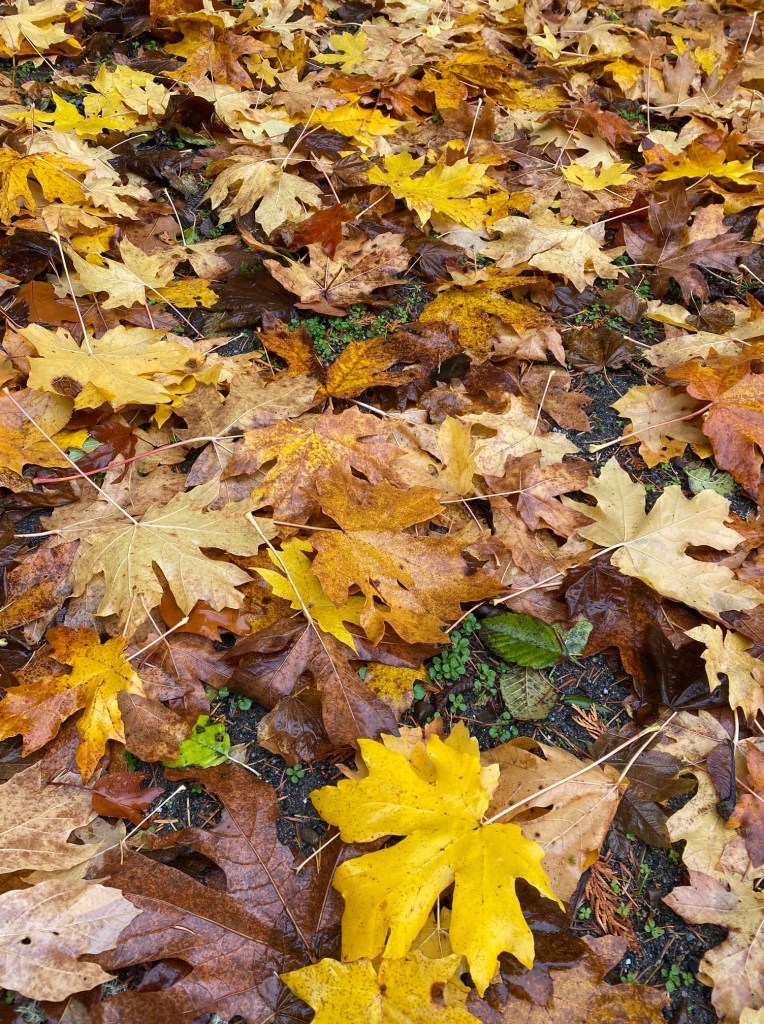
When you decide to write a blog about thoughts after seventy, it is inevitably going to include reminders of mortality.  As seasons turn, one after the other, you begin to figure on the remaining seasons left to enjoy.  Friends whose spouses died talk about the “last Christmas, or the last birthday.” Their calendar is marked with anniversaries of loss.   Kicking through big-leaf maple leaves, I smell the smoky aroma of leafy decay.  Curiously, it is a sweet aroma, somewhat like cotton candy.  It is not an aroma or a season to take for granted. Will it be the last autumn I pause to look back on the trail and comment on how easily I can see through the woods?  It is not the finality of a lost season, but the presence within it that rewards.  In my over-seventy years, I have travelled through many woods, some tangled with downed branches and dense salal.  I kept going because there was always something ahead worth reaching.  There are still destinations beckoning around the bend, but more often than not, I am pausing along the trail to look back from where I came.

Only six months ago, I applauded the buds on the maples. I could hardly wait until they widened into those foot-wide leaves of summer. But today, the view I admire is the one where I am looking back. Trees we had planted are masters of the woods. They stand naked against green cedar and fir. If they were human, their branches would be ribs. I needed that loss of foliage, that almost bare landscape through which I can travel. Like cleaning house, the forest is down to the essentials. In the present moment, I can see clearly now . . .


Shared Spaces

“There is no delight in owning anything unshared.”
            — Seneca

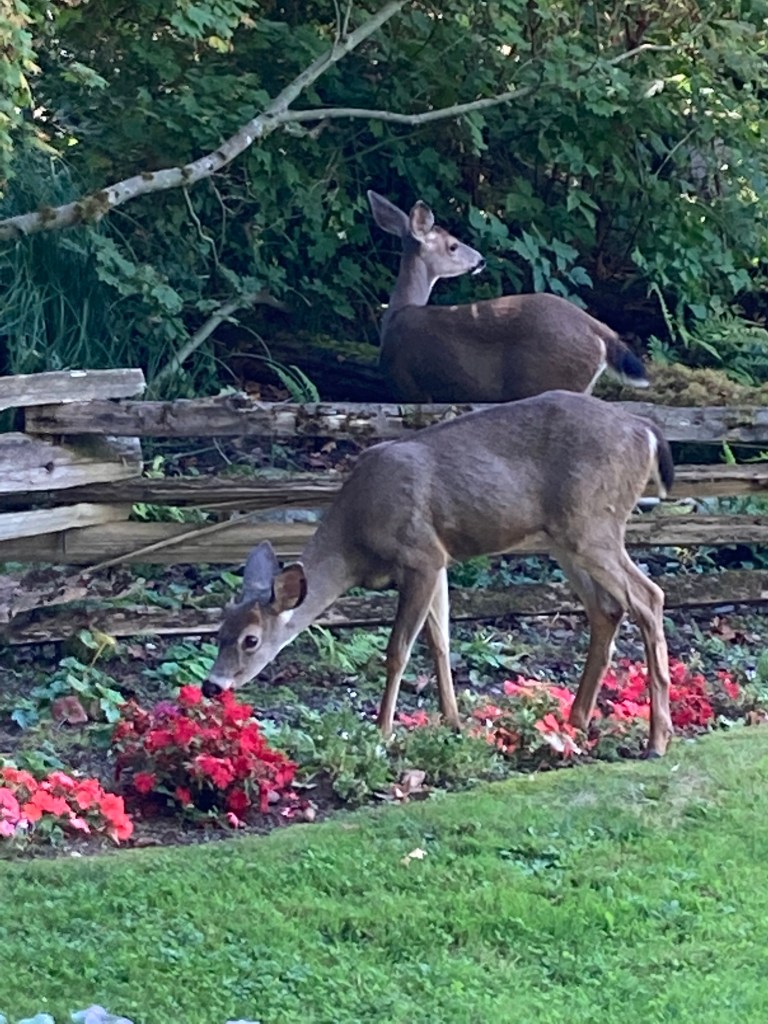
The afternoon opened with two visitors to the front yard.  Allan alerted me: “There are a couple of ladies here to see you.”  I ran from the back yard to greet who I thought would be  neighbors stopping by for a visit.  Instead, I spotted two does helping themselves to the impatiens on one side of the front lawn before ambling across the grass to a square of wildflowers adjacent to the crab shack.  There they munched through random strawberry plants while I held my I-phone camera close . . . closer . . .  Did they not worry the least bit at my presence?  Our space had become their space.   Who was intruding on whom?

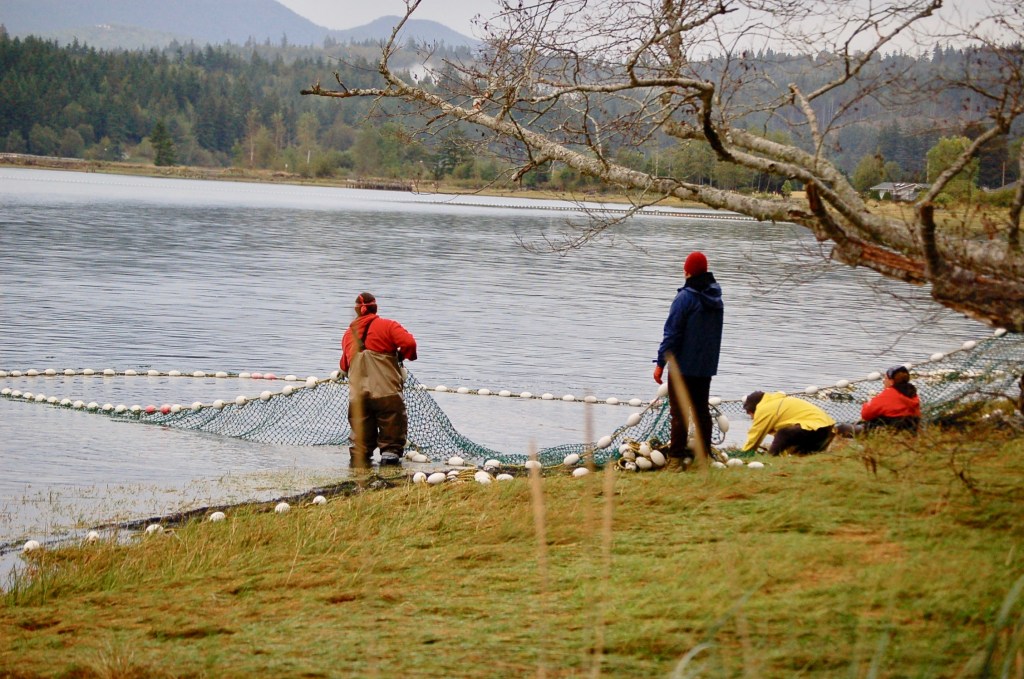
I have been thinking about the notion of shared spaces.  Quilcene Bay, for example, I call “my bay” or “our beach” along the bay.  My husband, editing my poems, has called attention to possessive pronouns and the superiority they suggest: “our cottage” or “our beach.”  Once alerted, I realize the beach is not ours.  Early September, when the tribal boats enter the bay to harvest migrating salmon, the native families extend nets and pull the heavy fish-filled harvest to shore as their ancestors did before any colonization by Europeans. Is the beach theirs?

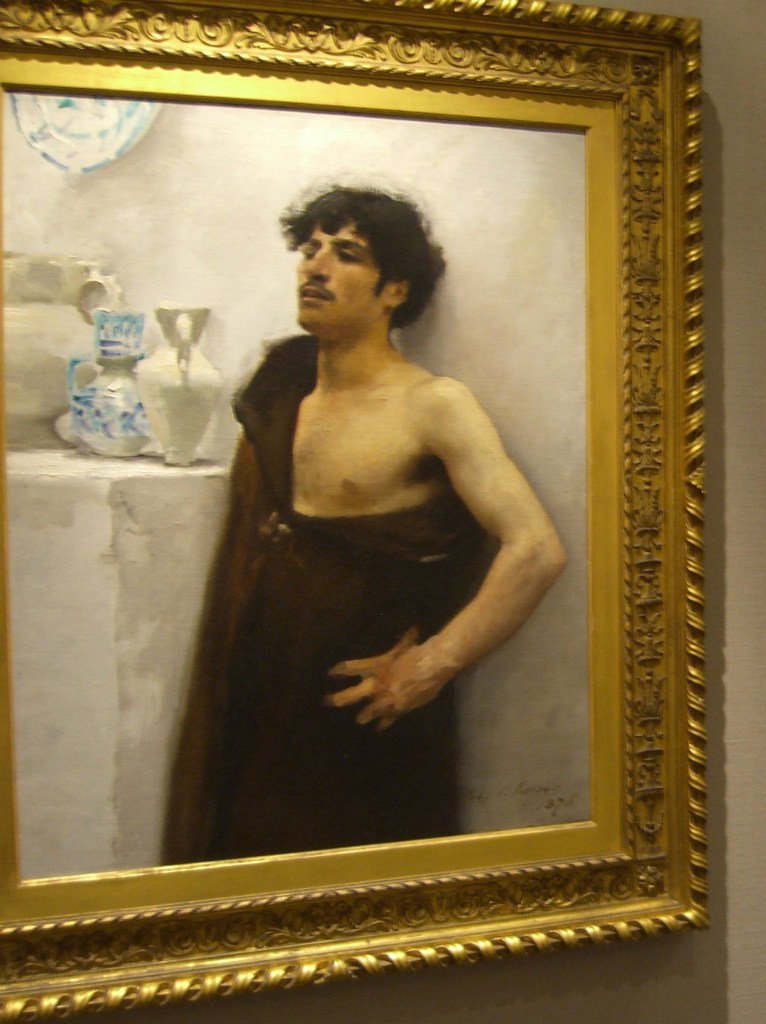
There is so much power in pronouns.  Sometimes those possessive pronouns are expressions of identification rather than possession, such as when I introduce a friend as one “who graduated from my high school.”  No one assumes that “my” suggests I own the school, but rather I was affiliated with it, much as when I refer to my beach.   Yet, possessive pronouns can also be  capitalistic little things that suggest ownership and division, one person from another. Years ago, I was enjoying an exhibition of  American paintings brought to Seattle by Christie’s Auction House.  Standing before a stunning and expensive portrait by John Singer Sargent, I commented to Betty Balcom, who was also admiring the work, “Wouldn’t it be wonderful if that portrait could be ours?” 
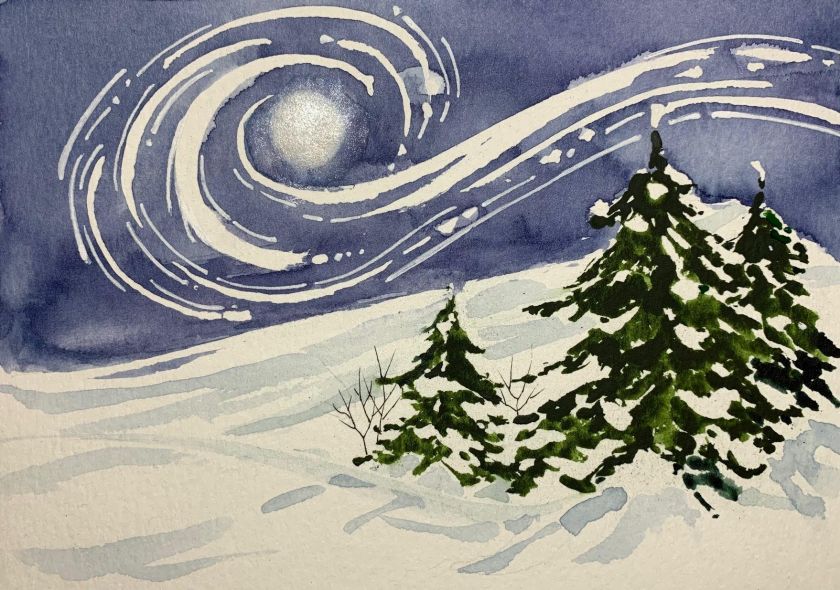
Betty replied, “We never own fine art.  We are the  caretakers of the work for a period of time.”

Her words resonate with me when I look at the art temporarily hanging in the house. I think of that art not exclusively as “our” collection.   Sharing, rather than owning, is not only a privilege, it is also a responsibility.  That means keeping those works away from too much heat, moisture or light, conditions that would damage the works.  

Sharing can be a challenge.  Watch any toddler to discover the evolution of ownership.  “Mine” is one of the first words a child uses. 

“You need to share your toys with your brother or sister” are among the first words from the child’s parent.  Sharing may not be an instinctive behavior. It must be taught.

I admit that I struggle with shared space.  Over the past few years, tents filled with homeless people cover our city parks and sidewalks.  Along with this human habitation comes refuse, some of it drug paraphernalia.  The parks and sidewalks are not mine to share, although my taxes contribute to their maintenance.  Yet, when I see encampments spread over the parks, even playgrounds adjacent to local schools, I feel threatened and invaded. The proliferation of these communities is a shared concern of our city, county and nation.

Have you noticed in the past year how many organizations begin gatherings with a land acknowledgement?  Programs at the Seattle Art Museum and services at churches now begin with the featured speaker acknowledging that the audience is gathered on the traditional lands of indigenous people.  Shared Spaces – even when those peoples may not have wished to share their space, have been driven from the space, are, in some places, extinct from the space.
Back to pronouns.  I have written a blog about recent changes in pronoun usage, changes that acknowledge the identities of gender, departures from demanding agreement in number between subject and verb so that a person who doesn’t want a binary pronoun can be included in conversation with a gender-neutral pronoun: they rather than he or she.  Perhaps we should look at those possessive pronouns as well.   The planet is OUR planet, and until we acknowledge the way we share the precious resources of the planet, we are in danger of losing what is mine, what is yours.

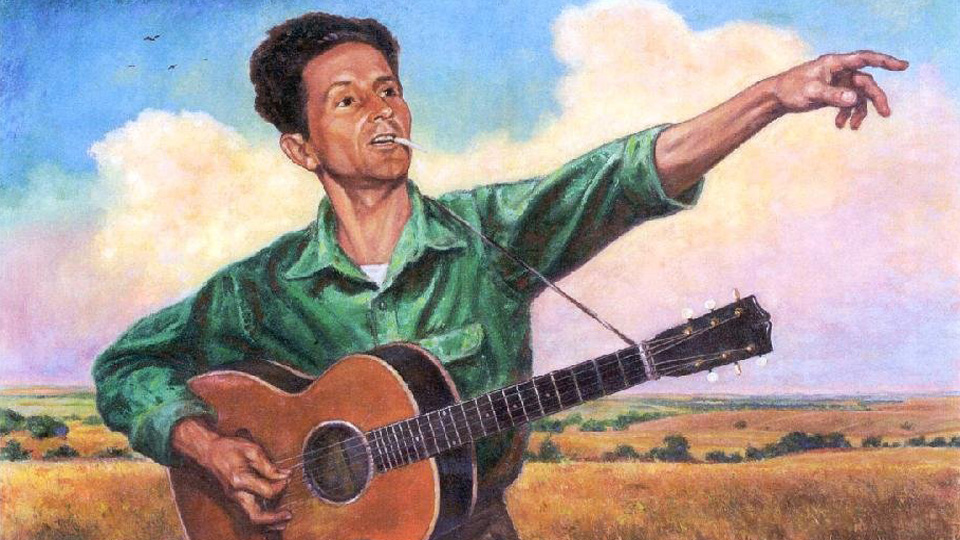
Woody Guthrie sang “This land is your land, and this land is my land.”  We all know the tune and the words.  Our hearts lift to it as we join in on the chorus.  It is a song where “my” and “yours” are synonymous with “ours.”

I didn’t plant those flowers or strawberries for the deer who found them delectable.  Yet, seeing them quietly enjoying my produce makes me smile.  Without them, I have more greenery.  With them feeding there, I have beauty and that peaceful aura of deer, in their graceful meandering.