 Moving into our 70’s we still listen to our 16 year-old self sleeping in somewhere behind our hearts. It is the adolescent fame-future voice that promises some day to star in a film or rescue a child clinging to a rooftop while floodwaters rise. We feel we have the talent or the hero within, as soon as we decide to call it out of hiding. After seventy, we shed one goal at a time, after first allowing old-age wisdom to acknowledge those ambitions are now fantasy as if they were not always. I have concluded that I will never climb Mt. Rainier. Even nudging 50 years of age, I thought I might do that some day, would sign on to a group tour led by Jim Whitaker, who still ascended surrounding peaks well into his geriatric years.
I also allow other voices to encourage me to loosen my grip on that climb. “Mary, “ my husband reminds me, “you have Raynaud’s Syndrome so that you can’t walk by the frozen food section at QFC without your fingers freezing stiff.” Experience convinces. I have never climbed a glacial peak, but I have arrived at the checkout stand where I struggled to withdraw my credit card from my wallet because of frozen fingers. Some other physical feat will have to substitute.
Why physical ambitions? Soreness reminds us that we are still alive. Muscle soreness from physical exertion differs from the joint pain we feel now just by standing quickly at intermission, after sitting through two acts of King Lear. Active muscle soreness feels rejuvenating, not debilitating. So last year I decided to run a 10k race in our hilly community on the Olympic Peninsula. I have not been running regularly for years, but I figured I could train for it starting with a three-mile run of the course and building from there. Honesty suggests I insert here that it wasn’t just completing a 10 k that attracted me. I guessed I would be the only woman over 70 running the 10k and thereby would receive a first-place medal in my age category. I knew more than one woman over 50 who competed in races, winning first or second places, especially after moving across one age category to the next. There, it became a bucket-list thing, although I didn’t think of it that way at the time. What I wanted was that first place medal. In my younger years, I had run a 10k. I never had won a medal. Voila! I would get that medal at 73. The monkey wrench came twisting in when I went to pick up my race number the evening before and learned there were no age categories for the 10 k race, only for the half marathon – yes 13 miles, not 6.
“How much more do I pay to register for that?” I asked.
“Twenty bucks.”
I paid it. The next cool September morning, my husband dropped me off at the community park where runners gathered, pinning their numbers to their shirts, stretching their legs against pine trees growing up from the dew-damp grass. I pinned on my number, plugged my I-phone in to the tunes that sang me along on my training runs, and started, shifting one foot ahead of the other up the steep 3 ½ miles ascent on Center Road until it peaked at Tarboo Road where race helpers pointed me towards the crescent logging road that would take me most of the ten miles further until I could finally descend steeply, foot numbingly, to the park again, where other runners had long since grabbed their Gator aide, oranges and yogurt and were already settled in the beer garden. I arrived just as medals were being distributed, a shiny faux silver oyster shell. First place for women over seventy, Mary Kollar, second to last over the finish. Yes, the only woman running over seventy. Maybe the only one running over sixty, but the woman I beat was fifty-six. Success! Was it not?
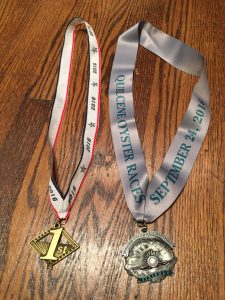 Was it the feel of the heavy medal on my sweaty chest? What made me feel most alive was the soreness of muscles, the labored inhales and exhales, that lifted my ribs as I lay on the cool quilt of our cottage an hour later. That is the pushed-to-the-limit soreness that rejuvenates, as in “makes young again.” Did I become a new person, thus far only fantasized? No, I became more of the same person, one competitive woman whose challenger is not the fifty-six –year-old running behind, but myself. After seventy I was getting to know me.
Yes, from seventy until the day the lights go out, we are still getting to know ourselves. I cannot recall when I realized the mileage needed for the journey of self-knowledge. Nonetheless in this 7th decade I am thinking a lot about who I am at the same time that I chastise myself for not having that inner dialogue more often in my younger years. Perhaps in the midst of becoming, I didn’t take time to contemplate who I was becoming. I either thought I knew, or would figure it out soon enough. Now I have the leisure to watch that becoming, in the way that I can watch my grandchildren grow through my philosophical eyes; whereas when I was raising my daughter I didn’t have time to philosophize about development. I was trying to keep one diaper, one meal, ahead of the next.
Should we spend our last decades wondering who we are? Can we do so without praise or blame for the person we discover? Imagine those teeter-totters you used to run up and down at the playground. Wasn’t it fun when you were the only one on board? When you stood on the balancing point, one foot on each side, holding the board in perfect balance? That is my image of taking time to self-explore without tears or applause. Running down one side of the board, you have self-deprecation. Running down the other, narcissism.
There are certain givens we accept to who we are. Some might be linked to particular gifts or occupations. I make excellent pies. That skill I acquired in the process of attracting my husband whose mother made a pie crust so flakey you could cut it with a piece of parchment. Changing a few ingredients for the crust and enhancing many of the fillings, depending on whether the pie was cream or fruit, I eventually matched and exceeded Eva Kollar’s pies. So the joke followed, that whenever my husband and I started musing “Why I married you . . “ he would laugh and say my good looks were fine, but he really married me for my pies. Being just fine with that, I too would tell others that my husband married me for my pies.
Then one evening out to dinner with friends, Allan told my friend’s husband, “You know I married Mary for her opinions.” Had I heard that correctly? Yep, he nailed me. I am one of the most opinionated persons I know, something I always thought could be modified a bit, but holding my tongue is not my strongest suit. That dinner moment was pivotal. Could I own it? Here was a self-revelation I could live with, and perhaps living with it, I might be in a better position to withhold excessive opinions, while accepting God’s grace for the ones that slip out.
Back on the teeter totter. Am I apologetic for freely sharing my opinions, or am I proud? Although my husband may have said it tongue-in-cheek, in fact he often seeks my opinions whether in selecting a work of art for our collection or marking our ballots for mayor and city council.
?Knowing myself as competitive and opinionated, being able to write that at this moment, is significant in these over-seventy years.
Several weeks ago, I wrote a blog post about wanting to be known, especially as the lights of life are flickering. Being known to oneself is perhaps more significant than being known to others. It is attributed to Socrates,:“The unexamined life is not worth living.” He meant philosophy in general, not only examining one’s own life. Were he to point to the value in self-examination, “worth-living” justified living on into the 7th, the 8th, maybe even the 9th decade with surprised discoveries of who we are, perhaps tweaking a bit toward self-improvement, perhaps accepting the friendship of the one person to whom we can talk and who is always listening. That is our talking/listening self.
You have to be of my generation to remember the RCA Victor ad with the spotted dog’s ear tilted to the trumpet coming from the record player. What if that record player were our inner self? Would we tilt our ear to listen to its music?
From the time of birth, our self-knowledge comes through the reflection of others: our parents, our peers and our teachers. My father so often called me a brat, that by the time I was ten years old, I knew I was a brat. Sad, but true, I did talk back to my parents and showed a strong will for my own way, unlike my brother, the Eagle Scout, who wore gentility like a badge on his sleeve.
My parents are long dead, allowing me time to disregard the white noise and tilt my ear to my inner self. Who were my literary heroines while my father was calling me a brat? They were the brats: Pippi Longstocking, Scout in To Kill a Mockingbird. Even Nancy Drew attracted me because she would forge out on her own, without her conservative father’s approval, though I read two Hardy Boys for every one Nancy Drew. The boys’ risks were closer to my own.
May 23, 1953, the cover of the Saturday Evening Post. A skinny freckled girl, pig-tails crooked, ribbons untied, knees knocked in and shoes unlaced, sits outside the principal’s office. Her left eye sports a shiner. As roughed-up as this soon-to-be-punished girl is, she is smiling, the most delicious smile of a winner. I was ten-years-old when Norman Rockwell illustrated that magazine. I thought it was a portrait of me. Today the famous painting is in the Berkshire Norman Rockwell Museum, but the postcard image is under the glass of my writing desk. My competitive, opinionated “Tom Boy” looks back at me every day. The delightful thing in taking that journey of self-awareness to this year is envisioning what I might once have seen as warts on a frog, as perhaps rather artistic.
A time machine could take us back to any year for a second look at the way we developed our self-image and came to know who we are. Without that machine, even a photograph won’t do. We rely on what others tell us who we were. There is a certain freedom in our senior years to be selective in judging who we were and settling on who we are at this moment.
 Next best thing to a time machine is the memory of others who knew us way back when . . . A few years ago I met up with two high school friends I had not seen in years. They reminisced about how every weekend we would get together at Sally’s house to play pinochle, drink coke and smoke cigarettes. I remembered that too. What I didn’t remember was their recollection that as soon as the hour got rather late, I would stand up, say I had to go home to wash my hair, and leave. They laughed heartily at that memory. Now I don’t doubt its truth. What I am learning about myself, looking back as best I can through the smoky telescope, is that I likely had ADHD all my young life, long before anyone named the condition. Result? A nervous brat who couldn’t or wouldn’t sit still at any activity for any time. Stories help us remember what we did, but not who we are. The stories are useful in helping us understand with our own loving acceptance who we are and maybe who we were.
Perhaps what we all could use is a wedding commitment ceremony with ourselves every ten years. Do you take Mary for who she is? Knowing oneself must progress to accepting ourselves. Personal peace is enough. Just enough.
 Writing connects people. Certainly, it tells when we have arrived. Think of 19th century Poles, Italians, Irish immigrants, who lined the ocean docks where they waved a permanent farewell to families. From the departing whistle until their final days, I like to imagine the divided families connecting by letters. Stories once told by the hearth would spin themselves in correspondence– long narratives that included incidents lived over weeks and months. Perhaps the newly arrived immigrant sits at a small desk, faintly lit by gas light. He or she has saved the early evening after a long day of labor, to describe poetically a new landscape, from sky scrapers to tenements. Or if the immigration ended in the Midwest, miles of prairie grass as if the world were flat. As the writer continues with pictures and stories, a voice within speaks up reminding the writer of feelings, longings, comparisons between the homeland and the adopted one. By the letter’s end, the epistle looks only vaguely familiar to what the writer intended to say. The reason? Writing is a process, not a product. It is the process of thought. In the process of writing, we learn what it is we have to say. Consequently, writing not only connects between people, it also connects to the cognitive and emotional life within us. Much like wading into an incoming tide, the process of writing may begin in the shallows, but as words flow in, before we know it, we are swimming among ideas we didn’t know we had.
 Most of us are old enough to have generations of material. A week away from Christmas, I offered the prompt to generate our writing. I selected phrases from several Christmas carols, copying them on red and green slips of paper. The writers chose as many as they wished to initiate thought, or to incorporate somewhere along the way. Nina chose “Oh Holy Night,” and she was off, recalling her 10th year, when prior to Christmas, she and her father walked hand-in-hand five freezing blocks to an evening of Christmas music at the University Christian Church. In the process of writing, she recalled, and so brought to us, her chapped shins where her snow boots rubbed, and the feel of her father’s comforting hand surrounding hers. Nina filled with pride in being the only sibling who had her father all to herself. After reading aloud, Nina leaned back in her chair as if she needed a certain distance to see where her writing had taken her. “Oh my,” she gasped, “I don’t know where that came from. I haven’t thought about that night in over fifty years.” Nina had connected with the child within her, had resurrected a father long dead whom she still loved. In the process of writing, she connected with her inner self. She also connected with us, planting her story in our memory. We regular attendees of the writing group, intimately know our fellow writers, because we carry their stories within us.
 John is writing his memoir, each week his episodes carrying us to a small Michigan town where his grandfather was pastor of a humble church. John, himself a graduate of seminary, reads his work aloud as if it were a sermon. His resonant voice echoes in our meeting room. He affects his grandfather’s voice in one register, and his grandmother in another. We all feel we have visited Charlevoix, could find our way from the fishing camp to the church.
 Not all writing is sent to an audience. One might wonder why anyone should write, lacking intentions to publish. There comes the journal and its audience of one. Two years ago, with Lent approaching, I thought about what I might give up for 40 days. Realizing giving up might be less worshipful than taking on, I decided for Lent I would write a Gratitude Journal, 40 days of contemplating something for which I am grateful. Each day surprised me with another positive gift, my enhanced outlook on life. Articulating my gratitude made me feel good. I wonder how I would feel had I committed to 40 days of complaints. This past Lent, I decided again to write at least a page a day, but without the theme of gratitude. Rarely do I go back to read what I have written, but the seeds are planted in my journal for flowers I will gather in later written discourse.
 Mary's Room With a View