
An April afternoon in 1956, I walked down Pigeon Hill where snowmelt still made the ground mushy beneath the trees, my sneakers sodden by the time I reached Betsy’s house, the last house on the road that dead-ended at the railway tracks from Boston. I knocked on the front door, badly in need of paint and blackened by soot from the railway trestle. I had come to see if Betsy could come out to play. We didn’t say “hang out” then, though that is what my thirteen-year-old-self intended, for I had no particular plan other than a need for a friend to spend time with on a Saturday afternoon. Finally, more dressed-up than I had ever seen her, Betsy’s mother answered my knock. From within I heard a gathering of adult voices.
Betsy wouldn’t be coming out that day, Mrs. Watkins said. She was being married. Through the yellow hallway I could see into the living room lit with April light. Betsy wore a white chiffon dress. Her older sister, Barbara, wore what looked like silk flowers in her hair. There too were Mr. and Mrs. Purcell, recently divorced, sitting with their son Walter, my neighbor, who lived at the top of Pigeon Hill. Walter was a thin boy, a year older than Betsy and I, and he was smart, very smart. I remember that he wanted to be an atomic scientist. We didn’t know any other kid who wanted to be an atomic scientist.
Thirteen and pregnant, though exceptionally young, was not unheard of in 1956. Finishing high school was out of the question. By the time Betsy would have been a senior, she had four children. Walter got a job at a locksmith’s shop. Because he was resourceful, he eventually managed the place, and who knows, perhaps he ended up owning the shop or a string of shops. What he didn’t do was pursue a career in atomic energy. And that was tragic, my parents said, shaking their heads at the news. What a loss for that young man because Betsy got pregnant. All the adults said, “Betsy got pregnant.” No one used the plural for pregnancy in 1956. Only girls got pregnant, usually by their own fault, as if, like Greek goddesses, they sprung children from their heads. Boys, well, boys were unlucky. At least Walter, even if coerced by his parents, at least Walter married Betsy. No one discussed what career path Betsy would fail to walk.
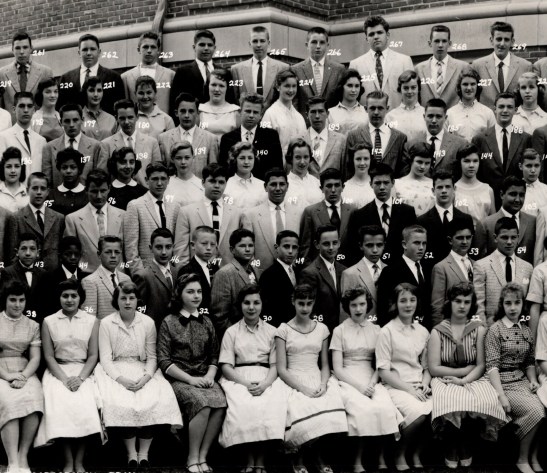
(Our Junior High 9th grade photo. Both Betsy and I are shown)
Mine was a blue-collar, rather middle-class neighborhood. I had a group of four fairly close girlfriends. I was the only one who would attend a four-year college. Three of the four were pregnant before finishing their senior year. No one talked about abortions, not that they didn’t happen. They would be reserved for girls from more affluent families, not to mention the sudden six-month vacations in the sophomore or junior years of high school.
Here at my seventy-fourth year, these are memories of my adolescence. It is not intended to suggest that this grandmother was more virtuous than her friends, just luckier. In spite of luck, or the lack of it, what I had in common with all teenagers who were sexually curious was the awareness that we were bad girls. Only bad girls let boys touch them. With a flashlight under the covers, we read Peyton Place, arousing our hormonal shame, eager to find a common badness in books that portrayed our summers on Cape Cod. Because we were all bad girls, we sought out other bad girls to befriend. And the bad boys could pick us out from a crowd of girl scouts selling cookies. We knew nothing of the complexity of sexual lives. Nothing about conjugal intimacy and certainly nothing about pleasure or mutual consent.
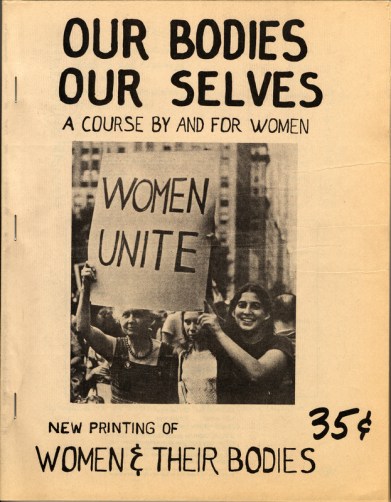
Where could we go for information other than to the bad girls who would talk? At twelve-years-old, I found brown spots on my panties. Had I accidentally pooped? Eventually the brown was more like blood, and I was certain I was dying from my insides. This information I would take to my mother. Wearing a sad look of resignation, as if I had told her I failed another Latin test, she gave me a little pamphlet that explained menstruation along with a blue box of Kotex, those bulky gauze bandages I had often seen in the linen closet and assumed were for really severe injuries. Yes, I was that naïve. There was no sex education in public schools. Some girls may have been luckier to have mothers willing to discuss sex and puberty. Looking back, I wonder if that sad look came from my mother’s realization that my days would be numbered until I too would be a mother, a celebration only in spite of her awareness that I would endure having sex. In 1971, The Boston Free Press published Our Bodies Ourselves. It cost 35 cents. A little late for me. By then I was twenty-eight years old with a two-year-old.
In the 1960’s, my college years, we had the pill, and of course it was a young woman’s responsibility to take it, for if she had sex that ended in pregnancy, it would still be her fault. Teenage pregnancies dropped only inasmuch as those girls could afford to have access to the pill. Generally, it was the drug of choice for college girls and affluent white women.
My little memoir could end here, but not without one more memory of April 25, 2004. The Bush administration, strangling access to reproductive health choices, reignited rage we hadn’t felt since the Vietnam era. It was as if the taste of something bitter threw us hurtling back through time to the sour years before Roe vs Wade. Here in Seattle, I joined my sixty-year-old lady friends, and we piled on planes that flew us back to Washington, D.C. to march.
“I can’t believe we have to do this again,” my friend sighed, as we buckled our seat belts. All the gray hair in that airplane, you would think we were going to a convention of quilters. But no, we were about a more serious fabric. We arrived late on a Thursday, and Friday spent hours doing the touristy things one does in D.C. In every museum, around every memorial, there were clusters of women our age, women in comfortable slacks and tennis shoes.
By Friday we heard each other mutter, “Where are the young women?” We had our signs ready: Abortion Rights are Women’s Rights. But where were the young women who couldn’t remember, but certainly must know? Where were the young women?
The morning of the march arrived, (eventually a million-citizens strong). We walked from our hotel toward the Mall, and there we spotted streams of loaded busses pulling in from Smith and Barnard and Mt. Holyoke and NYU and Brown and Yale. Out poured young women. Out poured young men. They wore t-shirts depicting clothes hangers, the symbol for self-mutilating abortions. They had signs too: Bush Get out of My Bush! We sixty-year-olds blushed, we giggled, we wept.

 O hushed October morning mild,
 October passed. The election failed to win the president I would have chosen. The Iraq war showed no sign of ending, and I stumbled across another Frost poem, November, that, if read closely, clearly indicates Frost was writing in opposition to war. December? Well my daughter mentioned how tacky the duct taped folder looked on the fence, so I removed it. In January, neighbors and folks I didn’t know (but who frequented the same coffee houses), asked me, “Where was December’s poem?”
 For the writer, the process takes her away to the shelter of her imagination. She puts herself in a garden or along a seashore. With the gift of remembrance, she sees the first daffodils blooming or hears waves licking the sand where her toes warm with each step. Escape? Yes, but in the process of getting away from the world, she returns to it with a greater understanding, as if she has larger hands with which to hold the worlds’ cares. Poetry gives her the confidence of quiet power — the greatest power known by the most courageous people like Dr. Martin Luther King or Ghandi.
 Mary's Room With a View