

If you are of my generation, and have an ear for familiar sayings, you have read the title of my blog, and your ear remembers “Hear Ye!” “Hear Ye!” That was the call for emergent attention that preceded an important announcement, anything from “The British are coming” to “All those coming on board… the train leaves in five minutes. “ I can’t recall the last time I actually heard that familiar and urgent call. Besides, who has used “Ye” in the last few decades outside of scholars of the King James Bible? Nevertheless, exclamations to be heard are as loud any time in history.
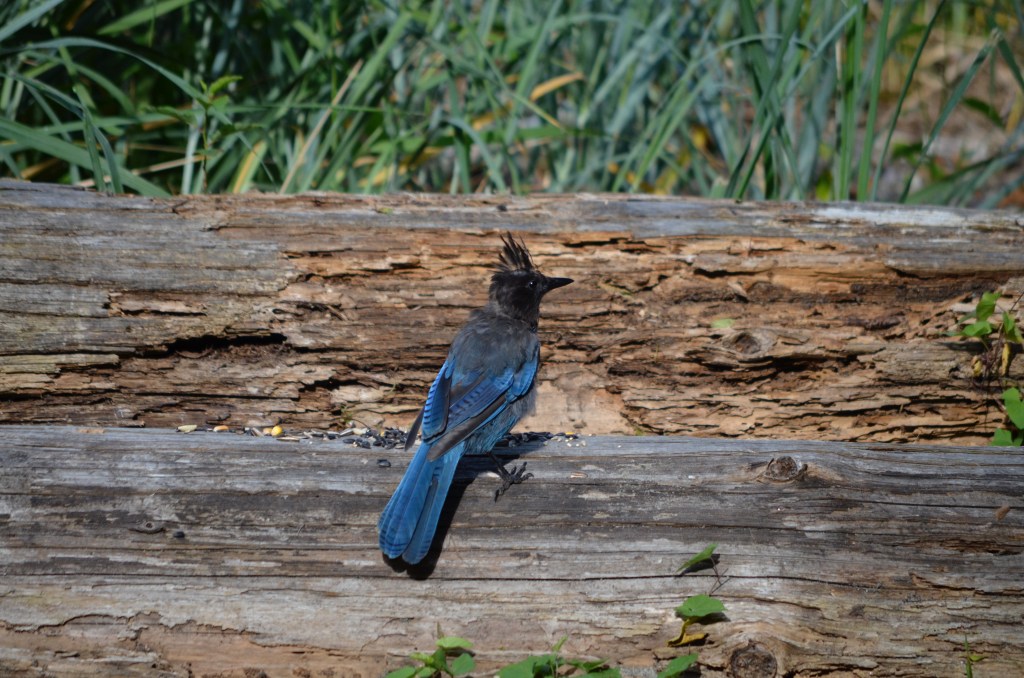
Mornings on the kitty walk around our Hood Canal property, the jay is screaming, expecting a peanut my husband has set on a log lining a trail. The jay has a broad vocabulary, and if you are lucky enough to have their blue presence on your property, you too might distinguish a whistle for jay companionship, a scolding squawk when a squirrel gets the nut first, or an unrelenting chatter that lets you know the bird is there with breakfast expectations. Usually, their voices are rewarded with nuts and seeds, but not always. A loud chatter is no guarantee that food will soon rest on a convenient post.

So too our vocal cat, Winslow Homer. He meows or whines or clicks at passing birds. At feeding time, he meows non-stop for a meal he knows by his internal clock is a few minutes late. Or having mounted a fence and once there finding the going rough for his unwieldy weight, he lets us know by a few meows that he would rather be lifted off than jump down. We hear him and respond.
We hear a honking flock of geese when the tides change. We hear the ravens kaaing among themselves high in the cedar trees along the shore. They ask nothing of us, but nonetheless we hear them. It interests me that there are calls for the sake of calling and calls with expectations of reciprocal action.
Now to jump from our animal kingdom to our human “kin-dom.”
My father, a garrulous man who enjoyed his own humor more than any other person in our family, often egged me on to a debate, usually a political one. Then when I expressed my deeply held views, he grunted, “Children should be seen and not heard.” One of his favorite axioms, up there with “Spare the rod and spoil the child.” He was not a physically abusive parent, but his sayings reminded me that he undervalued my ideas. When it comes to being heard, children are among the most marginalized populations. A walk through any grocery story can confirm this, as an exhausted parent heading for a box of detergent ignores the pulling on her shirt from her child who has just walked by a neat stack of Hershey bars. Yes, there are reasonable times to ignore a childish “Hear me,” that we have all experienced from our years as the pleading toddler to becoming the harangued parent.

On the opposite end of life, are the elderly, euphemistically called “senior citizens” to disguise their insignificance. As their culture melts from all they had known as comfortably familiar, they feel as if they are not heard, or if they ARE heard, they are misinterpreted. Consider the technological changes and social media in the past ten years alone. Having spent fifty or sixty years dialing a phone, they are pushing letters with their swollen fingers on a gadget that “upgrades” so often they have no time to internalize the new terms included in the small print to which they must agree for service to be continued. Having learned their English grammar and usage under strict instruction, they must recalibrate their ears to allow for a plural pronoun to represent a single person. All for good reasons they can understand because that elderly person may not intend to insult someone who is offended by a binary pronoun. Then there are the words for which they would have been reprimanded, such as “queer,” now embraced by the very community they did not wish to offend.

Some seniors feel as if the most vocally rewarded populations have no interest in the stories of their lives. What happened to the Norman Rockwell portrait of a child perched on a footstool attentively listening at the knees of a grandparent? Unless they are collectors of American Art, I would guess that most Americans have long forgotten Norman Rockwell, and never knew The Saturday Evening Post Magazine. Is there any interest in the grandparent’s life?
Last week I was one of those senior citizens demanding to be heard. Swimming at the club pool between 7:00 and 8:00 AM, as was my decade’s long custom, I was instructed by the twenty-some-year-old lifeguard to give my lane to a man who paid $80/month extra to have Master Swim at that hour. The schedule change from 5:00 PM Master Swim hour to 7:00 AM occurred because that lifeguard was the coach, and the most convenient time for him was in the morning. Before leaving the pool, I told the young man of my 40+ year membership and my history of morning swims. He shrugged and walked off to the swim office. My parting words: “You’ll hear from me.” And yes, he did hear from me, after I emailed the Club Athletic Director. There will now always be a lane available for me to swim at 7:00 AM. That is what is called economic power regardless of age, a reality of which I am not proud, but I used it.
Whether or not someone is heard depends not only on age but on power. Who around you is asking to be heard? What is that person’s access to power? One of my earliest blog posts featured the importance of remembering names. Who does not want recognition for having spent a lifetime on Earth? Sometimes that recognition comes during one’s life, and the name is noted. Other times the story appears in an obituary, so persons who felt unheard during their life will never know that their voice was heard.
Voices matter. Sometimes they are heard, and what a reward when they are, such as in Psalm 116: 1-2 “I love the Lord, for he heard my voice;/he heard my cry for mercy./Because he turned his ear to me,/ I will call on him as long as I live.”
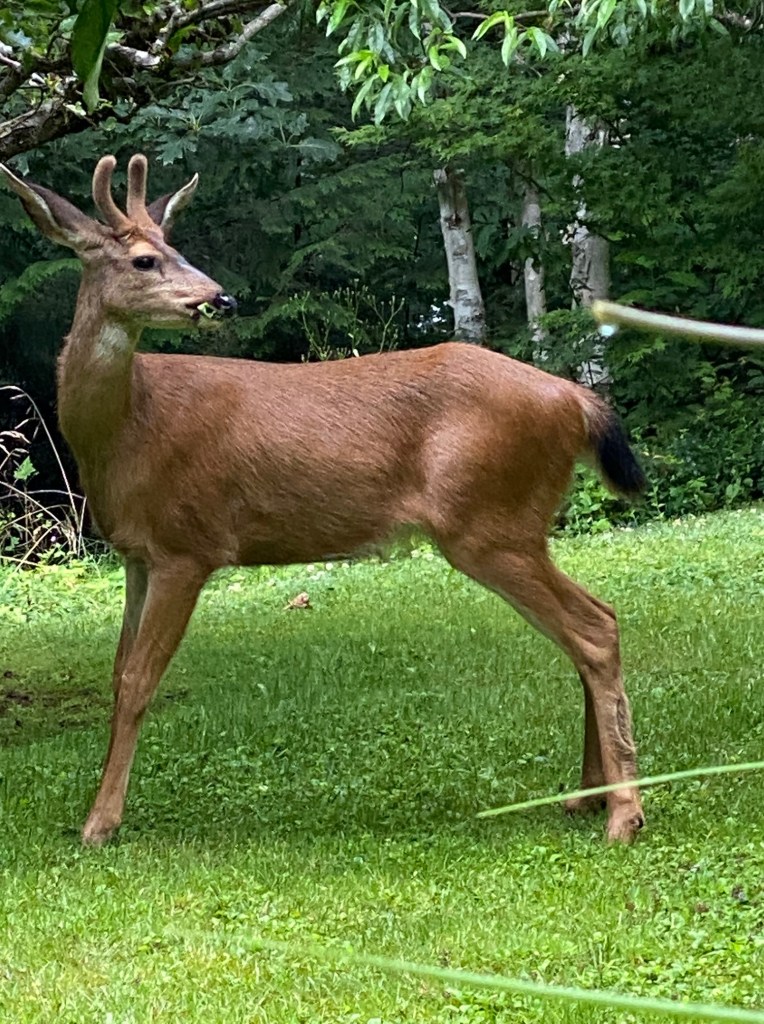
Curiously, silence may also be the tool for getting what we seek, such as this stunning young buck crossing beneath our fruit trees. The hungry deer surprised us, and ignoring our presence, munched his way to satiated delight – all without a sound.

 Mary's Room With a View
Yes, you tell it like it is! We all have a need to be heard and for them to know our names.
LikeLike