Think of it as a field of corn
seeded in May, spaced equidistant
one kernel three feet from another
then submitted to the summer sun
and rain from spring to fall.
In forty years the harvest comes.
Each tree is of equal height --
nothing random here,
nothing wild with memory of
old growth girth that took a team of men
each one gripping a handle of a crosscut saw,
sweat making their wide suspenders
rub their flesh ripe and raw with wear.
Now, even you could wrap your 20th century arms
around the perimeter of a Douglas Fir.
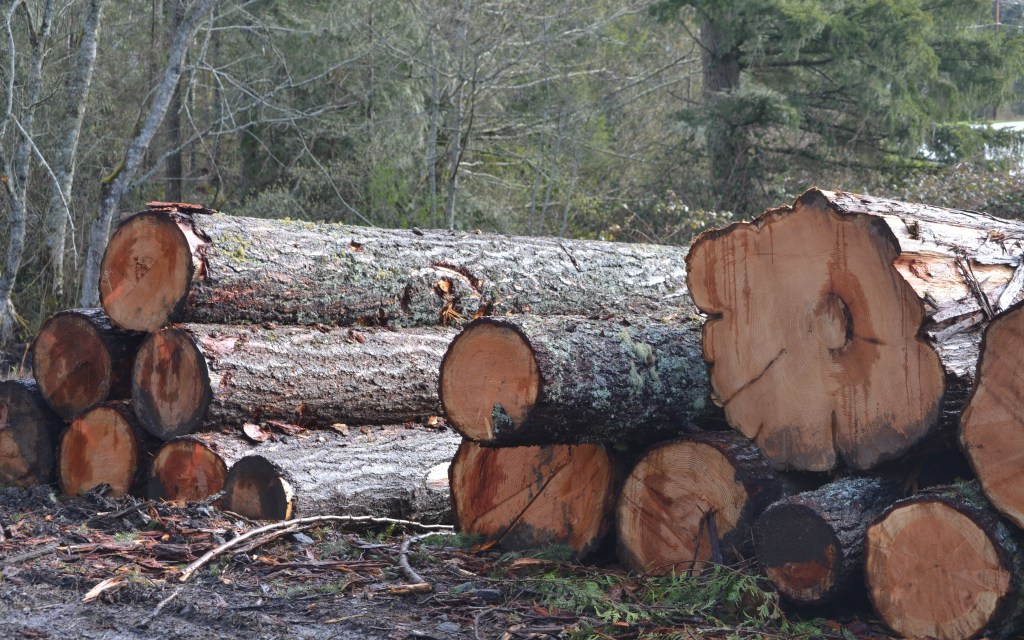
Don’t bother counting rings of logs
exposed and waiting to be trucked away
to wonder what the tree had seen
decades before you were born.

Don’t listen for what raven calls from
a wind-snapped snag, nor listen for its throaty caw
ricocheting from cedar to alder above
the density of ferns and salal,
a green grip of undergrowth even bears
lumber to cross toward rivers
shimmering with salmon the raven sampled
on its way, sweeping to the highest limb.
Don’t wonder about deer, fox or ermine
no longer there, but where they might have gone.

It’s not the forest that once was there before your birth
before the earth was just another garden
for acres of trees the same year sown.
Did you miss something?  Why mourn
like Miniver Cheevy child of scorn
born too late, knowing the party ended
before his time, before an invitation to a wilder world.
Find comfort in your poetic wandering
with the Hollow Men lamenting
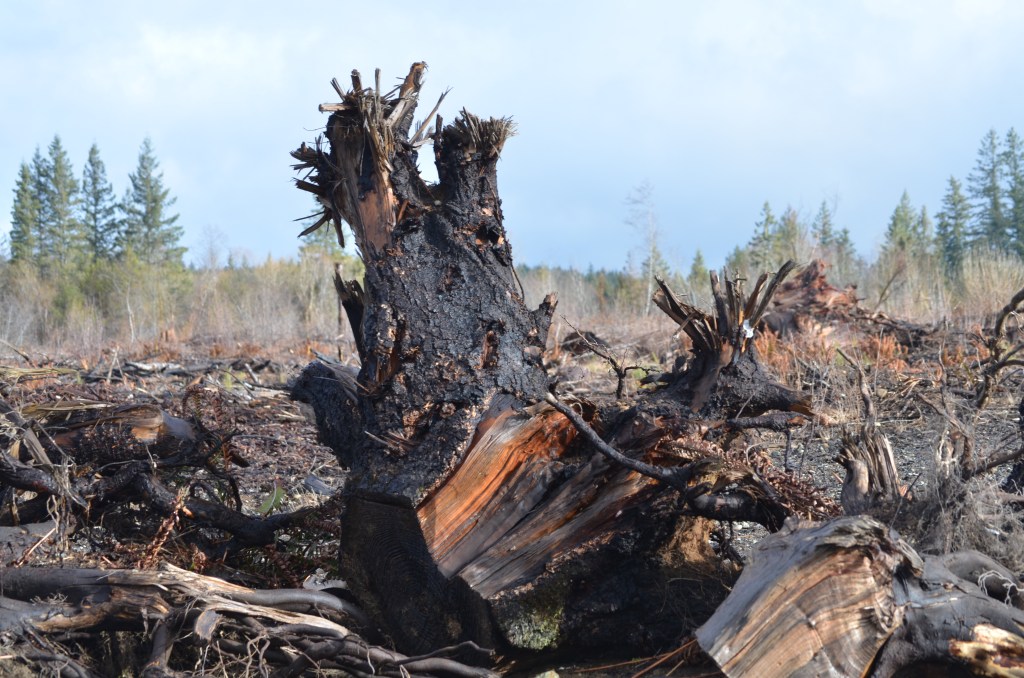
as they stumble through jagged stumps
encircling heaps of slash smoldering
burning for days or weeks
like sacrificial offerings to spring,
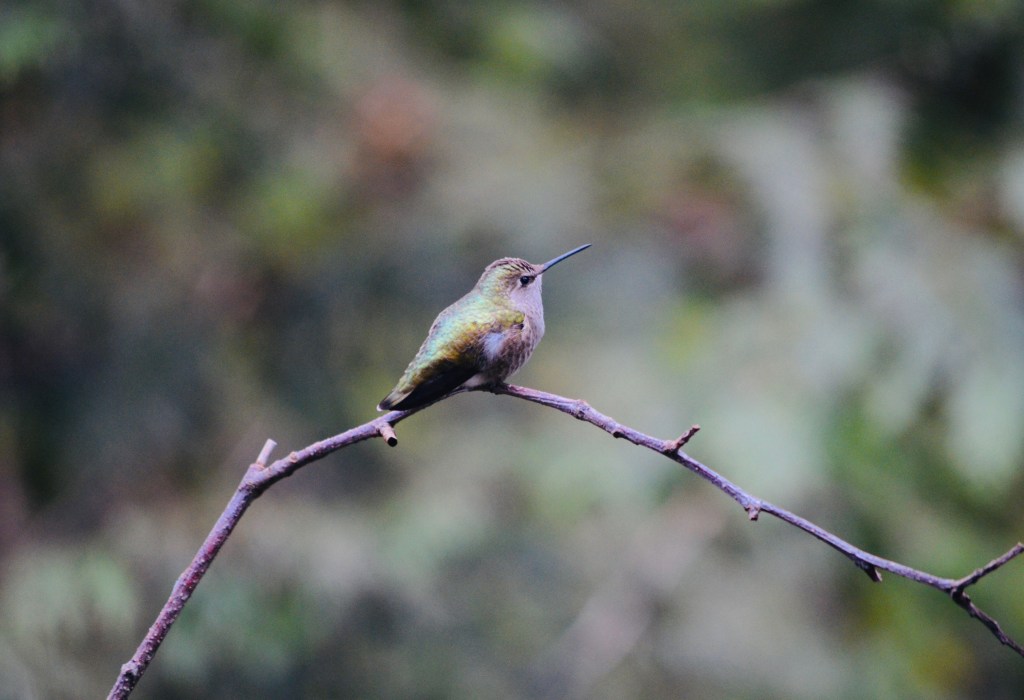
to this April, when the thrush and jays would,
in another year, return to nest, and yet
what makes its home within a field of corn?


     Mary Kollar
	Copyrighted, March 2021
Mary, your poem inspires and challenges me! I may be way off base from your intended message, but here are my thoughts.
I recently read “The Overstory,” a fictionalized version of a book called “The Hidden Life of Trees.” The plot involves what happens when the interests of clear-cutters are pitted against the interests of environmentalists and then details the ensuing competition, leading to disastrous results. The book peaked my interest because the protagonist asks if evolution would be better served if the parties were to find ways to cooperate rather than engage in win-lose battles. The book does not answer the question, and not surprisingly the environmentalists lose. Applying this idea to your poem, Miniver Cheevey avoided resolution to his internal conflicts by drinking rather than engaging with others in his environment to find ways to live a satisfying life, and the Hollow Men likewise “stumbled” through life without actively working with others to seek out solutions to problems. To me, the implication in both poems is that most, if not all, of us are like the title characters.
Your poem with its lovely imagery suggests to me that we also think about the competition-cooperation dilemma from the perspective of how plants and wildlife perceive and adapt to people’s intrusion on forest lands. You set the scene so beautifully with your descriptions of the challenges faced by trees, animals and birds when humans intrude on their natural habitats. I find hope in believing that flora and fauna do a better job in dealing with conflict than many of us, and perhaps we can glean insights from them about how to handle adversity through cooperation.
Your dedication to the arts, especially poetry, is impressive, and I am grateful that you share your creations with us.
Sylvia
Dear Sylvia
You are the most perceptive reader who really keeps me on my toes. Of course you would know Miniver Cheevy and The Hollow Men. Furthermore, your analysis of their characters enriches the poem well beyond my initial understandings. Thanks
This poem may be your best yet. Although the subject is soul-crushing for a Nature lover like myself, it’s a story aching to be told. I hope you send the poem to publishers, newspapers and anyone who will listen – it could open eyes. I think William Wordsworth would be proud of your poem. I’m thinking of the last stanza of his poem “A Psalm of Life”
Let us, then, be up and doing,
With a heart for any fate;
Still achieving, still pursuing,
Learn to labor and to wait.

 Mary's Room With a View
Mary, your poem inspires and challenges me! I may be way off base from your intended message, but here are my thoughts.
I recently read “The Overstory,” a fictionalized version of a book called “The Hidden Life of Trees.” The plot involves what happens when the interests of clear-cutters are pitted against the interests of environmentalists and then details the ensuing competition, leading to disastrous results. The book peaked my interest because the protagonist asks if evolution would be better served if the parties were to find ways to cooperate rather than engage in win-lose battles. The book does not answer the question, and not surprisingly the environmentalists lose. Applying this idea to your poem, Miniver Cheevey avoided resolution to his internal conflicts by drinking rather than engaging with others in his environment to find ways to live a satisfying life, and the Hollow Men likewise “stumbled” through life without actively working with others to seek out solutions to problems. To me, the implication in both poems is that most, if not all, of us are like the title characters.
Your poem with its lovely imagery suggests to me that we also think about the competition-cooperation dilemma from the perspective of how plants and wildlife perceive and adapt to people’s intrusion on forest lands. You set the scene so beautifully with your descriptions of the challenges faced by trees, animals and birds when humans intrude on their natural habitats. I find hope in believing that flora and fauna do a better job in dealing with conflict than many of us, and perhaps we can glean insights from them about how to handle adversity through cooperation.
Your dedication to the arts, especially poetry, is impressive, and I am grateful that you share your creations with us.
Sylvia
LikeLike
Dear Sylvia
You are the most perceptive reader who really keeps me on my toes. Of course you would know Miniver Cheevy and The Hollow Men. Furthermore, your analysis of their characters enriches the poem well beyond my initial understandings. Thanks
LikeLike
This poem may be your best yet. Although the subject is soul-crushing for a Nature lover like myself, it’s a story aching to be told. I hope you send the poem to publishers, newspapers and anyone who will listen – it could open eyes. I think William Wordsworth would be proud of your poem. I’m thinking of the last stanza of his poem “A Psalm of Life”
Let us, then, be up and doing,
With a heart for any fate;
Still achieving, still pursuing,
Learn to labor and to wait.
LikeLike
Thank you Anne. Wordsworth is always welcome in our woods
LikeLike
Oh, Mary! This is so heart breaking and so poignant. It is like a slug to the gut to realize all that has been lost. And in our terribly young years!
LikeLike
Yes Arlene. We need to write about the challenges of our times, as well as the joys. Thank you for your response
LikeLike