Poet Bill Carty opens the evening’s workshop asking, “Did anyone experience a poetic moment since we last met?” One or two writers share their moments. No one asks Carty to define “poetic moment,” as if they intuitively know one when they have it. Besides, as with all things significant, it is better intuited than defined.
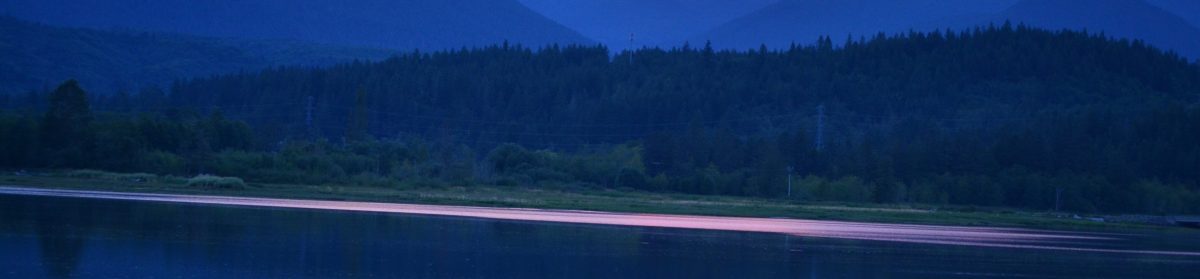
For me, salmon migration from Hood Canal into Quilcene Bay; a journey to the Big and Little Quilcene Rivers to lay eggs, to fertilize them, and to die; creates a series of poetic moments beyond a biologist’s explanation. Every year, I reflect on the sheer determination of the salmon: the impulse, the mission, the harrowing journey past humans with snagging hooks, and  spread nets – as well as dodging ravenous seals a hundred pounds greater than the fish’s silvery weight, and the penetrating eyes of eagle and osprey from great heights. Moses’s flight from Egypt pales in comparison.
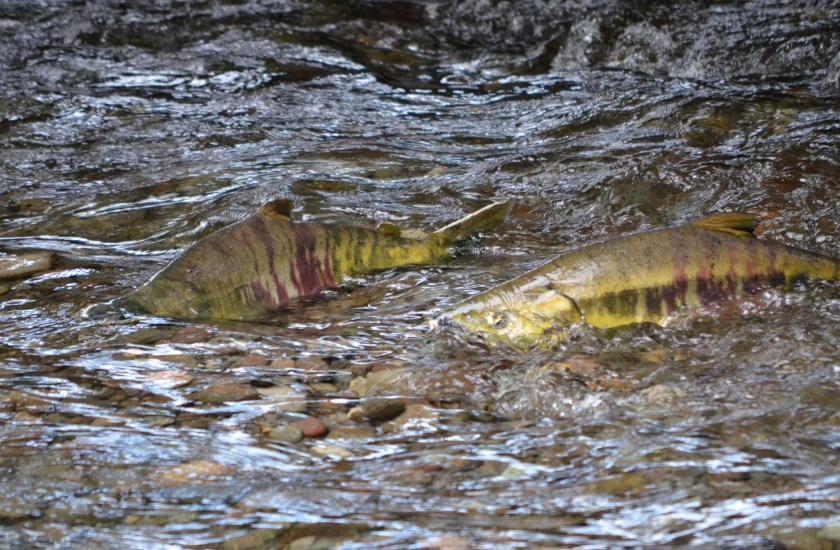
 I lean precariously over the Little Quilcene Bridge and hold my camera steady, my back against the glare of early autumnal light, to capture the thrilling swish of a spawning pair. The shallows swirl around them in mock frenzy, river water splashing upwards like reverse rain.
When the tide recedes, only the stream beds remain across the flats. What fish have not yet reached the river’s mouth, struggle up thin streams, surrounded by twenty to forty, rubber-booted people, their trousers rolled. 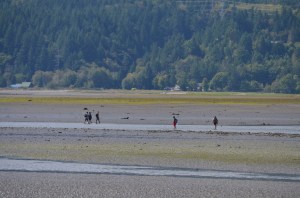 They have parked their trucks along the road at the end of the bay and sloshed through the flats with fishing gear to snag the stragglers in the shallows. Determined to spawn, the fish have lost interest in feeding, ignoring any dangling bait, and thus victims only to snagging. Some sport.
Yet, in a way, I too am taking something from the salmon run. Within hearing distance of the fishermen on the flat, I sit on my beach with my journal open. Overhead, a raven calls, like a muse from ancient tribes who fished this bay before white intruders were imagined. I thank the salmon for another poem.
Decay

Through September’s opened windows,
comes a stench of chum rejected
from tribal nets, and tossed overboard,
rotting corpses half buried in sand
and whiskered eel grass.
I fetch a shovel and the rusty wheelbarrow
from my garden on the hill.
Where the tide retreats, September’s
light spills like olive oil
across the muddy flats.
On the beach where yesterday I swam,
three large salmon lie,
shining slabs in wasted stages of decay.
It should be easy to shovel
one into the waiting barrow,
then push it up the hill to a hole prepared
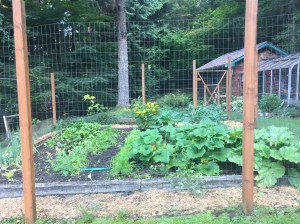
beside late-to-harvest squash.
Death’s stench softens in the salted sand.
Shovel ready, I thrust
the tool under a silver belly,
golden roe spilling like marbles intended
(in her unfinished swim)
for the cool stones of the Quilcene River.
Her agate eye– a stone too–
as is her three-foot corpse, a defiant
cemetery slab refusing to bend.
End over end, I wedge and swivel
with my tool, until feeling like a fool
flip her into the waiting barrow.
What would you expect?
Not her defiant weight,
nor the way her fragrance freed
from beach to garden gags me.
I wrap across my nose
a towel used to dry the morning dishes,
then push the little boat of a barrow
to tip it over radishes gone to seed.
I promise to visit her in spring,
when compost brims with mulching
autumn leaves and the soil is
turned for another hopeful crop.
One fish, a gift to earth, will with winter’s rain
nourish us with lettuce next July.
But when April comes,
not one flinty bone of her remains.

 Mary's Room With a View
light spills like olive oil
across the muddy flats.
Good stuff, thank you. 🙂
>
LikeLike