

Tell all the truth but tell it slant—
Success in Circuit lies –
Emily Dickinson
With metaphor, you know precisely what something is by explaining — if not exactly — then almost. You pinpoint a treasure by standing nearby. Long before Google, even before Johnson’s Dictionary, or the first written word, metaphorical thinking expanded the human world. I like to think of my cave sister explaining sex to her daughter when she ventures out to accept an invitation to mate. “Mating? It is like taking a long hike through unfamiliar woods with a person who will exhale his being into your being, like the wind that comes into our cave when we roll away the stone.” That may be a far-fetched example, but how else can a mother communicate the leaving home, then the joining of man and woman without using a comparison to something known? Such is the excitement of metaphor. It doesn’t travel alone into the unknown. It always has one foot in what we know so that we can extend the other foot into the unknown.
Metaphor is particularly useful for understanding abstractions, like TRUTH. Poets use metaphor for exactly that purpose. How do we communicate grief? It is both personal and universal.  Archibald MacLeish writes in Ars Poetica, “For all the history of grief / An empty doorway and a maple leaf.” What profound absence he expresses in one metaphorical image, so that my heart hollows out with sadness as I picture that open doorway beyond which there is absence. In defining grief, a dictionary would settle for “deep, sadness, often lasting a long time.” The dictionary is accurate enough but cannot replicate the feeling of grief defined in MacLeish’s open door or the falling maple leaf.
My piano teacher explained to me how I should properly begin the music by Liszt that I was learning. He instructed me to first put my foot on the pedal, then slowly lift my hands to the keys — first the right, as the opening note is in the treble clef, then the left, joining it for the first chord.
“Think,” he said, “that you are giving a gift to the audience. Do you want to simply hand out the gift, or do you want to wrap it with a bow, then offer it? A polished performance is a beautifully wrapped gift.” Now as I play that first measure, I envision the notes, but I also see an exquisitely wrapped package. Without the metaphor, I might have played the measure correctly, but not with the same commitment his package metaphor describes.
In my church community, we regularly discuss how literally or metaphorically we read the Bible. 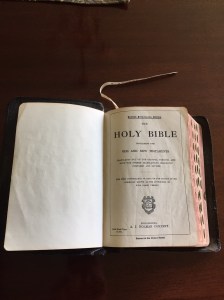 Many Americans have left religion altogether because the Bible remains the cornerstone of churches, and in an empirical age, people will not subscribe to a belief in miracles such as virginal birth. Others, in some fundamentalist churches, turn off the reality button, permitting their literalism to deny what science disproves. The Bible itself abounds in contradictions, making “the word of God” as evasive as mercury spilled from a broken thermometer. For me, literal readings can make the Bible as shallow as a puddle in which we look no deeper than the reflection of our own face. Metaphorical readings expand in lakes and oceans, often feeding channels between islands no one mapped.
  Christ does not have to resurrect in the flesh, offering his wounds to Thomas or anyone else in doubt. Christ can “come again,” among his followers who, despairing his death, realize his teachings never left them, but will endure. Christ had risen!
For those of us who love to read and to write, metaphor is an engaging friend. I recently finished reading Michelle Obama’s memoir, Becoming. I will never be the First Lady of the United States and cannot possibly experience living in the White House for eight years when every move the family takes necessitates hovering protection from secret service agents. Even the windows of the White House are so thick that a helicopter landing on the roof cannot be heard from a top floor room.  These are facts about Ms. Obama’s life there, but it was her metaphorical descriptions of her life from the South Side of Chicago to 1600 Pennsylvania Avenue that helped me to feel what she felt. Metaphor opens the envelope for empathy. What a wonderful organ our brain is that we can look at the moon while Alfred Noyes describes “the moon is a ghostly galleon tossed upon cloudy seas,” and we can see a full sail sailing ship in rough seas and at the same time a real moon, flitting in a tumultuous dance among clouds.


 Mary's Room With a View
I love the bit about the moon!
LikeLike
Brilliant, Mary! Especially the parts where you use metaphors to help us understand the power of metaphors. I am inspired to use them in my technical writing.
LikeLike
Good stuff. Thank you. 🙂
>
LikeLike