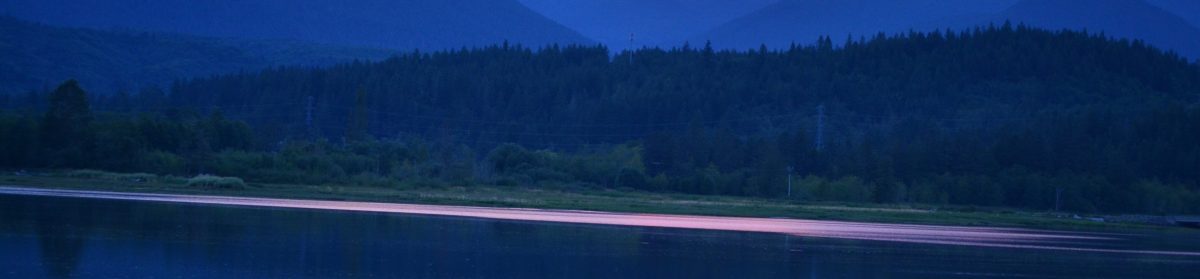
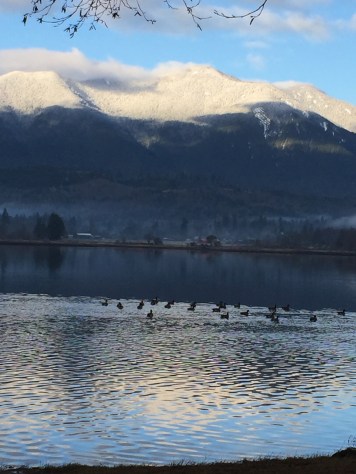
From the second week in October through the end of January, wildfowl, flying above or riding the wavelets on Quilcene Bay, survive in the grace that falls between shotgun shells. Mallards, pintail, buffleheads, and Canadian geese, known for pairing for life. Looking to the horizon above the tawny shore grasses and beneath the green and purple foothills of the Olympics, I try hopelessly to count the individuals in a flock, their migrations so wide and long, undulating like a flag in the winter wind. There are hundreds, although plentitude cannot heal the stab in my heart with each blast that brings one down to the fetching dogs. In my empathy, each fallen bird may as well be Icarus. The loss cuts more cruelly in my gut when a goose falls, its life-long mate honking rage in the smoking gunfire. For over thirty-years I have watched the flocks, as large one year as the year before. I marvel that they return to the killing fields.  But they do. Are they that foolish, or are they aware the odds are on their side as they are hundreds strong against a handful of hunters, hovering before dawn in a chilled swampland?
Hold your breath between the end of hunting season and spring. Where are the garrisons of courageous birds? In Seattle, they are walking down the center of the Burke Gilman bike trail, not a body of water in sight. Mallards waddle in courting pairs, as dodging cyclists swerve around them, without a single duck pulling in a pin feather to avoid a crushing death. Oblivious. Completely oblivious, not only to cyclists, but to camera-toting pedestrians. I walk as close as I want to photograph a pair, their muffled quacks indicating more annoyance than fear. 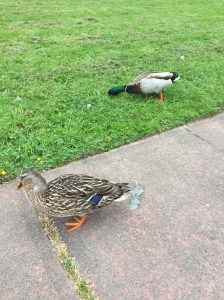 And what comes to mind, is not the under-fire ordeal they may have experienced over a duck hunting winter, but how vulnerable they are when mating.
Vulnerable when mating. How true for us all. I will not be too anthropomorphic about this. Surely the ducks are following natural urges to reproduce; theirs is not human love. Yet note how the drake puffs his breast, putting himself between the hen and the bicycle, as if to protect his lover. Human love is just as vulnerable, with or without reproductive urges.
Spring is the season of love. As we leave the shelter of our winter homes, walking out into the first days when the temperature exceeds sixty degrees, we look both ways crossing the street. Do we look both ways when approached by a potential lover? My twenty-something friend writes to me about her true love visiting from Ireland for a few weeks. She has longed to see him, but casually mentions he wants to date other women as well as being with her. I want to scream out “Look both ways! A truck is barreling down the road and its brakes don’t work.” I say nothing.
Our mailbox usually holds a couple of  wedding invitations for the month of June. We buy a gift, attend the wedding and listen to one more couple swear “’till death do us part.” Having known divorce from life-experience, I wonder, sitting there in the church pew, “Does the covenant refer to death of the individuals, or death of the marriage?” Either way, commitment leads to grief. I bought an anniversary card for my husband last week. Pictured on the front was a rustic couple in comical attire. Above the picture: “Marriage requires commitment. But so does insanity.” Inside, on a cheerier note: “Still crazy about you after all these years.”
There is no armor to protect us from falling in love, save living a life of not having been loved. Failing to be embraced may make us amateurs at stepping in to the vulnerable mating mess. Or perhaps the unloved jump in more eagerly to fill the hole in their hearts. We find ourselves in love like stepping unwittingly into consumptive quicksand. Any acceptance or rejection of advances will decrease or magnify the love, but won’t prevent it swallowing us like the invasion of the body snatchers.
 Recently I saw the film Call Me By Your Name that depicted the infatuation of a teenage boy with a man about six years his senior. How much more vulnerable could the boy be than to fall deeply in love with a person of his own gender, a man who would only be with him in the same Italian estate for a summer’s duration? “Where is this going?” one partner often asks as they couple. Here was a passionate love that showed no hope of continuing to a life of companionship. Still, I (and probably lots of others) applauded as the romance intensified, sensuous and consensual. Does love need a promise of security from heartbreak? I doubt the young boy could muffle his desire, even if he saw the truck rumbling down the road. Both partners could have chosen not to act on their love, though I doubt that too. Passion becomes its own reason for being. And even though the summer ended, and the older man married, there lingers a celebration as if the boy had an experience like climbing Mt. Everest, something the rest of us can only experience vicariously, looking on with envy.
My condolences to those who are “strong” enough to steer clear of love, even loving 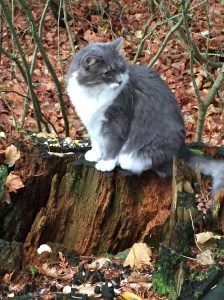 a pet. My friend who bonded with her cat for twelve fulfilling years, will not get another, now that beloved Chubby Toes is gone. “I could never endure the loss again,” she explains, as I try to drop a soft kitten on her front porch. My friend lives alone. Surely another cat would offer companionship, but a pet also offers loss, death by vulnerability.
Here I go again, I hear those trumpets blow again.
All aglow again, takin’ a chance on love.
It is good that so many classic songs pull their lyrics from love’s risky business. Somehow it makes us one of a huge flock. We may go by violence, but how much sweeter to be vulnerable to love.
![IMG_6141[1]](https://thoughtsafterseventy.com/wp-content/uploads/2018/06/img_61411.jpg?w=441&h=331)

 Mary's Room With a View
A lovely meditation on love. Here’s to taking a chance… and then another one!
LikeLike
Dear Mary, What an amazing piece of art! Poignant thoughts, exquisite writing. I am in awe of your talent. Thanks for sharing it with us. Love, Sylvia
Sent from my iPhone
>
LikeLike
Thank you Sylvia. I am honored to have supportive readers
LikeLike
Mary,
As always, your blog posts are a visible expression of your love of poetic narrative and your love of nature in all her wonders. Roger and I celebrate your disquiet over the horrors of hunting, but, as moral beings devoted to animal welfare, we see hunting as only one aspect of man’s inhumanity to all kind (not just to mankind).
The killing fields in Quilcene are as abhorrent as the brutal murders carried out in slaughter houses. We know animals are intelligent, have awareness, suffer and grieve, (https://www.psychologytoday.com/us/blog/animal-emotions/201203/elephants-mourn-loss-elephant-whisperer-lawrence-anthony) so it isn’t a big leap to believe they have the ability to love. Witness the mournful reaction of a dog when his or her human or canine companion dies, and the dog is aware of that death. If the world stopped eating the flesh of animals, wearing their skin and hair, it would be the beginning of respect for all life and world peace. You know this quote by Albert Schweitzer
“We must fight against the spirit of unconscious cruelty with which we treat the animals. Animals suffer as much as we do. True humanity does not allow us to impose such sufferings on them. It is our duty to make the whole world recognize it. Until we extend our circle of compassion to all living things, humanity will not find peace.”
Love is risky business, as you said, “There is no armor to protect us from falling in love, save living a life of not having been loved.” Goethe agrees with you when he said, “The dangers of life are infinite, and among them is safety.” Our capacity to love is great and that capacity is what gives us the strength to love, whether we are in a state of joy as in a new marriage, or in a realm of pain as when we lose a loved one or witness another’s loss.
I love the stories your pictures tell and how they support your writing. Thank you!
Anne
LikeLike